
‘Astonishingly reckless:’ IL Dems intro tax on ‘unrealized gains’ to fund transit
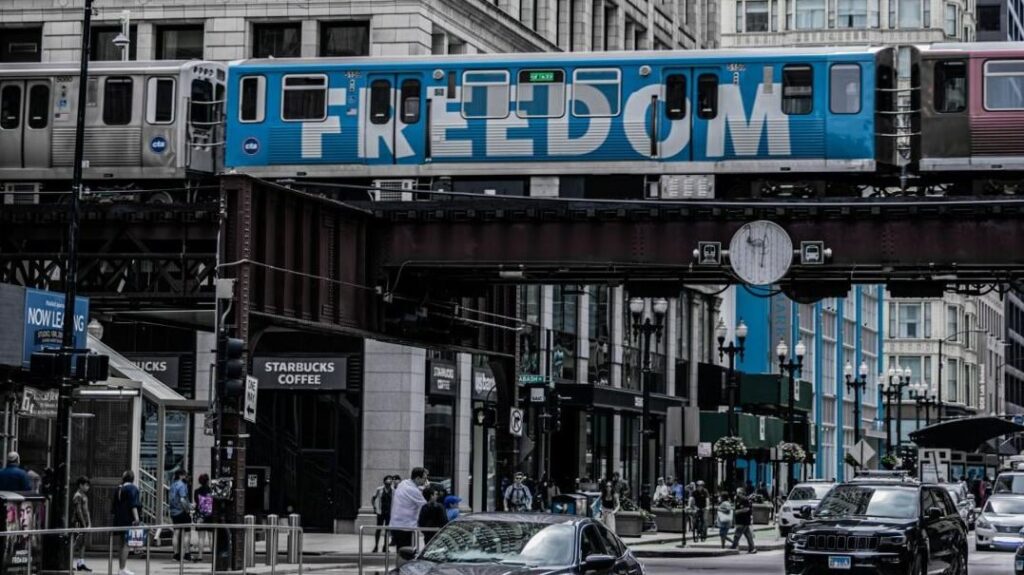
With just two days remaining in the Illinois legislative fall veto session, Illinois Democratic state lawmakers have introduced new legislation, ostensibly designed to help the state address financially failing Chicago area public transit systems, but which, if enacted, could make the Democrat-dominated state the first to implement a form of taxation never attempted anywhere in the U.S. before – a tax on the “unrealized gains” from assets.
The legislation was introduced late on Oct. 28 by Illinois State Rep. Eva-Dina Delgado (D-Chicago) as House Amendment 2 to the pending legislation known as Senate Bill 2111.
SB2111 was a so-called “shell bill,” meaning an innocuous-seeming piece of legislation on a generally uncontroversial topic, which is parked in a legislative committee until lawmakers decide to gut it of its original language and replace it completely to swiftly enact controversial legislation with minimal debate, sidestepping state constitutional provisions otherwise requiring days of debate.
Illinois Democrats have regularly used such procedures in recent years to pass a host of consequential legislation, including state gun bans and criminal justice reforms, with just hours of debate and minimal time for opposition to mount.
Under Delgado’s amendment, SB2111 would be rewritten to pass a slew of new taxes, seemingly ticketed to raise billions of dollars to fund public transit.
Since passing on taking action in this year’s spring legislative session, Illinois Democrats have promised they would move to enact new laws that would both reform governance of the Chicago area’s mass transit systems, while also slapping on new taxes to bring in money to help agencies like the Chicago Transit Authority, Metra and Pace deal with hundreds of millions of dollars in expected budget shortfalls this year and next.
The agencies have been accused by critics of mismanagement in recent years, particularly in how the transit agencies spent massive influxes of cash from the federal government amid the Covid era bailouts.
However, lawmakers have said they believe action is needed to prevent a transit disaster from unfolding in and around Chicago in coming years, as those federal funds run out.
The tax package introduced by House Democrats on Oct. 28 would include a host of taxes on leisure and entertainment, including an increase in the so-called RTA sales tax already used to fund public transit; a $5 per ticket surcharge on live event ticket sales; and a 7% tax on live event tickets, television and movie streaming services, among other charges.
However, the legislation also notably included a provision creating an entirely new kind of tax in Illinois, a 4.95% tax on so-called “unrealized gains” on assets held by billionaires.
Traditionally, such asset-based taxes have been assessed as taxes on capital gains, or the taxable diference between what an asset was worth at the time it was acquired versus what the owner may have received when the asset is later sold. Such profits are known as “realized gains.”
As proposed, however, the new tax would be assessed on the fair market value, as determined by the Illinois Department of Revenue, of a broad range of assets held by billionaires, including stocks, bonds, ownership shares in a range of corporations, art and other collectibles, real property, and much more, even if the asset is never sold.
All assets would need to be reported to the state, and taxes paid, annually, if the taxpayer’s assets are estimated to be worth more than $1 billion.
The idea of such a tax has been explored by Democrats and those further to the left for years, ostensibly as a way of making billionaires – who generally do not receive traditional taxable income – to pay much more in taxes.
However, such taxes have not been enacted anywhere before, largely because of steep constitutional and legal hurdles concerning how to implement the taxes.
In Illinois, for instance, the state constitution prohibits so-called “progressive” income taxes, assessed based on income. All Illinoisans are required to pay the same flat 4.95% income tax rate, subject to certain exemptions.
Any tax specifically targeted at billionaires would likely face swift court challenges on constitutional grounds.
However, the legislation has also drawn alarm and scorn from observers on both sides of the ideological spectrum.
On the social media platform X and in a blog post, Jared Walczak, vice president of state projects at the Washington, D.C.-based Tax Foundation, noted such a tax would slam the Illinois economy with a host of unforeseen costs.
Walczak noted such a tax would prompt most billionaires to simply leave Illinois altogether, taking their already considerable tax revenues with them and leaving holes in the economy of cities like Chicago, particularly.
But more so, Walczak said such a tax would stifle business growth and innovation, particularly hammering “startups and closely held businesses … extracting money from businesses” who may appear to be wealthy on paper, but which “have yet to earn a profit.”
Such companies may be forced to liquidate valuable assets just to pay their taxes, disrupting development and job growth within Illinois, Walczak said.
At the same time, Walczak said such a tax would pose enormous challenges to the state to implement, given the complexity of annually estimating the value of an untold number of assets held by wealthy individuals, to determine not only how much they pay, but whether the tax should apply to them at all.
Walczak said the speed with which Illinois House Democrats appear to have desired to move this legislation through was alarming.
“No tax system anywhere in the world has ever used mark-to-market taxation,” Walczak said. “A state adopting it in two days would be astonishingly reckless.”
That assessment of the House Democrats’ breakneck speed in seeking to ram such legislation through was shared, at least in part, by Ashley Schapitl, a Democrat who worked in both the U.S. Treasury Department and as an aide to U.S. Senate Democrats on the Finance Committee.
In a post on X, Schapitl noted Democrats there “thought about how to effectively draft and implement a Billionaire’s Income Tax for two+ years.”
“Throwing together a proposal that does not even consider how to reasonably do non-trade valuations is unserious and sets back policymaking,” Schapitl said.
Other critics of the legislation have noted the law would include no provision preventing lawmakers from requiring all Illinoisans to report assets or preventing lawmakers from ratcheting the taxable value threshold down from $1 billion, particularly if tax revenue targets fall short of expectations.
According to published reports, Illinois is home to at least 16 billionaire residents. Of those, four are members of the family of billionaire Illinois Gov. JB Pritzker.
Pritzker, for his part, swiftly pushed back on the proposal, saying he couldn’t support the legislation in its current form.
The governor particularly faulted his fellow Democrats for springing “a whole bunch of things that have never been seen before, so it’s very hard to evaluate in a short period of time.”
The fall veto session will end Oct. 30.
Events

Latest News Stories

Pritzker: Trump to federalize Illinois National Guard

City taxpayer burden swells, as Chicago pension debt rises

Clark County Amends Liquor Ordinance, Keeps Sunday Morning Sales Ban
USDOT puts $2.1 billion of taxpayer funds for CTA under review

2025 C-W Homecoming Royalty

Senior Homecoming Attendents

Junior Homecoming Attendents

Sophomore Homecoming Attendents

Freshman Homecoming Attendents

WATCH: State police prepares ICE protest zones; energy policy debate continues

AI chatbots a child safety risk, parental groups report

WATCH: California officials seek early voting on Prop. 50