

Legal experts split over state, federal immigration control
The second Trump administration has been largely defined by strict immigration enforcement and net zero illegal border crossings. Amid the enforcement, legal policy analysts are divided over whether federal or state governments should control immigration and border security.
The U.S. The Department of Homeland Security reported fewer than 500,000 border encounters so far in 2025 compared to more than two million per year in 2022, 2023 and 2024.
A panel of lawyers spoke at the Federalist Society’s National Lawyers Convention on Friday about whether state governments were granted sovereignty to control immigration and naturalization by founding documents, like the U.S. Constitution.
Gene Hamilton, president of the America First Policy Institute, said the United States’ founders established immigration enforcement as a power of the federal government when it granted sovereignty to the government.
“The executive power would have been thought to have included the inherent authority to prevent the entry of people into the country,” Hamilton said of the founding father’s intentions.
Hamilton said President Donald Trump’s Jan. 20 executive order to pursue border security used authorities that belong to the executive branch in securing the sovereignty of a nation.
“I think the president’s position, as expressed in this order, is more consistent with an originalist understanding at the time of the adoption of the Constitution of what the federal government could have done to protect its own borders without requiring necessary implementing legislation from the Congress,” Hamilton said.
Trevor Ezell, general counsel for Texas Gov. Greg Abbott and a member of the panel, argued that state governments have often stepped into the role of enforcing immigration throughout the history of the United States.
He pointed out the 1837 Supreme Court case Mayor of New York City v. Milne, which upheld New York’s ability to impose a fine if a ship captain did not list the number of migrants on its boat when entering the state.
“States have the same power as foreign nations to exclude individuals from their territory,” Ezell said.
Akhil Reed Amar, a professor of law at Yale, said state governments should only have control over immigration if the federal government grants that authority.
“There are inherent powers of the federal government and control of the borders would be one of them, and that’s connected to sovereignty and how we interact with foreign nations,” Amar said. “States don’t get to do many of these things unless they’re permitted by the federal government.”
In 2012, the U.S. Supreme Court struck down several portions of a law in Arizona that gave state officials broad authority over immigration enforcement, in place of the federal government.
“It is fundamental that foreign countries concerned about the status, safety, and security of their nationals in the United States must be able to confer and communicate on this subject with one national sovereign, not 50 separate states,” Justice Anthony Kennedy wrote in the court’s majority opinion.
Amar brought up the Commerce Clause of the U.S. Constitution to defend his argument. The clause gives Congress the power to regulate commerce with foreign nations, among states and with Indian tribes.
Amar argued that the establishment of federal power over Indian tribes extends to Indian tribe affairs in general, especially when considering the language of the articles of confederation. He said this understanding of federal power extends to immigration and prohibits states from creating their own immigration restrictions.
“You have things that are non economic but involve crossing borders, whether economically or not, that Congress should regulate if it’s crossing state borders or international borders or tribal borders,” Amar said.
Hamilton argued that states should have a role in the protection of its borders when the federal government does not adhere to a responsibility to protect people who come into a certain state. He highlighted that state borders are more strictly defined now than when the constitution was first drafted and, therefore, require more nuanced enforcement measures.
“What happens when the federal government fails, completely fails, completely abdicates its responsibility to prevent people from coming to a state? Does that state not have the inherent power to guard its own borders,” Hamilton asked.
Amar pointed out that the Constitution omits the word “sovereign” when referring to the power of the states. He said this is a pointed omission because the Articles of Confederation, a predecessor document to the U.S. Constitution, provided for state sovereignty.
Ezell pointed out examples in Texas’ history where the federal government deferred to the state to handle immigration enforcement. He said both state and federal governments are sovereign entities that deserve to have the same enforcement measures.
“An exercise of enforcement discretion is in no way preemptive of the other sovereign’s prescription of the same underlying activity,” Ezell said.
Events

Latest News Stories

Second nationwide ‘No Kings Day’ protest set for Saturday
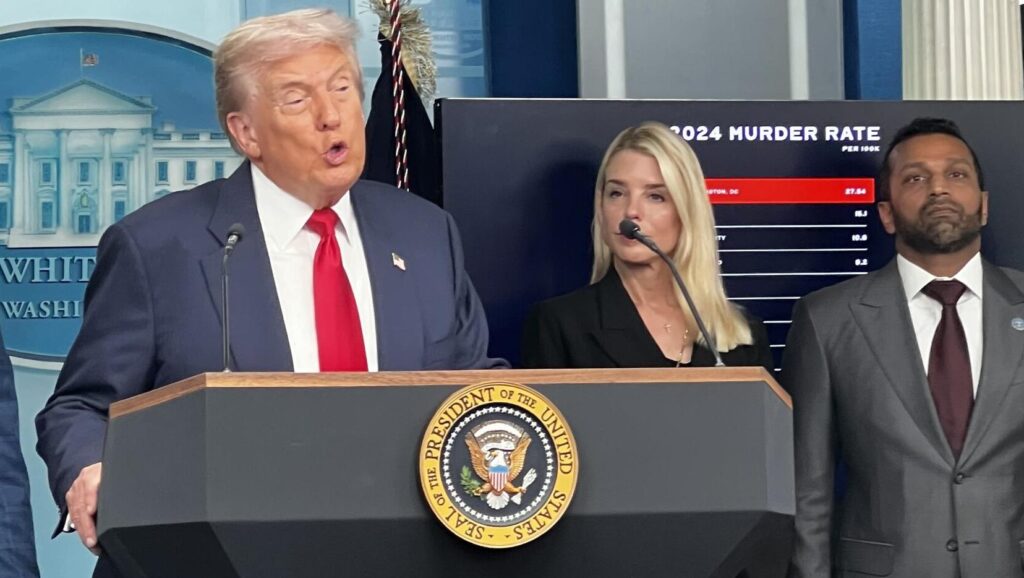
Trump, Patel tout ‘historic’ crime crackdown

Illinois quick hits: Business optimism index declines; Medicare open enrollment help offered

WATCH: California seeks investigation into big tech merger

WATCH: IL legislator blames Pritzker, Johnson rhetoric for ‘bounties’ on ICE

Voters concerned about prices amid tariff rollout, upcoming midterms

Supreme Court won’t let lawmaker intervene in tariff challenge
WATCH: Lawmakers differ on ‘affordability issues’ plaguing Illinois

Senate GOP leaders switch tactics as govt funding bill fails for 9th time

Federal judge blocks Trump from firing employees during shutdown

Colorado to receive $56.5 million for EV chargers
WATCH: Illinois transit agencies face ‘trust cliff’ along with fiscal cliff