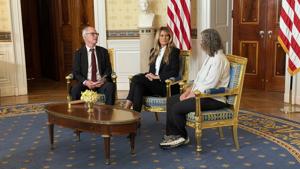
FAA partners with college to train next generation air traffic controllers
To expand specialized training under the Enhanced Air Traffic-Collegiate Training Initiative, the U.S. Department of Transportation Secretary Sean Duffy announced on Monday that the Federal Aviation Administration will be partnering with Nashua Community College.
“Our new partnership with Nashua Community College will help us continue to attract the best and brightest to fill our air traffic control towers,” Duffy said in a statement. “To all the young Americans considering a career in this exciting field – your work will make flying safer and more efficient than ever.”
Monday’s announcement is the newest program “to be announced this year” in Duffy’s initiative to build support for a new generation of air traffic controllers, according to the statement.
“Investing in the next generation of air traffic controllers is critical to maintaining the safety and efficiency of our national airspace,” said FAA Administrator Bryan Bedford.
Across the country, the FAA has only nine programs that have been approved at eight colleges and universities. These programs reflect the curriculum and technology being used in Oklahoma City, Okla.
In New Hampshire, this marks the first FAA-authorized training program.
“By expanding training opportunities through these programs, we’re not only meeting today’s staffing needs—we’re building a resilient workforce ready to handle the challenges of tomorrow,” Bedford said.
“Expanding opportunities in high-demand fields is essential to ensuring New Hampshire has a dependable pipeline of talent,” New Hampshire Gov. Kelly Ayotte said.
During the Supercharge hiring campaign, over 10,000 people applied for it before it closed on March 17. Out of that many applicants, only 8,300 made it to the testing phase. By the end of July, the FAA broke a record by having 550 students enrolled at the FAA Academy. That’s the most they have had in agency history.
In order to receive an official endorsement certificate, students must pass the Air Traffic Skills Assessment, meet the required medical and background clearance standards, and successfully demonstrate their skills through an evaluation based on how well they perform.






Partly Sunny
Latest News Stories
Senate Bill Secures $1 Million for Casey Sewer Improvements

EXCLUSIVE: 5 largest U.S. cities don’t have enough money to pay bills: report

INVESTIGATION: Wisconsin university closes DEI unit but keeps most staff working on equity issues
Board Approves Updated School Resource Officer Agreement
Casey Advances Housing Strategy with Land Bank Transfers and Inspection Contract

Chicago’s $41 billion financial hole exposes city’s pension crisis
Trump seeks $1B from Harvard in federal funding dispute

Lawmakers react to U.S. Supreme Court’s ruling on Prop. 50

WATCH: Senators slam fraud, call for welfare scrutiny in Minnesota

Nurses demand inclusion in professional degree definition

Early voting starts Thursday in most Illinois jurisdictions

Trump tells Iranian leaders they ‘should be very worried’