
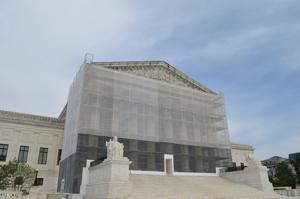
U.S. Supreme Court could rule on Texas lawsuits brought in Democratic-led state courts
If courts in Democratic-led states don’t honor a request by the Texas House of Representatives to domesticate civil warrants for the arrest of absconding Texas House Democrats, the cases could be ruled on by the U.S. Supreme Court.
The Texas House of Representatives has so far sued 33 House Democrats in Illinois and six in California who absconded from their duties in Austin during a special session. They fled the state to prevent a vote on Texas Republicans’ plan to Congressionally redistrict. When a special session is called, the Texas Constitution requires all members to attend. The Texas Constitution and rules of the Texas House also stipulate fines, penalties and enforcement mechanisms.
On Friday, Texas House Speaker Dustin Burrows imposed financial penalties after signing civil arrest warrants for 56 House Democrats who were “absent without leave,” (AWOL), The Center Square reported.
The nearly identical lawsuits request Illinois and California courts to domesticate warrants under the Full Faith and Credit Clause of the U.S. Constitution. “The United States Constitution, federal statute, and the doctrine of comity between states demand otherwise,” the lawsuits state. “This Court must give full faith and credit to warrants duly issued by the Texas House of Representatives that compel these civil servants to return to Texas and to their civic responsibilities.”
In the Illinois lawsuit, Texas asks the court to issue an order “to effectuate the Quorum Warrants, just as if they were acts of the State of Illinois,” treating Texas’ Quorum Warrants “as its own civil order.” It also asks the court to “issue a rule to show cause why Respondents should not be held in contempt,” to initiate contempt proceedings against Texas Democrats “for unlawfully seeking to evade Texas’s duly issued Quorum Warrants,” and set a hearing as soon as possible. If it doesn’t, “Texas is threatened with immediate and irreparable harm,” the lawsuit argues.
The Californian lawsuit asks the same. Both lawsuits seek enforcement by requesting the assistance of Illinois and California law enforcement officials and respective courts “to lawfully return to Texas the Defendant legislators who fled to [Illinois and California] to evade their duties to participate in the ongoing Special Session of the Texas Legislature.”
In response, Illinois Gov. JB Pritzker, who has expressed full support for Texas Democrats staying there, said Illinois won’t honor Texas’ request. He also said any intervention by the FBI was baseless. U.S. Sen. John Cornyn, R-Texas, requested FBI assistance to locate and potentially arrest Texas Democrats, including for possible bribery charges. Not soon after he issued it, Cornyn said his request was granted, The Center Square reported.
“There is literally no federal law applicable to this situation. None,” Pritzker told a “News Not Noise” podcast. “They can say that they’re sending FBI agents. The FBI might show up … to put a show on. The fact is that … our local law enforcement protect everybody in Illinois. Our state troopers protect everybody in Illinois and anybody who’s here in Illinois. Whether its federal agents coming to Illinois or state rangers from Texas, if you haven’t broken federal law, you’re … basically unwelcome. There’s no way that … Texas state legislators [here] can be arrested.”
Article IV of the U.S. Constitution governs the relationship between states. Texas cites Section 1, the Full Faith and Credit Clause, which states, “Full Faith and Credit shall be given in each State to the public Acts, Records, and judicial Proceedings of every other State. And the Congress may by general Laws prescribe the Manner in which such Acts, Records and Proceedings shall be proved, and the Effect thereof.”
While Pritzker argues Illinois doesn’t have to comply unless a federal crime were committed, a unanimous Supreme Court ruled that state courts must recognize and enforce court orders from other states that have jurisdiction over the parties involved.
In a 2016 Alabama case over child custody, a Georgia court ruled that petitioner V. L., was a legal parent of children she had raised with her lesbian partner, E. L.. After they separated and one moved to Alabama, a custody battle ensued. The Alabama courts were asked to enforce a Georgia judgment, which went to the Alabama Supreme Court. The court held that the Full Faith and Credit Clause didn’t require the Alabama courts to respect the Georgia judgment. The U.S. Supreme Court unanimously disagreed and reversed the Alabama Supreme Court decision.
The Texas lawsuit makes a similar argument, stating that Illinois and California must recognize Texas’ “judicial proceedings” and “public acts,” including civil arrest warrants issued by the Texas House of Representatives under the authority of the Texas Constitution.
The Texas lawsuit also cites federal statute, 28 U.S.C. § 1738, which codified the Full Faith and Credit Clause into law. It also cites the Judicial Comity doctrine.
The courts have yet to set a hearing in either case. Additional lawsuits against Texas House Democrats are expected.





Mostly Cloudy then Slight Chance Showers And Thunderstorms
Latest News Stories

Casey-Westfield High School Students Secure Top Honors at Regional Academic Competitions

Comptroller, state lawmaker call for federal tax credit scholarships

Early Surge and Defensive Miscues Propel Casey-Westfield Past Centennial 11-1

Karras and Goble Lead the Way as Casey-Westfield Softball Downs Clifton Central 6-1
Power Surge and Goble’s Arm Lead Casey-Westfield Softball Past St. Anthony, 7-1

Marshall School Board Approves Adjusted 2025-26 Schedule, Sets 2026-27 Calendar
Gilbert’s Shutout and Seven-Run Fourth Inning Propel Casey-Westfield Past Centennial, 10-0

District to Purchase Discounted Floor Burnisher for Junior/Senior High School
Casey-Westfield Capitalizes on Oakwood Errors, Holds On for 6-3 Victory
Casey-Westfield Capitalizes on Free Bases in 14-1 Rout of ALAH

Board Grants Fire Department Building Access, Upholds Wednesday and Sunday Sports Restrictions

Marshall Board of Education Approves Over $88,000 in Emergency Repairs and Fine Arts Upgrades
Meeting Summary and Briefs: Casey Township Library Board for February 5, 2026

Casey Township Library Announces “Plant a Seed, Read” Summer Program and Imagination Library Milestones