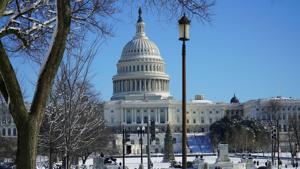
Senate pledges economic support for Russia-Ukraine deal as govt funding talks stall
As Republicans and Democrats remain deadlocked over how to fund the government for fiscal 2026 and prevent a shutdown, Senate leaders remain united on one front: Providing funding for Ukraine.
As President Donald Trump met with European leaders Monday – including Ukrainian President Volodymyr Zelenskyy – Senate Majority Leader John Thune, R-S.D., pledged his chamber’s willingness to provide economic assistance for Russia-Ukraine negotiations.
“President Trump should be commended for his dogged determination to bring peace to Ukraine and for his courage to engage with all parties in a way his predecessor refused to do,” Thune posted on X. “As peace talks continue today in Washington, the U.S. Senate stands ready to provide President Trump any economic leverage needed to keep Russia at the table to negotiate a just and lasting peace in Ukraine.”
While including a less flattering description of the president, Senate Minority Leader Chuck Schumer, D-N.Y., indicated his support for the beleaguered country as well, calling Russian President Vladimir Putin an “authoritarian thug” and urging Trump to “[stand] with Ukraine and our allies.”
Since Russia invaded Ukraine on Feb. 24, 2022, Congress has passed five major bills that cumulatively allocated over $128 billion to the Ukrainian government, including roughly $70 billion in military support. While no U.S. lawmaker has openly sided with Russia, some fiscal conservatives have objected to the high amount.
Thune’s offer to provide “economic leverage” comes as Congress nears the Sept. 30 government funding deadline without a clear bipartisan strategy in place. If lawmakers do not pass all 12 annual appropriations bills providing money for federal agencies through both chambers of Congress, they risk a government shutdown.
So far, only two of those bills have passed the House, while a three-bill minibus is the only 2026 appropriations legislation that has passed the Senate. Any appropriations bills passed in one chamber must be approved by the other chamber.
Even though Republicans control both chambers, they need Democrats’ help to finish the process when lawmakers return from their August recess in September. But Schumer has threatened to force a government shutdown unless Republicans “work across the aisle with Democrats to responsibly fund the government,” meaning that they must refuse to include any of Trump’s proposed budget cuts.
Given that lawmakers will only have a few weeks to synchronize and pass the rest of the fiscal year 2026 government funding bills, they most likely will pass a short-term Continuing Resolution.
A CR would keep government funding on cruise control until all appropriations bills are finalized. If the minibus (or other appropriations bills) pass both chambers by the Sept. 30 deadline, the CR would apply to the remaining federal agencies.
If lawmakers opt for the stopgap, Congress will have punted on funding the government properly for the fourth time in a row. Lawmakers never passed a fiscal year 2025 budget, instead passing three consecutive CRs to keep government funding on cruise control until Sept. 30.






Chance Showers And Thunderstorms then Showers And Thunderstorms Likely
Latest News Stories

‘An upward trajectory’: Petroleum expert on Iran conflict’s impact on gas prices

Early voting, vote-by-mail numbers trend higher as Illinois primary approaches

U.S. Senate to hold marathon debate on GOP voter ID bill
Carr calls for fair telecom treatment in Europe amid trade talks

Pritzker rolls out homebuyer aid; Republicans pitch other solutions

New health sharing program has seen 236% growth rate, with high hopes for 2026

Lawmaker, physician: Politicians are micromanaging medical education

FBI probes Michigan synagogue attack as targeted violence, antisemitism

Iran to see ‘highest volume of strikes’ yet on Friday

Illinois Quick Hits: One confirmed dead from Kankakee tornado

Four service members killed in KC-135 crash

U.S. military jet goes down over Iraq; incident not attributed to hostile fire