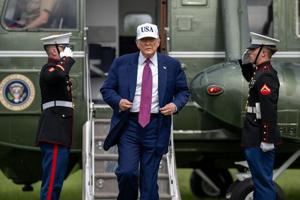
Trump says court’s tariff decision could lead to ‘catastrophic’ collapse
Attorneys for President Donald Trump told judges that if they yank the president’s tariff authority, “catastrophic consequences” would ensue, including a deep economic collapse not seen since 1929.
In a letter to the U.S. Court of Appeals for the Federal Circuit filed after oral arguments, Solicitor General D. John Sauer and Assistant Attorney General Brett Shumate warned that tariffs under the 1977 International Emergency Economic Powers Act must stay in place to prevent a financial disaster.
“Suddenly revoking the President’s tariff authority under IEEPA would have catastrophic consequences for our national security, foreign policy, and economy,” they wrote in a letter. “The President believes that our country would not be able to pay back the trillions of dollars that other countries have already committed to pay, which could lead to financial ruin.”
Trump announced a slate of “Liberation Day” tariffs on April 2 on imports from every U.S. trading partner. He then paused those tariffs for 90 days while working on trade deals with top U.S. trading partners. After reaching deals with some key partners – and extending talks with China, Canada and Mexico – Trump put in force the highest tariffs in nearly a century on 66 countries, the 27-bloc European Union and others. Each nation was assigned a specific import duty, with some as high as 50%. Those tariffs went into effect Aug. 7.
Attorneys for the administration noted that Trump could use other laws to implement tariffs. Still, those wouldn’t work nearly as well as the International Emergency Economic Powers Act – the law that’s under review in the legal challenge of Trump’s tariffs filed by small businesses and some U.S. states.
“Other tariff authorities that the President could potentially use are short-term, not nearly as powerful, and would render America captive to the abuses that it has endured from far more aggressive countries,” Sauer and Shumate wrote in the letter. “There is no substitute for the tariffs and deals that President Trump has made. One year ago, the United States was a dead country, and now, because of the trillions of dollars being paid by countries that have so badly abused us, America is a strong, financially viable, and respected country again. If the United States were forced to pay back the trillions of dollars committed to us, America could go from strength to failure the moment such an incorrect decision took effect.”
Trump publicly predicted an economic collapse similar to the “Great Depression.”
“These deals for trillions of dollars have been reached, and other countries have committed to pay massive sums of money,” Sauer and Shumate wrote. “If the United States were forced to unwind these historic agreements, the president believes that a forced dissolution of the agreements could lead to a 1929-style result. In such a scenario, people would be forced from their homes, millions of jobs would be eliminated, hard-working Americans would lose their savings, and even Social Security and Medicare could be threatened. In short, the economic consequences would be ruinous, instead of unprecedented success.”
The U.S. Court of Appeals for the Federal Circuit is considering a legal challenge to Trump’s ability to impose tariffs under the IEEPA of 1977. Trump is worried about the court’s decision, although his attorneys plan to appeal to the Supreme Court if the ruling doesn’t go Trump’s way.
In May, the U.S. Court of International Trade unanimously ruled that Congress did not give the president tariff authority under the International Emergency Economic Powers Act of 1977. The ruling voided Trump’s “Liberation Day” tariffs and struck down other tariffs Trump issued under the IEEPA. The administration appealed to the Federal Circuit, which ruled that Trump’s “Liberation Day” tariffs could remain in place while the legal challenge continued.
Appellate court judges scrutinized Trump’s tariff authority during oral arguments at the end of July. Judges asked attorneys on both sides of the case tough questions about the president’s authority to restructure global trade without help from Congress.
Plaintiffs in the case opposed the government’s letter.
“Any stay request is premature when it is not yet known how the court will rule and it is impossible to evaluate the likelihood of a grant of certiorari or success before the Supreme Court. Certainly, the court should deny any stay in excess of the shortest period necessary for the government to file a petition for certiorari and a mutually acceptable briefing schedule thereafter. Anything beyond that would unduly prejudice our clients, who face imminent and ongoing irreparable harm to their businesses from the challenged tariffs,” plaintiffs’ attorney Michael W. McConnell wrote.
The Liberty Justice Center, the Texas-based nonprofit representing small businesses in the case, doesn’t plan to oppose a stay.
“We are not opposing a stay here because it is more important, should we prevail, to compel the government to seek Supreme Court review on an expedited basis rather than the government taking their usual 90 days,” the nonprofit said. “The government routinely uses the maximum time allowed, and that delay would cause greater long-term harm to our clients and to the separation of powers at stake in this case.”
New tariffs raised $58.5 billion in revenue between January and June of this year before accounting for income and payroll tax offsets, according to an analysis of federal data from the Penn Wharton Budget Model. The study found that the average effective tariff rate increased to 9.14% in June from 2.2% in January, when Trump returned to office.
Trump has said he wants to use tariffs to restore manufacturing jobs lost to lower-wage countries in decades past, shift the tax burden away from U.S. families and pay down the national debt.
A tariff is a tax on imported goods paid by the person or company that imports the goods. The importer can absorb the cost of the tariffs or try to pass the cost on to consumers through higher prices.
Economists, businesses and some public companies have warned that tariffs could raise prices on a wide range of consumer products.



Mostly Sunny
Latest News Stories

Poll: 47% of U.S. voters oppose bombing Iran
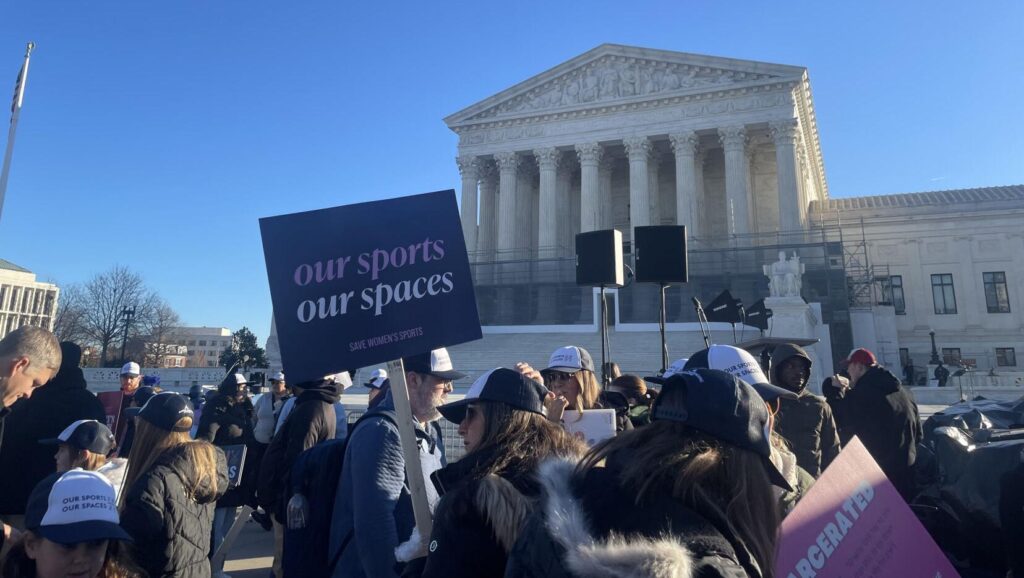
WATCH/EXCLUSIVE: Title IX debate continues with Supreme Court decision pending

Illinois diversity commissioner did not properly disclose $23K side job

DOJ indicts 30 more in St. Paul church protest case
Hegseth: Operation Epic Fury ‘just the beginning’ of U.S. action in Iran

Trump administration tells court tariff refunds ‘will take time’
Supreme Court declines to hear felony gun possession case
Illinois Quick Hits: Pritzker blasts Trump military action
Plastics industry applauds Trump’s focus on strengthening manufacturing

Everyday Economics: The Fed’s labor-market reality check
Trump: Iran operations to continue until objectives achieved

Junior High and High School Teams Capture Titles and Awards