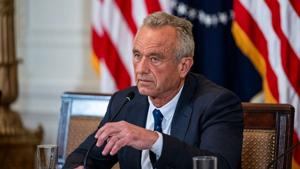
RFK Jr. wants doctors to learn more about nutrition
Health and Human Services Secretary Robert F. Kennedy Jr. is calling on medical education organizations to teach doctors more about nutrition during training.
The U.S. Department of Health and Human Services announced a major initiative to push leading U.S. medical education organizations to “immediately implement comprehensive nutrition education and training.” The U.S. Department of Education is backing the call.
“Medical schools talk about nutrition but fail to teach it,” Kennedy said. “We demand immediate, measurable reforms to embed nutrition education across every stage of medical training, hold institutions accountable for progress, and equip every future physician with the tools to prevent disease – not just treat it.”
Kennedy said that he knows the industry can move quickly when needed.
“When Covid-19 struck, the U.S. healthcare system proved it could move with extraordinary speed. In the spring of 2020, telehealth visits surged 154% compared with the year before. What had been a niche service became nearly universal in weeks,” he wrote in an op-ed published Wednesday in the Wall Street Journal. “That rapid pivot showed us a truth too often ignored: When we recognize a crisis, the medical sector can adapt overnight.”
Kennedy questioned recent Association of American Medical Colleges data showing that all U.S. medical schools cover nutrition. He said other studies show that most medical students receive fewer than two hours of nutrition instruction. Research published in 2024 found that 75% of U.S. medical schools have no required clinical nutrition classes, and 14% of residency programs have a required nutrition curriculum.
Kennedy called for nutrition education across the continuum.
“Accrediting bodies and medical organizations look the other way, declining to set clear requirements,” he wrote in the op-ed. “We train physicians to wield the latest surgical tools, but not to guide patients on how to stay out of the operating room in the first place. We know that when applied properly, nutrition counseling can prevent and even reverse chronic disease.”
Dr. Alison J. Whelan, the AAMC’s chief academic officer, said medical schools do indeed teach doctors about nutrition.
“Medical schools understand the critical role that nutrition plays in preventing, managing, and treating chronic health conditions, and incorporate significant nutrition education across their required curricula,” she said in a statement. “Through integrated education experiences, future physicians learn how to recognize the impact of diet on health and to apply evidence-based nutritional strategies in patient care.”
The AAMC represents 173 accredited U.S. and Canadian medical schools.
Kennedy said nutrition education should start before medical school.
“Change starts with prerequisites for premed students and nutrition testing on the MCAT,” he wrote. “Accreditors must then establish new standards for preclinical nutrition education, more hours of clinical nutrition training during clerkships, and specialty-specific nutrition requirements across all residency programs.”




Mostly Cloudy then Chance Showers And Thunderstorms
Latest News Stories

Former board member expressed concerns about indicted DeKalb superintendent

Fiscal Fallout: Illinois has among highest-paid state employees

Report: State reliance on federal funds up significantly since 1990s

Southwest low on list of safest states; Northeast at the top
Trump administration begins axing positions of furloughed federal workers

Washington state attorney general agrees to protect seal of confession
Senator urges Rubio to move forward designating Antifa a foreign terror organization

Pacific Northwest journalists sound off on Antifa at President Trump’s roundtable

Nvidia will pay 100k visa fees, others unsure

‘Shameful:’ GOP leaders frustrated with Dems on tenth day of shutdown

Trump snubbed by Nobel Committee, praised by winner

Trump threatens tariffs on China over ‘hostile’ rare earths policy

Illinois legislator urges school discipline to focus on behavior, not race

WATCH: Trump appeals Guard TRO as DHS looks to ‘double down’ law enforcement in Chicago