What a terrorist designation could mean for Antifa
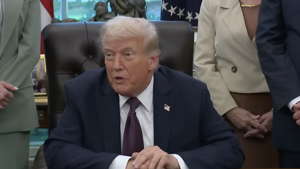
President Donald Trump declared Antifa a terrorist organization on Wednesday, describing them as a “sick, dangerous, radical left disaster;” however, it’s unclear at this time if or how the president will make the designation official, and what it all means for the group.
The Anti-Defamation League, a group that fights “all forms of antisemitism and bias,” defines Antifa as a “decentralized, leaderless movement composed of loose collections of groups, networks and individuals.”
Awareness of the movement, whose name stands for “anti-fascist,” spread in 2020, when its members were active in Black Lives Matter protests, riots, looting and clashes with police.
Domestic terrorism is defined in federal law as criminal acts occurring in the U.S. that either threaten human life, are intended to coerce or intimidate civilians or to influence government policy or action. But, domestic terrorism on its own is not a criminally chargeable offense.
Congress has considered the possibility of new domestic terrorism laws, but concerns over constitutional rights have seemingly prevented lawmakers from doing so.
“Any congressional consideration of additional legislation in the area of domestic terrorism—such as a criminal statute expressly prohibiting acts of domestic terror—would necessarily involve a broader discussion of potential policy concerns and constitutional constraints,” reads a report by the Congressional Research Service.
“Legislation seeking to address domestic terrorism also may implicate certain constitutional considerations, such as First Amendment protections of speech and association, Fourth Amendment restrictions on government searches, and broader federalism-based restraints on federal jurisdiction in general,” the authors added.
In his Wednesday post on Truth Social, in addition to the terrorist designation, Trump implied that any groups financially supporting Antifa could expect federal scrutiny.
“I will also be strongly recommending that those funding ANTIFA be thoroughly investigated in accordance with the highest legal standards and practices,” he wrote.
In a response to a question from The Center Square regarding Antifa, the president mentioned going after the group through the Racketeer Influenced and Corrupt Organizations Act, or RICO, a federal statute that was critical to the FBI’s takedown of the American mafia. It allowed prosecutors to hold mob bosses and other leaders accountable for crimes they directed lower-level members to commit.
“I’ve asked Pam [Bondi] to look into that in terms of bringing RICO cases… criminal RICO,” Trump said, “because what they’re doing to this country is really subversive.”
However, many have noted that it may be difficult to do since RICO was created for organized crime, and Antifa is allegedly leaderless.



Chance Showers And Thunderstorms
Latest News Stories
Bessent backs 3% deficit goal despite 5% budget forecasts

Constables hope to find missing children in immigration search effort

Lawmaker blasts reports of ‘equitable assessments’ at medical school

FOID changes advance in Illinois House, not called in Senate

Texas tops California, New York, with the most Fortune 500 headquarters
Nine candidates run in Las Vegas congressional district
U.S. seeks dismissal of lawsuit over deadly boat strikes

Seattle mayor reverses course, activates surveillance cameras for World Cup
Expert: GOP success this week doesn’t mean Nov. 3 victories
High-speed rail project criticized again after $3.5B contract
Platner leads Collins in Maine U.S. Senate race despite controversies
Illinois quick hits: Illinois parole absconder arrested in Tennessee