Catholic law professor says lower courts botched tariff rulings
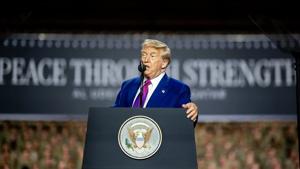
A Catholic law professor told the nation’s highest court Tuesday that President Donald Trump’s tariffs are on solid legal ground after two lower courts’ botched rulings.
Chad Squitieri, an assistant law professor at Catholic University of America’s Columbus School of Law, said Congress has already granted Trump the authority to impose import duties around the world.
“Both lower courts concluded that tariffs must be an exercise of taxation power. Those courts were mistaken,” he wrote Tuesday in a friend-of-the-court brief. “Overwhelming originalist evidence establishes that tariffs can be an exercise of either taxation or commerce-regulation power. Congress need not delegate taxation power to delegate tariff power. Congress can instead delegate tariff power by delegating commerce-regulation power.”
Squitieri is director of the Separation of Powers Institute and a managing director of the Center for the Constitution and the Catholic Intellectual Tradition.
“This Court should rule that, by empowering the President to ‘regulate … importation,’ IEEPA empowers the president to use a traditional and familiar means of regulating foreign commerce conducted via importation: tariffs,” Squitieri wrote. “Since the Founding, it has been understood that tariffs can be imposed as an exercise of commerce regulation power. That understanding is reflected in the writings of James Madison, Chief Justice John Marshall, Joseph Story, and ordinary Americans such as the revolutionary pamphleteers.”
Trump used the 1977 International Emergency Economic Powers Act – which doesn’t mention tariffs – to reorder global trade in a matter of months to try to give U.S. businesses an advantage in the world market. Under the International Emergency Economic Powers Act, Trump imposed import duties of at least 10% on every nation that does business with the U.S.
Squitieri argues the major questions doctrine doesn’t apply to foreign policy matters.
“Foreign affairs present fundamentally different considerations. The president – not an unelected bureaucrat – makes these determinations, and he answers to all the American people. Moreover, as Justice Kavanaugh recently observed, ‘the major questions canon has not been applied by this Court in the national security or foreign policy contexts’ because Congress typically ‘intends to give the President substantial authority and flexibility’ in these domains,” Squitieri wrote. “The practical requirements of international relations favor broad executive discretion, not detailed micromanagement.”
In August, the U.S. Court of Appeals for the Federal Circuit affirmed a previous lower court ruling, but said Trump’s tariffs could remain in place while the administration appeals to the U.S. Supreme Court.
In the 7-4 decision, the majority of the Federal Circuit said that tariff authority rests with Congress. It used that same language: “We discern no clear congressional authorization by IEEPA for tariffs of the magnitude of the Reciprocal Tariffs and Trafficking Tariffs. Reading the phrase ‘regulate … importation’ to include imposing these tariffs is ‘a wafer-thin reed on which to rest such sweeping power.'”
The challengers argue that Congress, not the president, retains the power to tax. Trump says he has the authority and that his deals worldwide benefit all Americans.
Trump’s legal team has identified two emergencies for tariffs under the International Emergency Economic Powers Act. The first is fentanyl smuggling, and the second is high trade deficits with U.S. trading partners.
The Supreme Court agreed to consider the tariff challenge on an expedited schedule. A victory for Trump would cement the federal government’s newest revenue source – the highest import duties in nearly a century – in place, at least for now.
Trump has said a loss could be catastrophic for the U.S. economy.
A group of Democrat-led states, five small businesses and two private companies sued Trump, saying the president overstepped his authority by imposing tariffs on every U.S. trading partner.
Trump has made tariffs the centerpiece of his economic agenda during the first six months of his second term.
Trump’s new tariffs raised $80.3 billion in revenue between January 2025 and July 2025 before accounting for income and payroll tax offsets, according to an analysis of federal data from the Penn Wharton Budget Model.
The Congressional Budget Office estimated that Trump’s tariffs could generate $4 trillion in revenue over the next decade, but they would raise consumer prices and reduce the purchasing power of U.S. families.
Trump has said he wants to use tariffs to restore manufacturing jobs lost to lower-wage countries in decades past, shift the tax burden away from U.S. families, and pay down the national debt.
A tariff is a tax on imported goods that the importer pays, not the producer. The importer pays the cost of the duties directly to U.S. Customs and Border Protection, a federal agency.




Sunny
Latest News Stories

September jobs report adds 119,000, steady unemployment

Indicted Florida congresswoman leaves committee leadership post

Existing home sales up 1.2% in October

Chip Roy calls for full pause on all U.S. immigration
Prosecutors defend indictment in Comey case after defense questions

IL Rep on congressmen trading: ‘We’re not going to take a pile of money to hell’

House axes provision letting senators sue over data surveillance

DoEd’s six new agency partnerships will give parents freedom, break up bureaucracy

Illinois quick hits: Officer shot report numbers down; Thanksgiving meal costs down

WATCH: Chicago activist testifies; Quinn’s millionaire surcharge; High SNAP error rate

Farm Bureau says Thanksgiving prices down, but not enough

GE Appliances announces $150 million partnerships