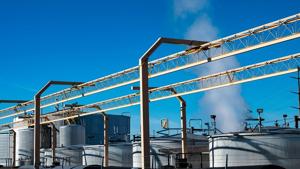
Lower U.S. oil production projected in 2026
Activity in the oil and gas sector declined slightly in the third quarter of 2025, according to executives at exploration and production firms headquartered in Texas, northern Louisiana, and southern New Mexico, the Federal Reserve Bank of Dallas said in a quarterly survey released Wednesday.
The broadest measure of the conditions faced by the energy firms in the Eleventh District remained negative but rose from -8.1 in the second quarter of 2025 to -6.5 in the third quarter, the Dallas Fed reported. The Eleventh District accounted for about 59% of U.S. oil production in 2024, according to the U.S. Energy Information Administration.
The executives at 139 exploration and oil field services firms in Texas, Louisiana and New Mexico cited elevated global uncertainty and higher costs as the primary reasons for negative perceptions of current market conditions. About 36% of the respondents said they have significantly delayed investment decisions due to market uncertainty, and 42% reported slight delays.
While respondents said production costs in U.S. oil and gas fields have risen across most categories, reduced regulation has provided some relief. About 25% of respondents estimated regulatory changes since January 2025 have reduced their firms’ break-even costs for new wells by $1–$1.99 per barrel, and 57% reported reductions of $1 per barrel or less, according to the Dallas Fed.
The oil and gas executives surveyed expect the price of West Texas Intermediate crude oil will drop to $63 per barrel at the end of 2025 and to $69 per barrel two years from now, which compares to about $65 per barrel at market close today.
The EIA projects crude oil prices will drop sharply in 2026, however. The agency forecasted in September that oil prices would sink to an average of $48 per barrel next year. U.S. crude oil inventories are expected to climb 2.1 million barrels per day in the second half of 2025, according to the EIA’s Short-Term Energy Outlook.
Based on EIA analysis, lower WTI crude oil prices should lead to lower gasoline costs for U.S. consumers in 2026. The average retail cost of gasoline in the United States, at about $3.17 per gallon on Sept. 15, will sink to an average of $2.90 per gallon in 2026, according to EIA estimates. If realized, this would be the lowest average retail price paid by U.S. drivers since 2005.
While the prices of crude oil and gasoline are expected to decline in 2026, the cost of natural gas produced in the United States is likely to increase, according to EIA projections. EIA projects the average U.S. price of natural gas at $4.30 per million British thermal units, up from $3.90 MMBtu in 2025, with growing demand for U.S. liquefied natural gas exports driving the increase.
The EIA projects U.S. dry natural gas production will climb to approximately 107.2 billion cubic feet per day in 2026, an increase from 104.5 Bcf/d in 2025 and 103.6 Bcf/d in 2024, with the growth led by higher output in the Permian and Haynesville regions of Texas, New Mexico, and Louisiana.






Slight Chance Showers And Thunderstorms then Chance Showers And Thunderstorms
Latest News Stories

Remote marriage license bill faces skepticism from former clerk

Lawsuit: Illinois Dems can’t use state law to control the name ‘democrat’

Senators weigh American privacy risks in FBI Investigations

Illinois quick hits: John Deere to build in North Carolina

State rep questions Pritzker move to ‘expand and expand and expand’ on abortion

$1,000 Trump accounts to start July 4

Rubio explains reasoning behind Trump’s Venezuela strikes in Senate hearing

WATCH: Kelly to vote against funding Homeland Security

Census projections show red states to see gains in U.S. House seats, electoral college

Chicago mayor visits D.C., considers order to prosecute federal agents

‘GO ICE’ social media post sparks GOP-Dem clash in Illinois

Illinois Quick Hits: Water rates could rise