Businesses seek more time to address ‘diverging interests’ in tariff challenge
A group of small businesses that brought a legal challenge against President Donald Trump’s global tariffs asked the Supreme Court for more time to argue the case in November, citing “diverging interests” among the groups involved in the high-stakes case.
The small businesses, represented by the Texas-based nonprofit law firm Liberty Justice Center, asked the highest court to give all three groups challenging Trump’s tariffs 45 minutes to argue before the court during oral arguments on Nov. 5.
In addition to the five small businesses, Oregon and 11 other Democrat-led states challenged the global tariffs and Trump’s drug trafficking tariffs. The states and the small businesses both brought their cases to the Court of International Trade. That specialty court ruled that Trump didn’t have tariff authority under the 1977 International Emergency Economic Powers Act.
Two educational businesses – Learning Resources Inc. and hand2mind Inc. – also challenged Trump’s tariffs, but took a different route through the legal system. They took their case to the United States District Court for the District of Columbia. The Trump administration tried to get that case transferred to the Court of International Trade. The D.C. District Court rejected the government’s motion because the 1977 law, which doesn’t mention tariffs, doesn’t authorize tariffs. Therefore, the issue was outside the jurisdiction of the Court of International Trade.
The D.C. District Court also granted the Learning Resources petitioners’ motion to preliminarily enjoin the tariffs because it said the president lacked any statutory authority to impose them. The government appealed that decision to the D.C. Circuit.
When the Supreme Court took up the case, it added Learning Resources petitioners to the consolidated case it will hear in November.
“The case arises from three consolidated suits involving separate groups of plaintiffs who brought distinct challenges to three different sets of tariffs in two different courts,” attorneys for the small businesses wrote.
Each group of respondents wants 45 minutes during oral arguments, according to the filing.
“Moreover, the need for V.O.S. Private and State Respondents to continue to represent themselves separately is enhanced before this Court because of the breadth of the grant of certiorari,” attorneys for the small businesses wrote.
They noted the parties on all sides have conferred with the government on the matter. They don’t oppose the request for a divided argument. The federal government also does not oppose an extension of argument time to 45 minutes per side, according to the motion from the small businssses.
The case sets out to answer two questions. The first question asks if the International Emergency Economic Powers Act authorizes Trump’s tariffs. The second question asks whether, if IEEPA authorizes the tariffs, the statute unconstitutionally delegates legislative authority to the president.
“Extending the time for argument to 45 minutes per side and permitting each of the three sets of Non-Federal Parties to argue will ensure that the various interests are adequately represented before the Court,” the small business attorneys wrote. “It will also ensure that the fundamentally important statutory and constitutional arguments in this case are fully explored, and that the jurisdictional dispute is properly ventilated.”
The Supreme Court has yet to consider the motion.
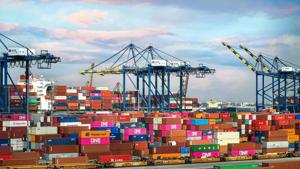
Trump used the 1977 International Emergency Economic Powers Act – which doesn’t mention tariffs – to reorder global trade in a matter of months to try to give U.S. businesses an advantage in the world market. Under the International Emergency Economic Powers Act, Trump imposed import duties of at least 10% on every nation that does business with the U.S.
The challengers argue that Congress, not the president, retains the power to tax. Trump says he has the authority and that his deals worldwide benefit all Americans.
In August, the U.S. Court of Appeals for the Federal Circuit affirmed a previous lower court ruling, but said Trump’s tariffs could remain in place while the administration appeals to the U.S. Supreme Court.
In the 7-4 decision, the majority of the Federal Circuit said that tariff authority rests with Congress. It used that same language: “We discern no clear congressional authorization by IEEPA for tariffs of the magnitude of the Reciprocal Tariffs and Trafficking Tariffs. Reading the phrase ‘regulate … importation’ to include imposing these tariffs is ‘a wafer-thin reed on which to rest such sweeping power.'”
The Supreme Court agreed to consider the tariff challenge on an expedited schedule. A victory for Trump would cement the federal government’s newest revenue source – the highest import duties in nearly a century – in place, at least for now.
Trump has said a loss could be catastrophic for the U.S. economy.
Trump has made tariffs the centerpiece of his economic agenda during the first six months of his second term.
According to an analysis of federal data from the Penn Wharton Budget Model, the president’s new tariffs raised $80.3 billion in revenue between January 2025 and July 2025 before accounting for income and payroll tax offsets.
The Congressional Budget Office estimated that Trump’s tariffs could generate $4 trillion in revenue over the next decade, but they would raise consumer prices and reduce the purchasing power of U.S. families.
Trump has said he wants to use tariffs to restore manufacturing jobs lost to lower-wage countries in decades past, shift the tax burden away from U.S. families, and pay down the national debt.
A tariff is a tax on imported goods that the importer pays, not the producer. The importer pays the cost of the duties directly to U.S. Customs and Border Protection, a federal agency.




Mostly Sunny
Latest News Stories

Trump touts accomplishments, future policies during primetime address

Closing arguments made in congressional redistricting suit

U.S. House passes GOP health care bill, sends to Senate

Tips solicited for Brown University still at-large shooter

Illinois quick hits: Bovino thanks police; fire assistance grants available

Senate passes $900 billion Pentagon funding bill, sends to Trump’s desk

Bongino to resign as FBI deputy director in January

IL House Speaker: ‘not even close’ to school choice legislation

IL comptroller: Chicago mayor’s policies chase businesses away

Menards settles deceptive 11% rebate lawsuit for $4.25M with 10 states

WATCH: Illinois decoupling law recaptures taxes federal code cuts
WATCH: Amid continued enforcement, Pritzker tells ICE protesters: ‘Do as you have’