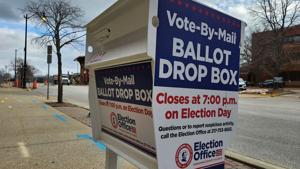
U.S. Supreme Court appears split over mail-in ballot challenge
The U.S. Supreme Court appeared split during oral arguments on Wednesday about a challenge over mail-in ballot laws in Illinois.
The challenge centers around Rep. Mike Bost, R-Ill., who sued the Illinois Board of Elections over a law allowing the state to count mail-in ballots marked on Election Day as much as 14 days after an election.
Bost filed the lawsuit in 2022, arguing Congress sets the time for federal elections and the state’s mail-in ballot counting procedures go against that policy.
Justice Ketanji Brown Jackson said she did not understand the harm caused to Bost by allowing mail-in ballots to be counted in the period after Election Day.
“In every election, candidates voluntarily put themselves up for election and there is a risk that they will win or lose,” Jackson said.
Paul Clement, an attorney for Bost, said candidates who comply with mail-in voting counts after an Election Day are “forced to gamble” with the chance of an election not turning out in their favor.
Justices Elena Kagan and Sonia Sotomayor also appeared skeptical of the harm caused to a candidate under the Illinois law. Kagan pointed to other challenges to election law like not allowing citizens to vote early on Sunday as an example.
Sotomayor said Bost’s case appeared to be on the basis of speculation rather than proven harm.
Chief Justice John Roberts pointed out that Bost won reelection each cycle since 2015. He questioned whether there was a credible threat Bost could lose even after mail-in ballots were counted.
Jane Notz, an attorney for the Illinois State Board of Elections, argued Bost did not have standing to sue because he was simply concerned with the results.
Notz said Bost’s “smaller margin of victory does not have real world consequences.”
However, Justice Samuel Alito appeared skeptical of the Illinois Board of Election’s conclusions. He appeared concerned that a smaller margin of victory due to counting mail-in ballots is sufficient proof of harm.
Justice Alito, joined by Justice Kavanaugh, questioned whether Bost’s campaign team would need to expend resources to count additional ballots.
Notz said provisional ballots would still be counted up to two weeks after an election, which would make harm difficult to prove since there would not be additional campaign resources expended to count mail-in ballots.
Clement argued that any amount a candidate needs to expend in order to get the results of an election results in harm for that candidate.
“[The] candidate is not a bystander in his or her own election,” Clement said.
If the high court upholds Bost’s standing to sue the board of elections, it could allow other states to move forward with similar litigation against mail-in ballot laws.
In an August social media post, President Donald Trump said he is planning to “lead a movement” to end mail-in ballots and voting machines. He said he would sign an executive order in the near future to formalize his plans but has yet to make such an order.
Trump said challenging mail-in ballots would restore election integrity and create a faster voting process.
“Remember, the States are merely an ‘agent’ for the Federal Government in counting and tabulating the votes,” Trump said. “They must do what the Federal Government, as represented by the President of the United States, tells them, FOR THE GOOD OF OUR COUNTRY, to do.”



Mostly Cloudy
Latest News Stories
California asks court to end federalization of National Guard

ICE, Florida officers arrest 230, including 150 sex offenders

With shutdown over, fight over Obamacare reform is on

Feds launch initiative to conduct welfare checks on unaccompanied minors
Judge: Biden-era decree deal requires release of 600+ from ICE detention

Poll: Majority believe free speech in U.S. headed in wrong direction
Illinois quick hits: Chicago treasurer to boycott U.S. securities to protest against Trump; Governor marks opening of new union training center; Illinois farms expected to lose $67.2 million a year

Clark County Board Approves Earlier Sunday Alcohol Sales for Lakeside Oasis
Trump signs executive order to improve foster care

Hegseth announces Operation Southern Spear, targeting narco-terrorists
Justice Department accuses California of racial gerrymandering in redistricting plan

Illinois quick hits: WARN Act reporting shows 1,600 job losses in October
Pritzker, alders oppose Chicago tax plans, property tax hike could be next