
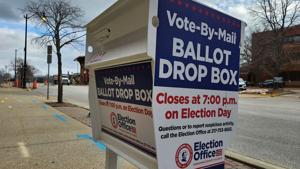
U.S. Supreme Court appears split over mail-in ballot challenge
The U.S. Supreme Court appeared split during oral arguments on Wednesday about a challenge over mail-in ballot laws in Illinois.
The challenge centers around Rep. Mike Bost, R-Ill., who sued the Illinois Board of Elections over a law allowing the state to count mail-in ballots marked on Election Day as much as 14 days after an election.
Bost filed the lawsuit in 2022, arguing Congress sets the time for federal elections and the state’s mail-in ballot counting procedures go against that policy.
Justice Ketanji Brown Jackson said she did not understand the harm caused to Bost by allowing mail-in ballots to be counted in the period after Election Day.
“In every election, candidates voluntarily put themselves up for election and there is a risk that they will win or lose,” Jackson said.
Paul Clement, an attorney for Bost, said candidates who comply with mail-in voting counts after an Election Day are “forced to gamble” with the chance of an election not turning out in their favor.
Justices Elena Kagan and Sonia Sotomayor also appeared skeptical of the harm caused to a candidate under the Illinois law. Kagan pointed to other challenges to election law like not allowing citizens to vote early on Sunday as an example.
Sotomayor said Bost’s case appeared to be on the basis of speculation rather than proven harm.
Chief Justice John Roberts pointed out that Bost won reelection each cycle since 2015. He questioned whether there was a credible threat Bost could lose even after mail-in ballots were counted.
Jane Notz, an attorney for the Illinois State Board of Elections, argued Bost did not have standing to sue because he was simply concerned with the results.
Notz said Bost’s “smaller margin of victory does not have real world consequences.”
However, Justice Samuel Alito appeared skeptical of the Illinois Board of Election’s conclusions. He appeared concerned that a smaller margin of victory due to counting mail-in ballots is sufficient proof of harm.
Justice Alito, joined by Justice Kavanaugh, questioned whether Bost’s campaign team would need to expend resources to count additional ballots.
Notz said provisional ballots would still be counted up to two weeks after an election, which would make harm difficult to prove since there would not be additional campaign resources expended to count mail-in ballots.
Clement argued that any amount a candidate needs to expend in order to get the results of an election results in harm for that candidate.
“[The] candidate is not a bystander in his or her own election,” Clement said.
If the high court upholds Bost’s standing to sue the board of elections, it could allow other states to move forward with similar litigation against mail-in ballot laws.
In an August social media post, President Donald Trump said he is planning to “lead a movement” to end mail-in ballots and voting machines. He said he would sign an executive order in the near future to formalize his plans but has yet to make such an order.
Trump said challenging mail-in ballots would restore election integrity and create a faster voting process.
“Remember, the States are merely an ‘agent’ for the Federal Government in counting and tabulating the votes,” Trump said. “They must do what the Federal Government, as represented by the President of the United States, tells them, FOR THE GOOD OF OUR COUNTRY, to do.”



Sunny
Latest News Stories

Hochul weighs AI regulations as Trump sets federal rules

EXCLUSIVE: First Nation police chiefs want to participate in border security efforts
Justice Department sues Fulton County over election records

USPS electric fleet push sparks cost, security and job concerns

WATCH: Use of Guard debated; Trump singles out Pritzker on AI; Property tax ruling

Illinois quick hits: Chicago Fed president explains vote; Treasurer encourages Bright Start gifts

EXCLUSIVE: Canadian groups, First Nation police support stronger border security

More than 9,500 commercial truckers taken off U.S. roads nationwide

WATCH: ‘Unfortunate accident’: Miss. senator blasted for comment on Guard troop shootings
WATCH: House Homeland Security hearing filled with tense exchanges

Judge rules against Trump’s freeze on wind energy

Illinois’ new paint fee takes effect, with critics calling it another burden on taxpayers

Pritzker decision looms for energy bill ‘on ratepayers’ backs’
WATCH: Use of National Guard debated in U.S. Senate as Illinois case lingers
