Consumer Watchdog says no legal support for president’s tariff power
A nonprofit group told the nation’s highest court that even if a 1977 law that doesn’t mention tariffs gives the president unbounded tariff authority, Congress doesn’t have the authority to delegate that kind of “immense power.”
Trump has focused his economic agenda on tariffs. A group of small businesses, some Democrat-led states, and two education businesses have challenged the president’s tariff authority under the International Emergency Economic Powers Act of 1977.
In his second term, Trump used the 1977 law to reorder global trade through tariffs to give U.S. businesses an advantage in the world market. Using tariffs under the International Emergency Economic Powers Act, Trump put import duties of at least 10% on every nation that does business with the U.S. Some nations, including many U.S. allies, face much higher tariff rates.
The U.S. Supreme Court agreed to take up the challenge to Trump’s tariff authority in September, setting a schedule for an expedited review.
Consumer Watchdog, a nonprofit dedicated to protecting consumers, noted in its friend-of-the-court brief that the Supreme Court hasn’t struck down a statute on delegation grounds since 1935.
However, attorneys for the group argued: “But it also has never encountered a law like IEEPA as applied to the imposition of tariffs.”
“As a result of the twenty-three separate Executive Orders … these tariffs have come on and come off, and rates fluctuated up or down, with ever changing rationales and exceptions, with no ties to any limits or conditions in IEEPA – and everything determined by the unfettered choices of the President,” attorneys for the group wrote. “That is not law in our constitutional system.”
The attorneys pointed to two other reports that show the “immense power” Trump claims under the 1977 law. One report from U.S. Customs and Border Protection shows the U.S. has already collected nearly $90 billion in tariffs through September. The other report is from the Congressional Budget Office, which estimated tariffs could bring in $4 trillion over the next decade. That CBO report came with caveats and noted that tariffs will raise consumer prices and reduce the purchasing power of U.S. families.
“The constitutional flaw in nondelegation cases depends on what Congress did, or more precisely, did not do,” Consumer Watchdog attorneys wrote. “Here, it failed to provide guardrails to limit the ability of the President to impose whatever tariffs he pleases.”
Attorneys for Consumer Watchdog also noted “tariffs of the magnitude at issue here inevitably raise consumer prices and threaten the economic security of working families and small businesses.”
In August, the U.S. Court of Appeals for the Federal Circuit affirmed a previous lower court ruling saying Trump did not have the authority, but said Trump’s tariffs could remain in place while the administration appeals to the U.S. Supreme Court. In the 7-4 decision, the majority of the Federal Circuit said that tariff authority rests with Congress. It used that same language: “We discern no clear congressional authorization by IEEPA for tariffs of the magnitude of the Reciprocal Tariffs and Trafficking Tariffs. Reading the phrase ‘regulate … importation’ to include imposing these tariffs is ‘a wafer-thin reed on which to rest such sweeping power.'”
A Supreme Court victory for Trump would cement the federal government’s newest revenue source – the highest import duties in nearly a century – in place, at least for now.
Trump has said a loss would be catastrophic for the U.S. economy.
Economists, businesses and some publicly traded companies have warned that tariffs could raise prices on a wide range of consumer products throughout the U.S.
Trump has said he wants to use tariffs to restore manufacturing jobs lost to lower-wage countries in decades past, shift the tax burden away from U.S. families, and pay down the national debt.
A tariff is a tax on imported goods that the importer pays, not the producer. The importer pays the cost of the duties directly to U.S. Customs and Border Protection, a federal agency.
Oral arguments before the Supreme Court are set for Nov. 5.





Partly Sunny then Isolated Rain Showers
Latest News Stories
Bonta’s anti-Exxon emails may have run afoul of CA corruption law: Claim
Expulsion votes for two members of Congress could happen next week, Luna says

NAACP sues xAI over air pollution near Memphis data center
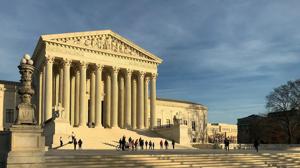
Trump says he’s ready to nominate up to three Supreme Court justices
Military hostilities in Iran continue after Senate tanks War Powers Resolution

WATCH: Detransitioner battles to revive landmark malpractice and fraud lawsuit

Iran economic fallout is temporary, Hassett says

Illinois Quick Hits: NFIB says biz deduction will bring jobs, benefit to Illinois

Soaring costs and short supply shut millennials out of housing market
Vought testifies before lawmakers on Trump’s $2.1T budget request

SNAP eligibility changes spark debate on gap for impacted recipients

Trump puts spotlight on China, Iran’s top oil consumer