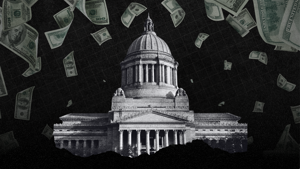
Congress used government funding bill to ‘erase’ $3.4 trillion in deficits

Spread the love

Quietly tucked inside Republicans’ funding deal to end the government shutdown is a provision wiping the congressional Pay-As-You-Go (PAYGO) scorecard, effectively forgiving nearly $3.4 trillion in deficits.

When Republicans passed their budget reconciliation bill in July, which included a permanent extension of the 2017 tax cuts, they broke precedent by operating under current policy baseline. This accounting method treats tax cut extensions as a continuation of current policy that costs nothing, rather than new policy that decreases federal revenues.

As a result, Senate Republicans were able to codify the tax cuts via a simple majority vote without having to fulfill reconciliation rules that require offsetting the deficit impact. Senators could not, however, bypass similar PAYGO rules unless they had 60 votes.

Under PAYGO, a law meant to ensure budget neutrality, the Office of Management and Budget records the deficit impact of legislation.

If Congress passes legislation that hikes mandatory spending or decreases revenue, and does not offset the deficits by the end of the year, automatic spending cuts to Medicare and other programs are triggered.

The tax cuts in the reconciliation bill added roughly $3.4 trillion to the PAYGO scorecard. But rather than finding offsets or accepting the automatic cuts to mandatory spending, Congress added a provision in the recent government funding bill – which fulfilled the 60-vote requirement – to reset the PAYGO scorecard to zero.

“That’s why this was included in the appropriations bill. It had nothing to do with appropriations,” Romina Boccia, director of budget and entitlement policy at the Cato Institute, told The Center Square. “It was all about getting those 60 votes, because that’s what PAYGO requires in order to eliminate those required spending reductions that would have been triggered by the Republicans’ reconciliation bill.”

This is hardly the first time Congress has wiped the PAYGO scorecard to avoid the consequences of a bill’s deficit impact.

In fact, Congress has never allowed the automatic spending cuts to take effect. Lawmakers wiped the PAYGO scorecard for the 2017 Tax Cuts and Jobs Act and the American Rescue Plan, while simply excluding both the CARES Act and the CHIPS and Science Act from the scorecard.

“There’s a lot of hand-waving when it comes to these deficits, but unfortunately, because Congress has pretty much consistently eliminated the spending cuts from the PAYGO scorecard in all instances – whether the Democrats put the deficits on there, or the Republicans – there’s been very little fight on it,” Boccia said.

“What it tells us is that PAYGO has become completely worthless, and that we should replace it and stop pretending like we have a deficit-controlling rule on the books when it’s pretty much understood that it will always be negated,” she added.

The U.S. racked up close to $2 trillion in net federal deficits during fiscal year 2025, according to the Congressional Budget Office, causing the national debt to top $38 trillion in October.

Leave a Comment


Latest News Stories

Buck to run against Titus in Las Vegas congressional race
Buck to run against Titus in Las Vegas congressional race

By Liam HibbertThe Center Square Nevadans overwhelmingly backed the incumbent and favored Republican challenger in Tuesday’s primary election for the state’s 1st Congressional District. Longtime incumbent Dina Titus ran ahead...
Candidates notch wins in Nevada U.S. House primaries

Candidates notch wins in Nevada U.S. House primaries

By Andrew RiceThe Center Square Voters in Nevada selected incumbent and new partisan candidates in the primary races for the U.S. House of Representatives on Tuesday. Here are some of...
Lombardo, Ford projected to run in Nevada's Nov. 3 gubernatorial race

Lombardo, Ford projected to run in Nevada’s Nov. 3 gubernatorial race

By Liam HibbertThe Center Square Nevadans voted for the two biggest names on the primary ticket Tuesday to send Democratic and Republican heavyweights to the general election on Nov. 3....
Platner will face Collins in November; U.S. House races pending

Platner will face Collins in November; U.S. House races pending

By Andrew RiceThe Center Square Graham Platner, a Maine oyster farmer, is projected to move forward in a general election for U.S. Senate against incumbent Republican Sen. Susan Collins. Platner...
Seattle enacts one-year ban on data centers
Seattle enacts one-year ban on data centers

By Randy DiamondThe Center Square A one-year ban on new large-scale data centers was approved by the full Seattle City Council on Tuesday. The ban comes after 98,000 residents emailed...
Social Security fund to run dry in 2032, automatic cuts loom
Social Security fund to run dry in 2032, automatic cuts loom

By Brett RowlandThe Center Square Social Security's retirement trust fund will be depleted in 2032, triggering an automatic 22% reduction in benefits for about 70 million Americans unless Congress acts,...
$70B bill funding ICE, Border Patrol through 2029 heads to Trump's desk

$70B bill funding ICE, Border Patrol through 2029 heads to Trump’s desk

By Thérèse BoudreauxThe Center Square Republicans in Congress on Tuesday sent their $70 billion bill funding federal immigration enforcement agencies through 2029 to President Donald Trump’s desk. The 214-212 U.S....
Lawmakers probe taxpayer savings in military contracts
Lawmakers probe taxpayer savings in military contracts

By Andrew RiceThe Center Square Advocates urged lawmakers on Tuesday to implement legislation that will provide for greater accountability of taxpayer dollars in military contracts. The Department of War requested...
U.S. launches retaliatory strikes against Iran

U.S. launches retaliatory strikes against Iran

By Sarah Roderick-FitchThe Center Square U.S. forces have begun launching “self-defense strikes” against Iran after President Donald Trump announced a response to the Islamic Republic's shooting down of a U.S....
Congress debates effects of U.S. immigration policies
Congress debates effects of U.S. immigration policies

By Christine JohnsonThe Center Square Abuses of the Department of Homeland Security's Temporary Protection Status program allowing foreign nationals of specifically designated countries to come to and remain in the...
Another approach to border security: Denaturalization
Another approach to border security: Denaturalization

By Bethany BlankleyThe Center Square The Trump administration is advancing multiple approaches to border security, including enforcing federal law that requires denaturalization. Under the Immigration and Nationality Act, a naturalized...
Kennedy nutrition pledge lacks enforcement as health costs rise
Kennedy nutrition pledge lacks enforcement as health costs rise

By Brett RowlandThe Center Square The federal government is spending $5 million on a voluntary medical school nutrition initiative, but fewer than 40% of the nation's 202 accredited medical schools...
Matchups not yet determined in redrawn congressional races

Matchups not yet determined in redrawn congressional races

By Andrew RiceThe Center Square One week after polls closed in California, several matchups in redrawn congressional districts have yet to be determined. The passage of Proposition 50 in California...
Changes made to Illinois public transport plan sends money downstate

Changes made to Illinois public transport plan sends money downstate

By Sean Reed | The Center SquareThe Center Square (The Center Square) – A law expected to bring reform to public transportation in Illinois took effect at the start of...
Proposal to regulate AI development at federal level gets chilly reception

Proposal to regulate AI development at federal level gets chilly reception

By Thérèse BoudreauxThe Center Square Despite mounting pressure on Congress to establish clear federal standards governing the rapid development of artificial intelligence, a bipartisan proposal to do just that is...