D.C.’s power to challenge Trump in jeopardy after Guard ruling
A federal court’s slapdown of the District of Columbia’s lawsuit against the Trump administration over the deployment of National Guard troops could have far-reaching implications over the power of the district’s left-leaning government to oppose federal policies.
A panel of the influential D.C. Circuit Court of Appeals kept in place a stay of an injunction blocking the Guard deployment, ruling the federal government was likely to prevail on arguments the district is a creation of Congress with no sovereignty of its own. The district sued the government in September, claiming the presence of the Guard violated a statute granting it “home rule” power over local affairs.
Not so, the court ruled.
D.C. is “a federal district created by Congress, rather than a constitutionally sovereign entity,” Judge Patricia Millett wrote in a Dec. 17 order. “The President’s order implicates a strong and distinctive interest in the protection of federal governmental functions and property within the nation’s capital.”
Judges Gregory Katsas and Naomi Rao went further in a concurrence, asserting D.C. doesn’t have standing to sue the President since it is a creation of the same government it is trying to sue. Unlike states, which were granted certain powers of sovereignty under the nation’s founding documents, the Constitution gave Congress sole “legislative power” over the capital district.
While Congress passed a law in 1973 allowing the district to elect a mayor and local government, the concurring justices said, there’s no precedent for D.C. to sue over injuries it claims it has suffered at the hand of the President.
“Such an injury is likely untenable as a matter of first principles and finds no support in our precedent or historical practice,” the justices wrote.
The concurrence, if adopted by the full court, could narrow the power of the D.C. mayor to engage in activities opposed by the executive branch, said Samuel Dewey, a litigator with the Oversight Project who wrote a brief supporting the broader arguments denying D.C. sovereignty. He said even the Trump Justice Department didn’t directly question D.C. sovereignty and power to sue.
“We were very surprised when DOJ didn’t make that argument because we think it’s obviously right,” Dewey said.
The Oversight Project’s brief stated simply: “One cannot sue oneself.” For almost a century, D.C. was governed by a three-person commission appointed by the President, but Congress abolished the commission in favor of home rule in 1973. Since then, the district has fought the federal government in court, including this year when D.C. Attorney General Brian L. Schwalb sued over pollution in the Anacostia River he blamed on the Washington Navy Yard.
With no sovereignty of its own, it is likely D.C. can’t persist with such lawsuits, Dewey said. The court’s reasoning also might undermine the city’s lawsuit against the oil industry over global warming, he said, at least to the extent D.C. claims sovereign harm to itself.
The city also might have trouble staying in lawsuits, typically involving Democratic states, against the federal government like a recent one targeting the Trump administration’s suspension of electric vehicle charging infrastructure funding.
The court order is not going to be popular within D.C., Dewey said. And if the reasoning expressed in it is ultimately upheld on appeal, it could trim the powers of whoever replaces current Mayor Muriel Bowser, who recently announced she isn’t running for reelection.
Whoever wins, “it will impact his room to do stupid things that impact the federal government,” Dewey said.




Slight Chance Showers And Thunderstorms then Chance Showers And Thunderstorms
Latest News Stories

Public education budgets balloon while enrollment, proficiency, standards drop

Illinois news in brief: Cook County evaluates storm, flood damage; Giannoulias pushes for state regulation of auto insurance; State seeks seasonal snow plow drivers

Governor defends mental health mandate, rejects parental consent plan

Illinois quick hits: Arlington Heights trustees pass grocery tax
Casey Joins Land Bank, Secures EPA Grant for Sewer Planning
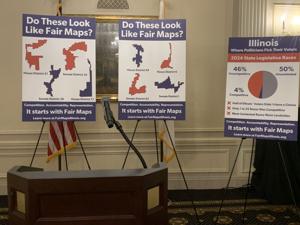
Plan launched to place redistricting amendment before voters in 2026

Rose G. (Crandall) Penrod
Casey Targets Two Dilapidated Properties for Remediation
Illinois GOP U.S. Senate candidates point to economy, Trump gains

Lawmaker criticizes $500 student board scholarships amid lowered K‑12 standards

Illinois news in brief: Work begins on $1.5 billion O’Hare expansion; Police catch man accused of road rage, shooting
Newsom files FOIA request on border patrol’s appearance