D.C.’s power to challenge Trump in jeopardy after Guard ruling
A federal court’s slapdown of the District of Columbia’s lawsuit against the Trump administration over the deployment of National Guard troops could have far-reaching implications over the power of the district’s left-leaning government to oppose federal policies.
A panel of the influential D.C. Circuit Court of Appeals kept in place a stay of an injunction blocking the Guard deployment, ruling the federal government was likely to prevail on arguments the district is a creation of Congress with no sovereignty of its own. The district sued the government in September, claiming the presence of the Guard violated a statute granting it “home rule” power over local affairs.
Not so, the court ruled.
D.C. is “a federal district created by Congress, rather than a constitutionally sovereign entity,” Judge Patricia Millett wrote in a Dec. 17 order. “The President’s order implicates a strong and distinctive interest in the protection of federal governmental functions and property within the nation’s capital.”
Judges Gregory Katsas and Naomi Rao went further in a concurrence, asserting D.C. doesn’t have standing to sue the President since it is a creation of the same government it is trying to sue. Unlike states, which were granted certain powers of sovereignty under the nation’s founding documents, the Constitution gave Congress sole “legislative power” over the capital district.
While Congress passed a law in 1973 allowing the district to elect a mayor and local government, the concurring justices said, there’s no precedent for D.C. to sue over injuries it claims it has suffered at the hand of the President.
“Such an injury is likely untenable as a matter of first principles and finds no support in our precedent or historical practice,” the justices wrote.
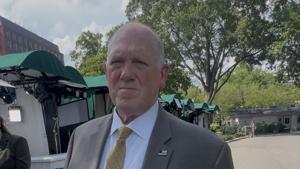
The concurrence, if adopted by the full court, could narrow the power of the D.C. mayor to engage in activities opposed by the executive branch, said Samuel Dewey, a litigator with the Oversight Project who wrote a brief supporting the broader arguments denying D.C. sovereignty. He said even the Trump Justice Department didn’t directly question D.C. sovereignty and power to sue.
“We were very surprised when DOJ didn’t make that argument because we think it’s obviously right,” Dewey said.
The Oversight Project’s brief stated simply: “One cannot sue oneself.” For almost a century, D.C. was governed by a three-person commission appointed by the President, but Congress abolished the commission in favor of home rule in 1973. Since then, the district has fought the federal government in court, including this year when D.C. Attorney General Brian L. Schwalb sued over pollution in the Anacostia River he blamed on the Washington Navy Yard.
With no sovereignty of its own, it is likely D.C. can’t persist with such lawsuits, Dewey said. The court’s reasoning also might undermine the city’s lawsuit against the oil industry over global warming, he said, at least to the extent D.C. claims sovereign harm to itself.
The city also might have trouble staying in lawsuits, typically involving Democratic states, against the federal government like a recent one targeting the Trump administration’s suspension of electric vehicle charging infrastructure funding.
The court order is not going to be popular within D.C., Dewey said. And if the reasoning expressed in it is ultimately upheld on appeal, it could trim the powers of whoever replaces current Mayor Muriel Bowser, who recently announced she isn’t running for reelection.
Whoever wins, “it will impact his room to do stupid things that impact the federal government,” Dewey said.





Mostly Sunny
Latest News Stories

Early voting starts Thursday in most Illinois jurisdictions
Trump tells Iranian leaders they ‘should be very worried’

Illinois Quick Hits: Group files FOIA lawsuit vs. Pritzker

First lady meets with former Oct. 7 hostages

U.S. regulator licenses deepwater port in Gulf for oil exports
Supreme Court declines challenge to California’s congressional map

Candidate: $243 million in unlawful spending is example of ‘Preckwinkle’s mismanagement’

Tillis probes ICE practices after calling Noem a ‘sycophant’
GOP lawmakers urge Thune to tweak filibuster rules to pass voter ID bill

Illinois housing crunch sees prices rising, units dwindling
700 federal agents to leave Minnesota, Homan says

New York, New Jersey sue feds over Hudson Tunnel funding cuts