Theis abruptly retires from IL Supreme Court; Tailor to replace
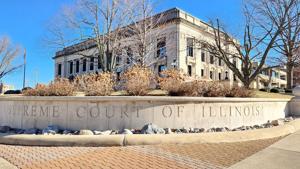
Illinois will have a new state Supreme Court justice at the end of January, after Justice Mary Jane Theis announced her sudden retirement from the court.
Theis’ announcement came Monday, a little more than three years into her current 10-year term and three months since the end of her term as the state Supreme Court’s chief justice.
Neither Theis nor the court provided a reason for her abrupt retirement.
Theis is 76 years old.
According to a statement from the court, Theis will be replaced on the court by current Illinois First District Appellate Justice and former Cook County Circuit Court Judge Sanjay Tailor.
Tailor’s interim term will begin Jan. 30 and end Dec. 4, 2028, following that year’s November elections.
Tailor was appointed by the state high court’s justices.
Under the so-called retire-and-replace system, retiring Illinois state Supreme Court justices can choose to step aside well before their 10-year term on the court expires, and then essentially persuade their colleagues to sign off on their choice to replace them and fill out the term.
The system then gives those newcomers the ability to run as an incumbent in the next election for state Supreme Court.
The system has been used by Democrats and Republicans alike for decades. Theis is among the justices currently serving on the court who were appointed and then, later, elected following the increasingly common method of choosing state Supreme Court justices in Illinois.
Others on the court who have landed on the state Supreme Court in such a manner include: Democrat Justice Joy V. Cunningham, selected to replace former Justice Anne M. Burke, the wife of convicted Chicago Ald. Ed Burke; Republican Justice Lisa Holder White, selected to replace retired Justice Rita B. Garman; and current Chief Justice P. Scott Neville, a Democrat, who was selected to replace former Justice Charles E. Freeman.
The court’s other three justices, Democrats Elizabeth M. Rochford and Mary K. O’Brien, and Republican David K. Overstreet, were all elected to the court without prior appointment following a retirement.
Rochford and O’Brien each won contested partisan elections in Illinois’ Second and Third Judicial Districts, respectively, in 2022, with strong financial backing from Illinois Democrats and Gov. JB Pritzker, particularly.
Overstreet was elected in a rare special Supreme Court election, held in 2020 in Illinois’ downstate Fifth Judicial District following the retirement of former Justice Lloyd Karmeier.
Theis was appointed to the court by the Supreme Court justices in 2010, replacing the retiring Justice Thomas R. Fitzgerald.
Theis, a Democrat, was elected by the voters of Cook County to a 10-year term in 2012. She won a retention vote in 2022, securing a new 10-year term on the court.
Theis most recently served as the court’s chief justice for three years, from 2022-2025, when she was replaced in the rotation by Neville.
Theis had replaced Anne Burke in that role.
During her time on the court, Theis played a role in deciding numerous consequential and precedent-setting cases.
Theis, for instance, authored the unanimous opinion in 2012 that led to the exoneration of Stanley Wrice, a man convicted in 1983 of abducting and raping a Chicago woman. Wrice asserted his confession had been beaten out of him by two Chicago Police detectives working under the disgraced Commander Jon Burge.
Burge was fired in 1993 for allegedly overseeing operations in which convictions were obtained against accused violent offenders by allegedly using torture to extract criminal confessions from suspects, many of whom were later cleared of the crimes after spending years in prison.
Theis’ opinion helped to set the stage for a stream of lawsuits which have continued unabated against the city of Chicago on behalf of convicted criminals who claimed they had been wrongfully convicted as a result of such tortured confessions.
Theis also served as the lead author on two particularly politically charged decisions.
Lawmakers and city officials argued the law was needed to avert a looming financial catastrophe in 10-20 years, as pension funds remained underfunded and continued to gobble up greater shares of city and state tax revenue.
In the ruling, however, Theis and her colleagues again slapped down any attempt to sidestep the Illinois state constitution’s so-called pension protection clause, which prohibits the state or local governments from “diminishing or impairing” public worker pensions.
In the ruling, Theis pointedly proclaimed that it did not matter if there was actually any money available to pay workers’ pensions or not; the pensions must be paid.
“… As we have explained, the Illinois Constitution mandates that members of the Fund have ‘a legally enforceable right to receive the benefits they have been promised’ – not merely to receive whatever happens to remain in the funds,” Theis wrote.
Then, in 2023, Theis authored a 5-2 majority opinion, declaring that Illinois Democrats could abolish cash bail without amending the state constitution. That ruling was delivered along party lines. The decision delivered a loss to Illinois prosecutors outside Cook County and a big legal win to Gov. JB Pritzker and Democratic leaders in the fight over the constitutionally questionable and controversial decision to reform the state’s criminal justice by stripping judges of the ability to require criminal defendants, including violent offenders, to post cash bond to stay out of jail as they awaited trial.
In the ruling, Theis and her fellow Democratic justices sided with Illinois Democratic lawmakers, Pritzker and Attorney General Kwame Raoul in deciding cash bail wasn’t required by the Illinois state constitution. Rather, she and her Democratic colleagues said, the use of cash bail was merely a tool that lawmakers allowed courts to use when balancing the rights of criminal defendants to remain free pending conviction at trial, and the rights of the public to remain safe from known criminal threats.
So, they said, lawmakers are free to take that tool away from judges now, and require courts to come up with other ways of trying to compel defendants to return to court to stand trial.
They agreed with Raoul and Democrats that the bail language in the state constitution should be correctly read to protect the rights of accused criminals, not to be used as a tool to protect the community from accused criminals.
Theis and her colleagues said they believed the so-called Pretrial Fairness Act had struck the correct balance between the rights of the accused and the community’s interest in being protected from criminals.
Theis also sided with Democrats repeatedly on many other consequential questions, including upholding the ability of Illinois lawmakers to ban so-called “assault weapons” and refusing to allow Illinois voters the chance to amend the state constitution to strip from Illinois state lawmakers the power to gerrymander the state’s legislative and congressional districts.
In that ruling, Theis and her Democratic colleagues sided with operatives of convicted Illinois House Speaker Michael Madigan, who had argued the effort to amend the state constitution was itself unconstitutional, because it violated procedural rules.
Theis and her colleagues refused to respond to calls from the public and her Republican colleagues for some guidance on how such grassroots reformers could actually ever amend the state constitution.
In a statement included in the release from the state Supreme Court announcing her retirement, Theis said: “I am deeply grateful to have had the opportunity to serve. It has been my foremost goal to further the Court’s mission of providing access to equal justice, ensuring judicial integrity and upholding the rule of law.”
In a letter to her colleagues on the state Supreme Court announcing her retirement, Theis asserted Illinois courts have made great strides since the 1980s in addressing what she described as the perception they were not “fair.”
“People will respect judicial decisions if they believe the court was fair,” Theis wrote in her letter, dated Jan. 12.
Separately, Theis has said: “The perception of fairness is what holds together our communities, our court system, the rule of law, and our democracy.”
She has been lauded for her work as chief justice to establish the Illinois Courts Commission as a separate agency to handle misconduct complaints against justice and dole out discipline against judges, without interference from the state Supreme Court.
Theis, who served as a Cook County Assistant Public Defender before becoming a judge in 1983, has also been praised for her work at increasing “access to justice,” particularly for “the most vulnerable people in our communities.”
In her letter, Theis urged her colleagues and others in Illinois’ courts system to continue that work, with particular attention to the state’s “crisis in indigent criminal defense.”
“Courts are not a place, they are a service,” Theis wrote in her Jan. 12 letter. “Courts must respond to real people with real people problems.”
In replacing Theis on the court, Tailor, an Indian American, would become the first judge of Asian ethnic descent to serve on the state’s high court. He also was the first Indian American male to serve on an Illinois appellate court.
“I am grateful to Justice Mary Jane Theis and the other justices of the Illinois Supreme Court for their confidence and trust in appointing me justice of the Illinois Supreme Court,” Tailor said in a prepared statement announcing Theis’ retirement and his appointment to the court. “I also look forward to continuing the work of the Illinois Supreme Court to ensure that our system of justice serves all people fairly and equitably.”
Tailor has served on the First District appeals court – a district which includes only Cook County – since 2022, when he was appointed to that court by the Illinois Supreme Court.
Tailor has served as a judge since 2003, when he was appointed to the bench as an associate judge.
He has faced voters just once, when he was elected as a Cook County Circuit Judge from the county’s 9th Judicial Subcircuit, which includes only Chicago’s far North Side and the North Shore suburbs, including Evanston, Wilmette and Winnetka.
Tailor was never elected to the appellate court.
Tailor’s term on the Illinois Supreme Court will end in 2028. Should he wish to hold the seat after that date, Tailor will need to run for election to the court that year from the state’s First Judicial District, which, again, only includes Cook County.






Mostly Sunny
Latest News Stories

Casey City Council July 7 Meeting Briefs
Donna K. Wilson

Cooling Centers Available

No Carts in Fairview Park Walking Paths

Beauty around the Rocking Chair

Rotary Hosts Discover Downstate Illinois Marketing Team
Julie Beth Redman

Julie Snyder Named Honorary Chairperson for 75th Casey Open

David Eugene Hawkins

Registration open now: ‘Pop On In’ to the 2025 CIA 5K Fun Run/Walk

Donald Lee “Don” Maxey

Keith Richard Wattleworth