SCOTUS declines to hear felony firearms cases
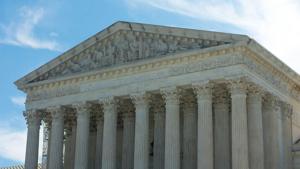
The U.S. Supreme Court on Tuesday declined to take up two cases over whether individuals with felony records can be permanently disarmed under the Second Amendment.
The court declined to hear Zherka v. Bondi and Duarte v. U.S. Each challenge targets laws banning individuals with felony convictions from possessing firearms.
Selim Zherka and Steven Duarte both petitioned the government to possess firearms despite previous non-violent felony convictions. Both Zherka and Duarte were convicted on fraud charges and have been denied the opportunity to possess firearms.
“The government should have had to identify a historical tradition of disarming people like Duarte, whose prior convictions were all for non-violent crimes and whom the government had never claimed was violent towards others,” lawyers for Duarte wrote in a brief to the court.
Lawyers for the government argued founding-era principles supported the death penalty for crimes such as counterfeiting, squatting, theft and smuggling. They argued firearm dispossession is a lesser threat to these crimes.
“Founding-era laws imposing capital punishment for serious crimes support the lesser restriction of disarmament in analogous circumstances,” lawyers wrote.
Justices on the court, however, have yet decide whether they will hear Vincent v. Bondi, a similar case on firearm possession and fraud.
Melynda Vincent, a social worker and nonprofit founder, was convicted of federal bank fraud in 2008 for attempting to pass a fraudulent check. While nonviolent, the felony prohibits Vincent from possessing firearms.
In Vincent v. Bondi, Melynda argued the prohibition violated her Second Amendment rights. She sought to have the law declared unconstitutional and for an injunction to prevent the U.S. attorney general from enforcing it against her.
After denials in lower court, Vincent sought relief from the U.S. Supreme Court.
“Text, history, and tradition show that the government cannot permanently disarm Ms. Vincent – a single mother, social worker, adjunct college professor, and nonprofit founder with two college degrees – soley because of one seventeen-year-old conviction for passing a bad check,” Vincent’s lawyers wrote in a petition to the Supreme Court.
The government disputed Vincent’s claims of a permanent ban from the possession of firearms. In a petition to the court, lawyers for the Trump administration said the government reinstated a process for convicted felons to gain their rights to possess firearms, leaving Vincent’s challenge on a faulty basis.
Even still, lawyers for the government argued the ban on firearm possession for felons aligns with the history and tradition of the Second Amendment.
“American colonies imposed that penalty even for non-violent crimes such as counterfeiting, squatting on Indian land, burning timber intended for house frames, horse theft, and smuggling tobacco,” lawyers for the government wrote in a brief to the court.
If the court were to pick up Vincent’s petition, it could have downstream effects on the arguments in Duarte’s and Zherka’s cases.




Sunny
Latest News Stories
Illinois Quick Hits: Pritzker wants to extend pension buyout program

Congressional Conflicts: Like Pelosi, NJ Rep. has made tens of millions from Wall Street
Clintons agree to appear before House committee, no date set

Head Football Coach Resigns as Board Approves Personnel Changes

Google to pay $68M to end Assistant recordings class action
Dems fail in first try to use ‘state sovereignty’ to ‘veto’ ICE

Report says California’s bond debt load exceeds $99 billion

Los Angeles mayor calls for unity, blasts ICE in State of City

Illinois Quick Hits: McIntyre back as inspector general for DCFS

Speculation on Seahawks’ sale heats up following proposed WA ‘jock tax’

WATCH: Newsom cites California’s seizures of fentanyl

Colorado bill says gun barrel purchases to be made at dealers