
Asylum advocates disappointed by Supreme Court arguments
Immigration asylum advocates expressed disappointment with justices on the Supreme Court after arguments Tuesday regarding asylum protections.
The case, Noem v. Al Otro Lado, challenges the Trump administration’s policy prohibiting immigrants on the Mexico side of the U.S.-Mexico border from seeking asylum.
Immigration law allows an individual who “arrives in the United States” to obtain inspection by a border patrol officer and may apply for asylum.
“They are not asking for the 100% guaranteed chance to stay, they are asking for access to the legal process,” said Nicole Ramos, director of the border rights project at Al Otro Lado.
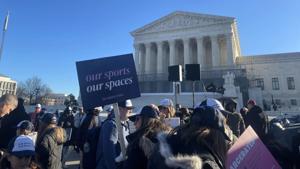
After the arguments, Ramos and other advocates discussed the case on the steps of the Supreme Court. Advocates compared the denial of asylum for Mexican refugees to Jews who sought asylum in the U.S. during the Holocaust but were turned away.
“They were not thinking about the fact that people die when they can’t access asylum procedures,” said Erika Pinheiro, executive director for Al Otro Lado.
During the arguments, justices appeared to debate over at what point an immigrant can be considered “arriving in the United States.” Justice Amy Coney Barrett questioned the considerations for when an asylum seeker arrives in the U.S.
“What is the magic thing that we’re saying happens to make it so now someone arrives in the United States,” Barrett asked.
Chief Justice John Roberts and Justice Brett Kavanaugh appeared to agree with Barrett. They argued that someone in line for asylum at the border cannot be considered under the current immigration law.
“It was disappointing, honestly, to see some of the justices so focused on where you have to be standing on an imaginary line to save your own life,” Pinheiro said.
The advocates said they define “arrives in the United States” as coming “to the threshold” of a port of entry, “about to step over.” Melissa Crow, director for litigation at the Center for Gender and Refugee Studies, spoke to The Center Square on the steps of the Supreme Court.
“Arriving means coming to the threshold of the United States, which triggers an obligation on the part of U.S. government officials to inspect and process noncitizens,” Crow said. “If an individual says that they fear persecution, there are a number of specific processes that they can be channeled through.”
Before arguments at the Supreme Court, advocates appeared to have difficulty explicitly defining what “arrives in the United States” means. Bertha Nibigira, a refugee herself, said immigrants are entitled to start the asylum process wherever possible, but recommended engaging with it at the border.
“Whatever the closest location where people can go to seek asylum, they deserve to be heard,” Nibigira said. “They deserve to be granted the due process.”
Charles Du Mond, another advocate outside the court, said the asylum process should begin when an individual leaves their home country for fear of danger.
“We should be welcoming people who are at risk wherever they’re coming from, and whenever it starts,” Du Mond said. “Working out the details of how, officially, when someone can be considered for asylum or not, is an unnecessary complication.”
Advocates urged the court to prevent the Trump administration from proceeding with this policy.
“This case is of most importance,” Pinheiro said. “I think if it is not decided in our favor the U.S. will lose its position of leadership in the world as a country that promotes the acceptance of refugees.”
Lawyers for the Trump administration argued immigrants can not be considered to “arrive in the United States” when they have not stepped onto U.S. soil.
“An ordinary English speaker would not use the phrase ‘arrives in the United States’ to describe someone who is stopped in Mexico,” lawyers for the government said in a brief to the court.
The Supreme Court is expected to deliberate on its ruling and issue a decision by the end of its term in June.




Partly Sunny
Latest News Stories
Supreme Court yet to decide high profile cases

Government spending on seniors’ benefits soon to make up majority of federal budget

Illinois Dems seek to expand post-release convict support, housing

$580B federal highway bill clears committee; includes rail safety, EV fees

Tennessee smuggling charges against Kilmar Abrego Garcia dismissed

NASA reorganizes to accelerate Moon Base, lunar programs

Gabbard announces resignation, cites personal reasons

Illinois Quick Hits: Community College reimbursement bill passed

Powell out, Warsh in as new chair of Federal Reserve

Nessel pushes back as Trump administration extends order keeping coal plant open

Bipartisan praise for federal charges in Minnesota fraud cases

Congress rejects Trump’s proposed NASA budget cuts