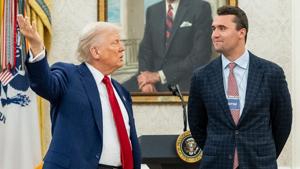
Court showdown over Trump’s tariffs could reshape U.S. trade policy
A ruling from a small federal trade court in New York could reshape global trade, as it decides the legality of President Donald Trump’s latest tariffs, a case with worldwide economic implications.
A little-known federal court in New York could soon decide the fate of Trump’s controversial new round of global tariffs, after a legal challenge brought by Democrat-led states and small businesses. The case, focused on the president’s use of a decades-old trade law, could have major consequences for U.S. trade policy and executive authority.
A coalition of Democrat-led states and small businesses is challenging Trump’s 10% global tariff, imposed under Section 122 of the Trade Act of 1974, a statute allowing tariffs of up to 15% for 150 days. Trump turned to this law after the U.S. Supreme Court struck down his earlier tariff attempt. Section 122 has not been tested in court.
The challengers argue that Trump’s use of Section 122 is unlawful because there is no international balance-of-payments problem, a requirement they contend is economically impossible for the U.S. under floating exchange rates. The federal government calls this view absurd. The Justice Department argues that large account deficits can trigger rapid economic disruption, including declining income growth and currency depreciation.
In their latest brief, the challengers accused the Trump administration of inventing justifications for the tariffs, even invoking Lewis Carroll’s 1871 novel about a chess-themed world.
“In ‘Through the Looking-Glass,’ Humpty Dumpty asserts his authority over language by declaring, ‘When I use a word … it means just what I choose it to mean – neither more nor less.’ Defendants take the same approach here, treating ‘balance-of-payments deficit’ and ‘fundamental international payments problem’ as if they mean whatever the administration now says they mean,” Jeffrey Schwab, an attorney for the Texas-based nonprofit law firm Liberty Justice Center, wrote in a reply to the government’s brief.
Schwab argued that the administration’s interpretation would transform a rarely used law into a tool with sweeping powers Congress never intended.
“Defendants assert unreviewable authority to impose tariffs under Section 122 by declaring a ‘balance-of-payments deficit’ whenever any component of the balance of payments has a deficit, effectively transforming a narrow trade statute into a grant of limitless domestic power,” he wrote.
The states and small businesses have asked the Court of International Trade to decide the case on summary judgment at a hearing on Friday. They’ve also asked the judges to pause Trump’s tariffs as the case moves through the courts. That hearing is scheduled for 10 a.m. EDT on April 10 in the Ceremonial courtroom at the U.S. Court of International Trade in lower Manhattan.
A court notice posted on Wednesday said an audio feed of the proceeding will be available via a YouTube livestream. The livestream link will be available on the court’s website, according to the notice.
Phillip Magness, a senior fellow at the Independent Institute, said Trump’s second set of tariffs could wind up before the U.S. Supreme Court.
“If the courts agree to review the Trump administration’s attempt to switch this terminology, there’s a good chance we will have another round of court proceedings that could reach the Supreme Court,” he told the Center Square.
Appeals from this specialized federal court go to the U.S. Court of Appeals for the Federal Circuit, located in Washington, D.C.
In April 2025, Trump unilaterally imposed the highest tariffs in nearly a century. The U.S. Supreme Court ruled in February that Trump overstepped by using the International Emergency Economic Powers Act to impose tariffs worldwide.
During Trump’s initial round of tariffs, courts permitted the administration to continue collecting import taxes as legal challenges played out.
Trump has defended the tariffs, saying the revenue could fund increased military spending and other goals, including a tariff refund check for some Americans. Still, experts have questioned whether tariffs will raise enough money to cover these spending plans.
As the midterm elections approach, Trump’s tariffs remain unpopular. Research shows that U.S. consumers and businesses bear the bulk of the costs of these import taxes.



Partly Sunny then Slight Chance Showers And Thunderstorms
Latest News Stories
Arizonans vote on successor to U.S. Rep. Raúl Grijalva
Google says Biden admin ‘pressed’ it to censor some COVID-19 content

Judge’s questions during IL gun ban arguments gives rights advocates ‘hope’
Illinois agencies to post monthly investment reports, lawmaker calls symbolic
Illinois quick hits: Pritzker orders ‘efficiencies’ for state spending; Marshalls recover missing child

WATCH: AR15s protected by 2nd Amendment; advocate reacts to appeals court hearing
Fiscal Fallout: Illinois spending swells 43% under Pritzker

Lake Land College to Name Nursing Simulation Lab for HSHS St. Anthony’s After Major Gift

New Incentives and Homecoming Plans Underway at Casey-Westfield Schools

White House does not expect arrests of sanctuary mayors and governors

ICE puts California, Illinois, New York on notice for refusing to cooperate
Appeals judge questions ‘uphill battle’ for IL gun ban found unconstitutional

Illinois library staff to be trained with overdose antidotes under new law