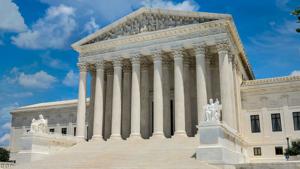
Supreme Court to hear migrant parole case Wednesday
The U.S. Supreme Court will begin its final oral arguments sitting of the current term on Monday. The justices will hear several high profile arguments on various issues before the term ends in June.
On Wednesday, justices will hear arguments in Blanche v. Lau, a case to determine how immigrants are admitted into the United States. The case focuses on Muk Choi Lau, a Chinese national who became a lawful permanent resident in the United States in 2007. In 2012, Lau was convicted of trademark counterfeiting in New Jersey and fled the country.
However, once Lau returned, immigration officers admitted him under parole, a status that allowed him to be brought into the United States but not to remain permanently.
“It’s kind of a catch-all way that DHS officers can allow someone into the country,” said James Rogers, senior counsel at America First Legal.
Once Lau returned to the country on parole, the U.S. Department of Homeland Security began removal proceedings to take Lau out of the country. According to the Immigration and Nationality Act, an immigrant admitted on parole is required to prove that they are admissible into the United States.
“It’s a lot easier to remove an alien in that sort of situation,” Rogers said.
The justices will hear arguements over whether the government had to establish clear evidence when Lau returned to the United States that he had committed a crime or if his later conviction proved that point. The justices will also likely decide how much authority federal courts have when reviewing parole determinations.
Lawyers for Lau argued that the United States cannot use charges of a crime to make a determination on how an immigrant can enter the United States.
“No one thinks that a pending criminal charge is clear and convincing evidence that the defendant committed the charged crime,” lawyers for Lau wrote. “To the contrary, criminal charges are not evidence at all.”
Rogers said the court’s decisionmaking process in this case will be important because the Biden administration used parole to allow immigrants into the country. The Center for Immigration Studies estimated the Biden administration granted parole to 2.86 million foreign nationals.
“The parole statute is supposed to only allow a narrow exception where a DHS officer is allowed to admit aliens on a case-by-case basis if the DHS officer determines that there’s a significant humanitarian need or significant national benefit to letting the alien in,” Rogers said.
Rogers warned that the Supreme Court’s definition of federal review with parole designations could have a large impact on future administrations. He said Democrat administrations could allow large numbers of immigrants in on parole without needing to review the decision in court.
“This can make it significantly harder in the future to challenge left-wing administrations attempts to open the borders and use parole again to let in aliens because there would be no review of those decisions in court,” Rogers said.





Mostly Sunny
Latest News Stories

Trump sues the IRS for $10 billion

Walz, Ellison to appear before House Oversight Committee

BREAKING: Don Lemon arrested for involvement in church attack
Lawmaker calls Pretti shooting an injustice, points to NRA statement as validation
DOJ to release more than 3 million Epstein documents Friday

WATCH: Commission meets as Chicago mayor seeks to prosecute ICE; SNAP changes Sunday

Illinois Quick Hits: Unemployment up over last year
Trump taps Kevin Warsh as next Fed chair
National shutdown, strike planned for Friday, Jan. 30 in protest of ICE

Gori firm accused of fraud, racketeering, ‘bounties’ in asbestos litigation

WATCH: Democratic legislators introduce anti-ICE legislation

Illinois Quick Hits: Grayson gets 20 years for murder