Trump-backed Moore leads Alabama Senate runoff
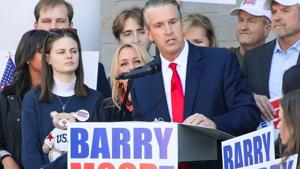
U.S. Rep. Barry Moore, R-Ala., is projected to become the Republican nominee for U.S. Senate in Alabama, setting him up to succeed retiring Tommy Tuberville in a historically conservative seat.
Moore will face attorney Everett Wess, the projected winner in the Democratic runoff, on Nov. 3 in a race to determine who will become Alabama’s new senator.
Alabama’s U.S. Senate seats have been held by Republicans for 30 years, apart from Democrat Doug Jones’ tenure between 2018 and 2021. Republicans intend to maintain this historical trend as they work to keep their 53-45 majority in the Senate after the midterm elections this fall.
Republican runoff
Moore, who represents Alabama’s 1st congressional district in the U.S. House of Representatives, defeated opponent Jared Hudson in the Republican runoff on Tuesday night. Moore led by 11.6 points with 98% of the vote counted.
After Tuberville announced his candidacy for Alabama governor last year, Moore jumped into the race for the state’s vacant Senate seat. Moore clinched President Donald Trump’s endorsement, a coveted asset for Republican candidates, and ran a campaign built on loyalty to the president.
“With President Trump’s complete endorsement, a double-digit win in the May 19 primary, and the support of Alabama conservatives from Mobile to Muscle Shoals, we’re confident in the campaign we’ve put together and look forward to victory on Tuesday,” Moore told The Center Square last week.
As a fiscal hawk and member of the conservative House Freedom Caucus, Moore pushed for deeper spending cuts in Trump’s One Big Beautiful Bill Act last year, but eventually voted for the sprawling spending package with his party.
Despite polling released earlier in June showing him trailing Hudson, Moore pulled ahead in Tuesday’s runoff and secured the Republican nomination. Moore outspent his opponent nearly two-fold, bringing in almost $3 million compared to Hudson’s $1.8 million, per the candidates’ latest Federal Election Commission (FEC) filings.
Democratic runoff
Wess, an attorney and political newcomer, is projected to win Tuesday’s Democratic runoff for Senate in Alabama. With 99% of the vote counted, Wess led his opponent by 9.2 points.
Wess advanced to the runoff after taking 39.6% in the primary in May. Alabama requires a winning candidate to receive at least 50% of the vote to avoid a runoff.
With roots as the son of a union shipyard worker and veteran, Wess utilized his working-class upbringing to appeal to voters.
“Those experiences have shaped my commitment to protecting Social Security and Medicare, supporting organized labor, expanding economic opportunity, and ensuring that every Alabamian has a fair shot at the American Dream,” Wess told The Center Square.
Wess took the lead in Tuesday’s runoff despite raising roughly half as much as his opponent Dakarai Larriett. According to FEC filings as of May 27, Wess reported $74,000 compared to Larriett’s $147,000.
Road to November
Moore and Wess will go head-to-head in the general election on Nov. 3 when Alabama voters decide who will succeed Tommy Tuberville in the Senate. Tuesday’s runoffs conclude a long primary process beginning with a pool of 10 candidates and ending with runoff races to secure nominations in both parties.
Wess faces an uphill battle as a Democratic candidate vying for a Senate seat the Cook Political Report rates “Solid Republican.”
The race for Alabama Senate in November will play a part in the battle for control of the Senate, with Republicans counting on keeping Tuberville’s seat red as they defend their slim majority.




Mostly Sunny
Latest News Stories

Illinois Quick Hits: Correctional officer charged with sexual misconduct

Costco faces lawsuit as consumers seek refunds from invalid tariffs

Insurer won’t back Gori defense vs asbestos lawsuit fraud claims
With teachers union support, committee approves charter school mandates

Allstate can’t delete class action over alleged secret app tracking

Chicago voters view housing affordability as bigger issue than crime

New Illinois gun bill aims at glock switches; critics say it misses the real problem

Illinois quick hits: Cook County spends nearly $20 million on food, housing services; Chicago Teachers Union tells teachers, students to skip school; Russell Dickerson to play Du Quoin State Fair

Meeting Summary and Briefs: Casey-Westfield School Board for Feb. 23, 2026

Illinois quick hits: Services Saturday for teen killed by line drive
Critics concerned seizure detection bill impacts Illinois’ small businesses

CTA security enhancement plan follows federal push, complaints