WATCH: Senate panel OKs limits on protests near worship
Protesters outside churches, synagogues and other religious places will have to keep a certain distance from places of worship if the California Legislature passes a new bill.
Assembly Bill 2664, authored by Assemblymember Rebecca Bauer-Kahan, D-San Ramon, would require protesters to stay at least 100 feet away from an entrance or exit of a religious facility and eight feet from people trying to enter such facilities.
After witnesses testified for and against AB 2664, the legislation passed 5-0 during the Senate Public Safety Committee hearing Tuesday, following the testimony by the bill’s author and others.
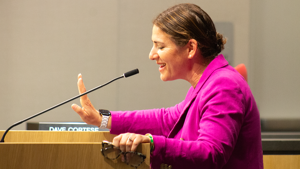
“Frankly, this is our lives every day when we show up to worship in our synagogue,” Bauer-Kahan, who is Jewish, testified before the Senate Public Safety Committee on Tuesday morning. “We have seen here in California that people who are entering their synagogues or mosques, churches and other places of worship, as they enter, they are surrounded. They are yelled at.”
Existing law makes it a crime to intentionally damage religious property, intimidate or threaten those trying to practice their religion and interrupt religious services. But those who advocated for the bill on Tuesday said current laws fail to define acceptable distances between demonstrators and worshippers.
“Assembly Bill 2664 has one simple goal: to ensure that people of all faiths have the freedom to worship without fear,” Robert Trestan, vice president of the Anti-Defamation League’s West Division, testified in support of the bill. “This bill does not ban peaceful political expression and protest. But rather, it is intended to ensure that worshippers can safely exercise their right to pray, while protecting the freedom of speech and assemble.”
However, opponents of the bill testified on Tuesday that public ways and sidewalks, where protesters often gather when assembling outside a place of worship, are protected places by the U.S. Supreme Court. The bill would undermine that legal precedent if it passes, Aubrey Rodriguez, a legislative advocate for ACLU California, testified at the meeting.
“If there is a record of people being harassed or assaulted near their place of worship, the government would need to show that it has attempted to enforce criminal statutes without success,” Rodriguez testified. “This seems to be an issue of enforcement and does not justify violating rights safeguarded by the First Amendment.”
According to previous reporting by The Center Square, such protests have taken place outside places of religious worship in the Golden State. A lawsuit filed in U.S. District Court Southern District of California in November 2025 alleged that protesters thought to be with a feminist organization called Code Pink harassed and intimidated Christian worshippers at The Mission Church in California.
First Liberty Institute, a law firm that represented the church in that case, did not respond to The Center Square’s request for comment before publication time Tuesday.
California Gov. Gavin Newsom ordered churches and other religious facilities to close during the height of the COVID-19 pandemic, earning a reprimand from the U.S. Supreme Court, according to previous reporting by The Center Square. Representatives from Newsom’s office did not respond to The Center Square before publication time on Tuesday.



Mostly Sunny
Latest News Stories
Major tech company to cut H-1B visas amid Trump pressure, fee
US, India to hold new round of trade talks, with focus on energy
Johnson: Republicans ‘have plans’ to ‘fix’ Obamacare
Illinois House Speaker: ‘Mr. Trump, tear down this fence!’
MIT rejects White House education demands
Energy cost concerns loom as legislators look at policy changes

WATCH: Trump touts ‘historic’ ‘Peace Summit’ as world leaders convene in Egypt
PJM exit: A price solution or power move?

U.S. consumers to pay 55% of tariff costs, Goldman Sachs says
JPMorganChase to invest $10B in U.S. firms key to national security
Broadview, Illinois reduces ICE protest zone after ‘chaos,’ 15 arrests
Louisiana: Voting Rights Act ‘balkanizes’ competing racial factions