
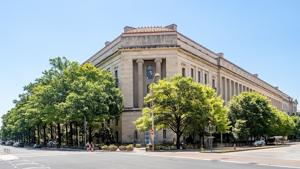
Feds seek to join case to halt Evanston black ‘reparations’ payments
The Justice Department is jumping into court against the city of Evanston, lending the heft of the federal government to a lawsuit challenging the city’s programs to pay out millions of dollars to Black current and former Evanston residents and their descendants through a race-based “reparations” program.
On June 16, the Justice Department filed a motion in Chicago federal court, asking for permission to intervene in the case. The filing was submitted by Chicago U.S. Attorney Andrew Boutros, together with Assistant U.S. Attorney General Harmeet K. Dhillon, who heads the Justice Department’s Civil Rights Division, and others from that division.
“The Supreme Court has repeatedly affirmed that government actions classifying citizens by race are presumptively unconstitutional,” said Boutros in a statement announcing the court action.
“The Constitution demands that the government treat citizens as individuals, not as members of a racial class. Distributing public funds based on an individual’s ancestry or race divides the citizenry and establishes the very hierarchy the Equal Protection Clause was designed to dismantle.”
The filing comes less than three months since a Chicago federal judge rejected the attempt by the city of Evanston to pull the plug on the lawsuit challenging the reparations program.
The original lawsuit was filed in May 2024 by a group of white former Evanston residents and their descendants. They are represented in the case by attorneys with the Washington, D.C.-based conservative public policy advocacy organization, Judicial Watch.
The lawsuit specifically took aim at a policy established by the north suburban city in 2021, allegedly to make up for decades of alleged race-based housing decisions and other alleged racist mistreatment at the hands of city officials.
Known as the Evanston Local Reparations Restorative Housing Program, the city originally stated it would dedicate $10 million to pay up $25,000 to Black current and former Evanston residents and their families for down payments on home purchases or to put towards repairs and renovations to existing homes.
City officials at the time said the program was intended to help Black and African-American residents purchase and maintain homes in Evanston and build “intergenerational wealth” and “equity.”
The city committed an additional $10 million to the program in 2022, and in 2023 revised the rules to allow for direct cash payments to Black Evanston residents and their descendants, and potentially others who assert they have suffered discrimination in Evanston.
At the time the lawsuit was filed, the city had approved payments of $25,000 each to 141 people identified as “ancestors,” meaning they are black, live in Evanston and were at least 18 years old during the period from 1919 to 1969. In all, the city had spent more than $6.3 million, as of the date the lawsuit was filed.
According to published reports, Evanston has steadily approved payments through the program to 40-45 current and former residents since 2021. More than 250 people have been awarded grants through the program since its inception, reports have said.
The lawsuit, however, said the program amounts to blatant and unconstitutional racial discrimination by the city government.
The lawsuit specifically accuses the city government of violating the constitutional rights of non-Black Evanston residents to equal protection under the law, as guaranteed by the U.S. Constitution’s 14th Amendment.
The lawsuit further noted the city has not taken any steps to actually compel potential recipients of the “reparations” grants to show they, their parents or grandparents actually suffered discrimination because of actions taken by the city government. Instead, the lawsuit said, the city is merely paying money to anyone who is black and whose family lived in the city from 1919-1969. The lawsuit says such a program, which uses race as a “proxy” to stand in for actual discrimination claims, is unconstitutional.
U.S. District Judge John F. Kness allowed the lawsuit to continue in a ruling in March 2026, rejecting Evanston’s attempt to argue the white plaintiffs couldn’t sue because they never actually attempted to apply for a cut of the money designated only for black recipients.
Now, the Justice Department said it is seeking to intervene in the case to force Evanston to abandon the program.
In their proposed complaint, the Justice Department seeks to join the plaintiffs in arguing the city’s “reparations” program is illegal and unconstitutional. Like the plaintiffs, the Justice Department seeks to argue the program illegally allows the city to simply give money to current and former Evanston residents who were Black, whether or not they can actually prove they or their ancestors were ever harmed by anything the city of Evanston did to them because they were black.
The Justice Department said the city’s own written justifications for the program make that plain.
“The initial resolution creating the City’s program makes clear the City’s purpose is to increase, in general, the quality of housing, the homeownership rate, and the intergenerational equity of ‘Black/African American Evanston residents,’ regardless of their individual experiences in Evanston or that of their ancestors,” the Justice Department wrote in its proposed complaint in intervention.
“Evanston has chosen to distribute substantial benefits to persons solely because of their race or the race of their ancestors. It has not taken any steps to tailor those benefits to the harms those persons may have suffered,” the Justice Department wrote. “Through its actions, Evanston has violated the Equal Protection Clause and the Fair Housing Act.”
And the Justice Department asserts the city has refused to cooperate with an investigation the federal government launched into Evanston’s program this spring.
In a statement, Dhillon said: “Under the pretext of paying reparations for events more than 100 years ago, the City of Evanston has chosen to distribute millions of dollars in cash and housing benefits to people because of the color of their skin or the color of the skin of their parents, grandparents, or great grandparents.
“There are sound ways for a city to remedy past discrimination or direct resources to its most vulnerable citizens and neighborhoods. Simply handing out money based on race, however, is not the answer. It is race discrimination, pure and simple. And it is illegal.”
According to published reports, Evanston Mayor Daniel Biss has pledged to continue to defend the city’s program in court against the federal interventions. According to a post on the social media platform X by reporter Matthew Eadie, of Evanston Now, Biss reportedly said: “We stand behind our first-in-the-nation reparations program, are confident in its constitutionality, and look forward to defending it in court.”






Showers And Thunderstorms
Latest News Stories

Illinois Quick Hits: Vacant lots go on sale in Chicago
State vs. local property tax debate rages in Illinois
Illinois Quick Hits: County study reflects massive property tax hikes
Fewer businesses of Illinois’ diversity-preferred group got state contracts last year

Casey-Westfield Uses Five-Run Fifth Inning to Defeat Cumberland 7-3
Casey-Westfield Takes Advantage of Late Errors to Defeat Cumberland 7-3

Casey-Westfield Capitalizes on Miscues to Defeat Oblong/Hutsonville/Palestine 7-3

Meeting Summary and Briefs: Martinsville C.U.S.D. #C-3 Board of Education for February 23, 2026

Some blame taxes as Illinois grows on paper but loses residents
Illinois quick hits: Cannabis company sued for alleged sexual harassment; Reparations class action suit to proceed; Disaster declaration approved for August 2025 storms
Clark County Approves Highway Engineering Agreements, Discusses Infrastructure Upgrades
Helm’s Two-Way Masterpiece Leads Champaign Central Past Casey-Westfield 3-0
