
Supreme Court allows drug users to keep guns
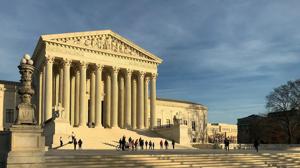
The U.S. Supreme Court, in a unanimous decision on Thursday, agreed that a regular drug user cannot be stripped of the right to possess a firearm.
The case, Hemani v. U.S., focuses on Texas man Ali Hemani, who was prosecuted by federal authorities after the FBI found marijuana, cocaine and a pistol in his home. Under federal law, an “unlawful drug user” can be stripped of their right to possess a firearm.
Justices on the high court said the government cannot prosecute people who are unlawful drug users. Lawyers for the federal government said laws against habitual drug users are similar to founding-era laws against habitual drunkards.
Justices on the court did not agree. Justice Neil Gorsuch pointed to marijuana’s varying legal status in states across the country.
“The Department of Justice has directed federal prosecutors to curtail enforcement efforts against marijuana users, most States have legalized marijuana use to some degree, and the government recently moved some marijuana products from Schedule I to Schedule III,” Gorsuch wrote in the court’s majority opinion.
While the court sided with Hemani, Gorsuch explained the decision is still narrow. He said the court’s opinion does not address people who are currently intoxicated on illegal substances and possessing a firearm as long as prosecutors can prove that person is dangerous.
“The government could bring a prosecution under §922(g)(3) accompanied by individualized proof that the defendant’s drug use renders him a danger to himself or others, or proof that a certain drug always renders its users dangerous,” Gorsuch wrote.
Amy Swearer, senior legal fellow at Advancing American Freedom and a Second Amendment legal expert, said the decision aligns with the U.S. Constitution.
“The Court’s decision today affirms one of the most basic tenets of the Second Amendment – the government may only disarm people whom it can prove are violent and unusually dangerous, based on individualized proof presented in legal proceedings,” Swearer said in a statement provided to The Center Square. “It cannot just broadly designate entire groups of people as dangerous and disqualify them from their right to keep and bear arms. Gun control activists will inevitably claim that the sky is falling. It isn’t. This federal statute is almost never the sole avenue the federal government has to disarm a truly dangerous person. Even in this case, it could have prosecuted Hemani for illegal possession of controlled substances. And the opinion today still leaves ample room for the government to disarm addicts or prosecute those who possess arms while actively intoxicated.”
Justice Samuel Alito agreed in the court’s judgement, but maintained that federal law should still restrict mentally ill people and felons from possessing a firearm. Justice Elena Kagan joined Alito’s opinion.
“Nothing in the opinion of the Court should be read to cast doubt on the constitutionality of other provisions of §922(g), such as §§922(g)(1) and (4), the ‘prohibitions on the possession of firearms by felons and the mentally ill,'” Alito wrote.
The high court agreed with a lower court, finding Hemani can keep possession of firearms despite being found with drugs. The ruling case could extend to many other people with unlawful drug use convictions across the country.




Mostly Sunny
Latest News Stories
U.S. House vote on spy powers extension delayed due to bipartisan pushback

Auditors praise Trump anti-fraud healthcare proposal

WATCH: Gun owners rally at Illinois Statehouse against more gun regulations

GOP seeks probe of $180B in fraud with taxpayers’ money

Bill advances to prevent local governments from clearing homeless camps
Bonta’s anti-Exxon emails may have run afoul of CA corruption law: Claim

Expulsion votes for two members of Congress could happen next week, Luna says

NAACP sues xAI over air pollution near Memphis data center
Trump says he’s ready to nominate up to three Supreme Court justices
Military hostilities in Iran continue after Senate tanks War Powers Resolution
WATCH: Detransitioner battles to revive landmark malpractice and fraud lawsuit

Iran economic fallout is temporary, Hassett says