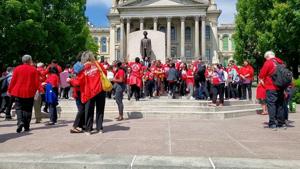
Wisconsin Supreme Court rules against race-based scholarships
A Wisconsin college grant program that sent financial aid to students based on specific race, national origin and ancestry cannot legally operate because it violates the Equal Protection Clause of the 14th Amendment, the Wisconsin Supreme Court ruled Thursday.
The ruling came after a Wisconsin Court of Appeals ruling that attaining diversity in higher education is no longer a compelling interest that allowed for an exception to the Equal Protection Clause. The case was filed by filed by six taxpayers against the Wisconsin Higher Educational Aids Board and Executive Secretary Connie Hutchinson, who was in charge of administering the grants.
The grans program began in 1985 for students attending private and technical colleges in the state who were a minority undergraduate who was a “Black American,” “American Indian,” “Hispanic” or a former citizen of Laos, Vietnam or Cambodia who entered the country in 1976 or later.
Justice Jill Karofsky concurred with the opinion of the court but wrote separately in her opinion, joined by Susan Crawford, on the benefits of the scholarship program.
“Despite this documented success, the grant program’s explicit reliance on race is fatal to its constitutionality for the reasons explained in Justice Dallet’s concurring opinion,” Karofsky wrote. “A suggested alternative means of maintaining a grant program to improve retention would be to target individuals who are economically disadvantaged, since there is also a statistical correlation between economic disadvantage and low retention rates.
“While this alternative aligns with the Supreme Court’s ruling in SFFA, it falls short because it does not acknowledge the racial inequality underlying the problem.”



Mostly Sunny
Latest News Stories

SNAP eligibility changes spark debate on gap for impacted recipients

Trump puts spotlight on China, Iran’s top oil consumer
Lawmakers, auditors offer fraud prevention solutions

Illinois unions seek to kill Waymo-friendly bill in Springfield
Rich States Poor States: Tax policy largely determines states’ economic competitiveness
78 pro-life orgs ask DOJ to stop undermining state laws by favoring aborting drug industry

Illinois Quick Hits: Two of ComEd four released; new trial expected

Casey-Westfield Launches Seven Home Runs in 18-4 Rout of Tri-County
Meeting Summary and Briefs: Casey City Council for April 6, 2026

Chicago suit vs oil cos. may yet survive SCOTUS ruling, judge hints

Two of ComEd Four released. new trial pending
GOP candidate Bailey urges Trump to apologize to pope; bishop calls for dialogue