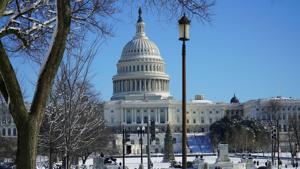
Senate pledges economic support for Russia-Ukraine deal as govt funding talks stall
As Republicans and Democrats remain deadlocked over how to fund the government for fiscal 2026 and prevent a shutdown, Senate leaders remain united on one front: Providing funding for Ukraine.
As President Donald Trump met with European leaders Monday – including Ukrainian President Volodymyr Zelenskyy – Senate Majority Leader John Thune, R-S.D., pledged his chamber’s willingness to provide economic assistance for Russia-Ukraine negotiations.
“President Trump should be commended for his dogged determination to bring peace to Ukraine and for his courage to engage with all parties in a way his predecessor refused to do,” Thune posted on X. “As peace talks continue today in Washington, the U.S. Senate stands ready to provide President Trump any economic leverage needed to keep Russia at the table to negotiate a just and lasting peace in Ukraine.”
While including a less flattering description of the president, Senate Minority Leader Chuck Schumer, D-N.Y., indicated his support for the beleaguered country as well, calling Russian President Vladimir Putin an “authoritarian thug” and urging Trump to “[stand] with Ukraine and our allies.”
Since Russia invaded Ukraine on Feb. 24, 2022, Congress has passed five major bills that cumulatively allocated over $128 billion to the Ukrainian government, including roughly $70 billion in military support. While no U.S. lawmaker has openly sided with Russia, some fiscal conservatives have objected to the high amount.
Thune’s offer to provide “economic leverage” comes as Congress nears the Sept. 30 government funding deadline without a clear bipartisan strategy in place. If lawmakers do not pass all 12 annual appropriations bills providing money for federal agencies through both chambers of Congress, they risk a government shutdown.
So far, only two of those bills have passed the House, while a three-bill minibus is the only 2026 appropriations legislation that has passed the Senate. Any appropriations bills passed in one chamber must be approved by the other chamber.
Even though Republicans control both chambers, they need Democrats’ help to finish the process when lawmakers return from their August recess in September. But Schumer has threatened to force a government shutdown unless Republicans “work across the aisle with Democrats to responsibly fund the government,” meaning that they must refuse to include any of Trump’s proposed budget cuts.
Given that lawmakers will only have a few weeks to synchronize and pass the rest of the fiscal year 2026 government funding bills, they most likely will pass a short-term Continuing Resolution.
A CR would keep government funding on cruise control until all appropriations bills are finalized. If the minibus (or other appropriations bills) pass both chambers by the Sept. 30 deadline, the CR would apply to the remaining federal agencies.
If lawmakers opt for the stopgap, Congress will have punted on funding the government properly for the fourth time in a row. Lawmakers never passed a fiscal year 2025 budget, instead passing three consecutive CRs to keep government funding on cruise control until Sept. 30.






Areas Of Smoke
Latest News Stories

Advocate calls for stronger IDOC oversight after payroll fraud guilty plea

Illinois Quick Hits: FAFSA applications rise with increase in state taxpayer funding

Casey Seeks $250,000 State Grant to Demolish Old VFW Building

Appeals court: Chicago’s ‘climate disinformation’ case belongs in Cook County

WATCH: Polish leader discusses Ukraine, Russia at Reagan Library

Firefighters from 30 states battle wildfires in Colorado

Democrats wary over DNI nominee’s stances on election security
GOP, Dems compete in Arizona congressional races

Abbott directs state investigation into ICE Houston shooting

Industry leaders: Feds can more effectively combat fraud, but privacy rights at risk

Union sues to stop $110B Paramount-Warner Bros. merger

Bipartisan bill would force vote before Social Security cuts hit