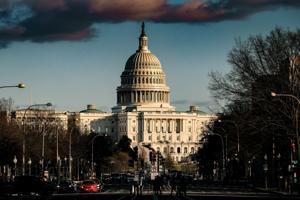
Report: Congress authorized $15 trillion in ’emergency’ deficit spending since 1991
Over the past 35 years, Congress has used emergency funding rules to bypass budget controls and spend a cumulative $15 trillion, a new analysis reveals.
That sum, financed almost entirely through deficit spending, roughly equals the money spent on Medicaid and veterans programs combined from 1991 to 2025.
“What happens when there’s an emergency, because there’s so little oversight of this process, everyone will get their little piece of the pie, and [lawmakers] will add things that don’t need emergency funding,” Dominick Lett, a Cato Institute budget policy analyst and author of the report, told The Center Square. “That leads to waste and further weakens the U.S.”
On paper, there are measures in place meant to prevent Congress from overspending. Federal budget rules like PAYGO require that Congress offset increases in mandatory spending – that is, automatically renewed spending on mandated programs like Social Security – by deficit reduction measures.
Other laws, such as the Fiscal Responsibility Act of 2023, placed caps on discretionary spending, which is renewed annually and funds government programs.
But these controls contain exemptions for emergency spending. And though the Budget Control Act of 2011 mandates that emergency spending provisions must be “necessary, sudden, urgent, unforeseen, and not permanent,” the lack of standardized evaluations means lawmakers can classify nearly anything as “emergency” spending.
As a result, Congress has used this loophole to authorize $12.5 trillion in outlays since 1991, incurring $2.5 trillion in additional interest costs, when adjusted for inflation.
During the COVID-19 pandemic, Congress authorized hundreds of millions in non-emergency spending through emergency funding bills, Lett found. Examples include $70 million for tourism marketing campaigns in Puerto Rico, $12 million to renovate a New York baseball stadium, and $6.6 million for irrigation systems at two Colorado golf courses.
“This isn’t a question of whether or not we should be spending money on that or not,” Lett said. “It’s just that [lawmakers] use the process to get around budget rules, and that obviously adds to the debt.”
The national debt topped $37 trillion earlier this year, with the U.S. government racking up a $1.8 trillion deficit in fiscal year 2024 alone.
Some Republicans want to reduce deficit spending – particularly through health care entitlement program reform – using the annual appropriations process. Other Republicans are wary of voting for more spending cuts in any future legislation, and Democrats have vehemently opposed any funding plan that omits boosts to health care funding.
Lett, however, said there are plenty of ways Republicans can control deficit spending, which he includes in his report.
“There is an enormous amount of spending for a variety of programs that Americans have never even heard of,” Lett told The Center Square. “So I think there’s lots of opportunities for Republicans to cut spending further, without committing political suicide. Whether or not that will happen, I think, is a different matter.”





Partly Sunny
Latest News Stories

Meeting Summary and Briefs: City of Casey City Council for March 16, 2026

U.S.-Israel-Iranian conflict escalating global energy, supply chain crisis

Casey-Westfield Completes Wild Walk-Off Comeback to Edge Teutopolis 16-15

Trump endorses Hilton in California gubernatorial primary

Feds award $1M for Rose Bowl upgrade ahead of Olympics

Trump defends Section 122 in latest tariff legal challenge

Education department rescinds Title IX resolution agreements
Illinois gun owners plan rally in wake of Supreme Court order

Artemis II mission breaks records Monday as astronauts observe far side of the moon
Illinois quick hits: Illinois House speaker’s son to attend private school; AFSCME workers set strike date at Illinois State University; IDOT urges public to avoid distracted driving

Federal-state showdown looms over regulation of prediction markets
No-knock warrant legislation brings Chicago victim, Illinois gun group together