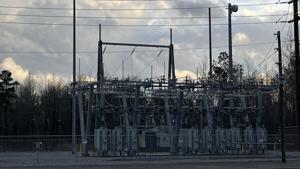
Louisiana joins four states in complaint against electricity grid operator
(The Center Square) – Louisiana and four other state public service commissions have filed a formal complaint against the Midcontinent Independent System Operator, accusing the grid operator of reliance on “patently unreasonable” assumptions to justify $22 billion worth of transmission projects in its long-range planning portfolio.
The grid operator functions to coordinate the reliable transmission of electricity across multiple states by managing power flows.
In a filing with the Federal Energy Regulatory Commission, the Louisiana Public Service Commission joined commissions from Arkansas, Mississippi, North Dakota and Montana in an accusation of a defective business case for the nonprofit’s Long Range Transmission projects known as Tranche 2.1.
Tranche 2.1, which only includes grid upgrades in the Midwest, will construct “a 3,631-mile 765 kV and 345 kV backbone that ensures future reliability while providing benefits that exceed costs,” according to the grid operator.
“The Louisiana Public Service Commission joined the complaint for two major reasons,” a spokesman for the commission wrote to The Center Square in an email. “First, MISO’s LRTP 2.1 process is flawed due to the unreasonable underlying assumptions relied upon to justify those projects as Multi Value Projects, which results in a broad allocation of costs. In addition, our concern is that, although currently there is no allocation of these costs to Louisiana, due to FERC precedent established in the Sunflower case, Louisiana is not guaranteed insulation from an allocation of those costs into the future.”
“These projects fail to meet the fundamental requirement of providing benefits equal to or in excess of forecasted costs,” the complaint says.
The complaint says the grid operator overstated economic benefits to push the portfolio’s benefit-to-cost ratio above the 1.0 threshold that is required.
The complaint asserts that the grid operator added new benefit metrics and revised others after its original modeling failed to show benefits exceeding costs. Stakeholders, including Midcontinent’s Independent Market Monitor, reportedly raised concerns about these assumptions throughout the stakeholder process, but the complaint says those were “ignored.”
“When the market monitor identified major defects with MISO’s assumptions, rather than address those concerns, MISO ordered staff to challenge the IMM’s authority,” the complaint states.
Potomac Economics, the market monitor, says the plan likely looks better on paper than in reality.
Potomac said Midcontinent made a couple of assumptions that don’t hold water, such as counting extra power plants that wouldn’t actually be needed and exaggerating the risk of blackouts, among others. Fixing those mistakes, the complaint argues, would show the plan’s costs outweigh its benefits.
Midcontinent, operating across parts of 15 states and the Canadian province of Manitoba, pushed back strongly against the allegations. The grid operator said the “deficient and misleading” complaint threatens to undermine needed infrastructure and inject regulatory uncertainty into future generation and transmission planning.
Jeremiah Doner, representing the grid operator, rejected the claim that Tranche 2.1 forces states to pay for unneeded projects, saying the plan was built in collaboration with state regulators and utilities and reflects their resource plans.
Doner said in his testimony that 93% of the generation in its “1A” planned infrastructure upgrades and more than half in “2A” came directly from member-submitted plans, with the rest added by the operator’s model to meet system needs.
“While the LRTP Tranche 2.1 Portfolio is estimated to cost MISO members about $5 per 1 MWh or 1,000 kWh of energy used, that investment will 12 provide $10 to $18 of value over that same amount of usage,” Midcontinent Independent System Operator said.
The long term planning effort is being rolled out in multiple tranches, with the first three focused on the Midwest region. Later tranches will address the South region and interconnections between the Midwest and South, where the nonprofit says transmission capacity is increasingly strained by a surge in renewable projects seeking interconnection.
The company’s South region includes Louisiana, Texas, Mississippi and Arkansas. The Central includes Illinois, Missouri, Kentucky, Indiana, Michigan and Wisconsin. The North includes Iowa, Minnesota, South Dakota, North Dakota, Montana and the Canadian province of Manitoba.





Isolated Rain Showers
Latest News Stories

Documentary shows cost of personal injury lawsuit abuse

Illinois congresswoman files impeachment articles against Noem

Military removing some personnel from bases in Middle East
Cost estimates vary, even as Denmark says Greenland is not for sale

U.S. Supreme Court allows IL rep to sue over late ballots

50 Years of Richards Farm Restaurant Celebrated

IL advocates warn permanent mail-in ballots could be exploited

Illinois Quick Hits: State spends $87M on ISU fine arts project

WATCH: Legislator warns tax dollars used to impede ICE; Pritzker and Trump talk crime

Trump visits Michigan to promote economic ‘turnaround’

Meeting Summary and Briefs: City of Casey Council for Jan. 5, 2026

Music, drama teacher sues Catholic HS over ‘anti-gay’ discrimination