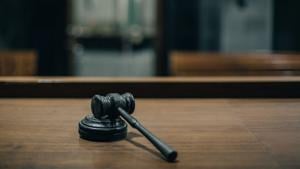
Maryland Supreme Court appears skeptical of climate change lawsuit
Maryland Supreme Court justices seemed skeptical during oral arguments Monday in a lawsuit filed by three local governments against oil and gas companies over alleged climate change impacts.
The court considered three separate cases from the Baltimore, Annapolis and Anne Arundel counties against fossil fuel companies, including the British oil and gas company BP. The cases claim fossil fuel companies concealed information about their products’ contributions to climate change.
Lower courts previously dismissed the lawsuits and the three cities appealed to the state Supreme Court.
Victor Sher, an attorney representing the city and county plaintiffs, said oil and gas companies must provide warnings on their products that are commensurate with the risk posed. In this case, the posed risk is the effects of rising global temperatures and climate change.
“Beginning at least as early as the 1960s, [BP] intensively researched global warming and its causes, accurately foresaw the catastrophic effects of their products’ intended uses, and invested to protect their own assets and infrastructure against those dangers,” a filing to the Maryland Supreme Court reads.
“As a result, Appellants and their residents have suffered and will suffer severe harms from sea-level rise, flooding, extreme precipitation and storms, and extreme heat,” the filing said.
Justices on the state’s high court appeared skeptical of Sher’s arguments. Several justices pointed to the national and international effects of ruling in a case based on climate change.
Justice Steven Gould asked Sher to provide a specific example of warnings fossil fuel companies should issue on their products. Sher did not provide a specific example.
“It seems like your theory of injury and relief are all tied and necessary for relief on international emissions,” said Justice Brynja Booth.
Theodore Boutrous, who represented BP and other fossil fuel companies in the lawsuit, criticized the government’s claims. He said state and local governments do not have responsibility for regulating the emissions.
“They want the court to impose a duty to the world,” Boutrous said of the government’s injury claim and proposed relief. “Take Maryland law and project it into the United States and around the world.”
Boutrous said federal agencies like the Environmental Protection Agency are responsible for regulating emissions across the country, rather than state and local governments. He said the EPA has a process for scientists to give their views on proposed rule changes like warning labels.
He also argued legislation like the Clean Air Act supersedes state and local authorities because it mandates allowable emissions levels.
The Clean Air Act prohibits stationary sources that emit or have the potential to emit 10 tons per year or more of hazardous air pollutants, or 25 tons per year or more of a combination of different hazardous air pollutants.
Several other state and local governments, including Hawaii and Colorado, have also sued fossil fuel companies over the same issue.
Critics of such lawsuits have previously told The Center Square that Congress has had a comprehensive regulatory framework in place for decades and that the oil companies have fully complied. They argue that changes to that framework should come from Congress, not legislated via a coordinated effort to elicit judicial activism.
The Maryland Supreme Court will consider arguments over the next several weeks, when it is expected to make a decision across all three Maryland-based cases.





Chance Showers And Thunderstorms then Partly Cloudy
Latest News Stories

Muslims in Virginia, New York face decades in prison for supporting Houthis, ISIS

Indian reservation focus of human smuggling probe at U.S.-Canada border
‘Temporary Band-Aid’: USDA able to cover 50% of November SNAP benefits

WATCH: Family, friends remember Bailey family at celebration of life

Duffy: We are going to go after the CDL mills

WATCH: Amid criticism, Pritzker defends using expletive to tell Trump where to go

Election integrity advocates urge reform after Illinois scores low in global survey

WATCH: Pritzker’s rhetoric criticized; tax amnesty program; status of Guard lawsuit
Trump predicts ‘ruination’ if Supreme Court rules against his tariffs
Illinois quick hits: Pritzker uses expletive with teachers union; Paprocki reacts to assisted suicide bill
Congressional Perks: House account spending jumped 21% in 2022
Everyday Economics: Rate cut debate: Reading mixed signals in a fragile economy