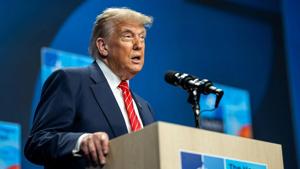
Trump to hit imported heavy trucks with 25% tariff starting Nov. 1
President Donald Trump cited national security, among other reasons, for hitting imported medium- and heavy-duty trucks with a 25% tariff starting on Nov. 1.
Mexico, the top exporter of trucks to the U.S., is looking for a way to avoid the latest import levies.
Trump plans to use authority under Section 232 of the Trade Expansion Act of 1962 to put the new tariffs in place. Last month, Trump said the tariffs would take effect on Oct. 1, but that has been pushed back a month amid a federal government shutdown.
In September, Trump said he wanted to protect American truck makers.
“Our Great Large Truck Company Manufacturers, such as Peterbilt, Kenworth, Freightliner, Mack Trucks, and others, will be protected from the onslaught of outside interruptions,” Trump wrote in a Truth Social post at the time. “We need our Truckers to be financially healthy and strong, for many reasons, but above all else, for National Security purposes!”
The U.S. Chamber of Commerce, which opposes the tariffs, noted back in May that most imported trucks come from U.S. allies and defense partners. The top five import sources, by customs value, are Mexico, Canada, Japan, Germany and Finland, “all of which are allies or close partners of the United States posing no threat to U.S. national security,” the Chamber noted in public comments before the Commerce Department’s Bureau of Industry and Security.
The U.S. trucking industry is dominated by small businesses, with 91.5% of carriers operating 10 or fewer trucks and 99.3% operating fewer than 100 power units, according to a report from the American Trucking Associations.
Larger operations might be able to absorb the added costs, but small ones could “forgo new purchases and keep trucks on the road longer, even as the vehicles start to deteriorate,” the Chamber said.
The business group said the added tariff costs could threaten U.S. security.
“At a time when the United States is heavily investing in infrastructure and seeking to expand mining capabilities to increase access to and processing of critical minerals, adding further to sourcing costs for these trucks and truck parts would hamper activity in an industry integral to U.S. national security,” the group wrote.
Mexico is the United States’ biggest supplier of such trucks. Mexican President Claudia Sheinbaum said Tuesday that she’ll seek to avoid the newly announced truck tariffs.
“We will seek an agreement before November 1,” she said during her morning conference.
Trump has said he wants to use tariffs to restore manufacturing jobs lost to lower-wage countries in decades past, shift the tax burden away from U.S. families, and pay down the national debt.
A tariff is a tax on imported goods that the importer pays, not the producer. The importer pays the cost of the duties directly to U.S. Customs and Border Protection, a federal agency.





Chance Showers And Thunderstorms
Latest News Stories

Expulsion votes for two members of Congress could happen next week, Luna says
NAACP sues xAI over air pollution near Memphis data center

Trump says he’s ready to nominate up to three Supreme Court justices
Military hostilities in Iran continue after Senate tanks War Powers Resolution

WATCH: Detransitioner battles to revive landmark malpractice and fraud lawsuit

Iran economic fallout is temporary, Hassett says

Illinois Quick Hits: NFIB says biz deduction will bring jobs, benefit to Illinois

Soaring costs and short supply shut millennials out of housing market

Vought testifies before lawmakers on Trump’s $2.1T budget request

SNAP eligibility changes spark debate on gap for impacted recipients

Trump puts spotlight on China, Iran’s top oil consumer
Lawmakers, auditors offer fraud prevention solutions