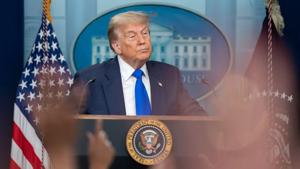
WATCH: White House says no decision yet on $2,000 tariff rebate checks
President Donald Trump and some GOP lawmakers have repeatedly floated the idea of sharing some of the government’s tariff revenue with taxpayers, but the White House said no checks are in the mail.
Trump said in an interview that he was considering sending Americans checks for between $1,000 and $2,000 from the tariff revenue.
“We’re going to do something, we’re looking at something. No. 1, we’re paying down debt. Because people have allowed the debt to go crazy,” the president told OAN. “We’ll pay back debt, but we also might make a distribution to the people, almost like a dividend to the people of America.”
The president said the $37 trillion national debt is “very little, relatively speaking” because the government is raking in tariff revenue.
Trump has said the tariffs will generate trillions in federal revenue, although other estimates are much lower.
In August, Treasury Secretary Scott Bessent said federal debt is the top priority.
“We’re going to bring down the deficit to GDP,” he said in a TV interview. “We’ll start paying down the debt, and then at that point that can be used as an offset to the American people.”
Bessent has estimated the tariffs will generate about $300 billion a year.
White House press secretary Karoline Leavitt said Trump hasn’t decided yet.
“I think it’s an idea that the president has discussed and floated with his advisers, but no decision has been firmly made at this point in time,” Leavitt told reporters on Monday.
The Congressional Budget Office estimated that Trump’s tariffs could bring in $4 trillion over the next decade, but would raise consumer prices and reduce the purchasing power of U.S. families.
U.S. Sen. Josh Hawley, R-Mo., introduced the American Worker Rebate Act, legislation that would send rebate checks to working Americans of at least $600 per adult and dependent child (or about $2,400 for a family of four).
That bill remains stalled in the Senate.
Earlier in his administration, Trump and former adviser Elon Musk floated the idea of returning money to taxpayers through the Department of Government Efficiency. Musk’s DOGE initially expected to find $2 trillion in savings by cutting waste fraud and abuse. However, Musk has since left the White House and DOGE was on track to save about $150 billion as of an April cabinet meeting.
Trump has made tariffs the centerpiece of his economic agenda during the first six months of his second term.
According to an analysis of federal data from the Penn Wharton Budget Model, the president’s new tariffs raised $80.3 billion in revenue between January 2025 and July 2025 before accounting for income and payroll tax offsets.
Trump has said he wants to use tariffs to restore manufacturing jobs lost to lower-wage countries in decades past, shift the tax burden away from U.S. families, and pay down the national debt.
A tariff is a tax on imported goods that the importer pays, not the producer. The importer pays the cost of the duties directly to U.S. Customs and Border Protection, a federal agency.
In the past 50 years, the federal government has ended with a fiscal year-end budget surplus four times, most recently in 2001. Congress has run a deficit every year since then.
According to the U.S. Department of Treasury, U.S. debt stands at $37.8 trillion.






Sunny
Latest News Stories

Court showdown over Trump’s tariffs could reshape U.S. trade policy

PSA urges consumers to think ‘Before You Call That Lawyer’

Vance to lead talks in Iran on Saturday

Rep questions state ed board’s higher budget request, proficiency standards

Illinois reps move bill to give remedy to young victims of hidden cameras
Illinois Quick Hits: Chicago Election Board says 94% of ballots casts were for Dems

Casey-Westfield Pitching Shines in 7-0 Shutout Over Cowden-Herrick/Beecher City

Goble’s Gem and 16-Hit Attack Propel Casey-Westfield Past Salt Fork 10-1

Chicago office vacancy rates worsen, card swipe numbers offer hope

Illinois Quick Hits: Illiois gas prices keep rising
IL Supreme Court says it can remove Cook Co. judge for pro-Trump column

FBI: Illinois’ cyber crime losses reached $535M in 2025