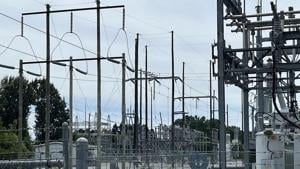
PJM exit: A price solution or power move?
(The Center Square) – Surging electricity demand, an aging grid, and generation sources retiring faster than new ones can be built have become some of the nation’s most pressing challenges.
Although experts agree the solutions are complex, states, frustrated at the lack of progress, are uniting to demand change.
Except, their threats to leave the nation’s oldest power pool, PJM Interconnection, may just prove less effective than it seems, according to some.
Leading the exit strategy is Pennsylvania’s Gov. Josh Shapriro, who has long been critical of PJM, which manages the country’s largest power grid that serves 67 million people across 13 states and the District of Columbia.
He recently spearheaded a summit in Philadelphia that brought together other state leaders and energy groups to discuss what they see as critical reforms, from managing large load customers like data centers and clearing the backlog of new generation projects in the interconnection queue, to tackling rising energy costs, and having more voice in PJM’s governance.
The issue grows more pressing every day: demand from residents living in the PJM territory could rise 72% between 2025 and 2040, nearly three-quarters of which would come from the proliferation of data centers across the region.
Between 2036 and 2040, this could translate into a 60% rise in utility costs for residents, according to a report from Synapse Energy Economics. The consulting firm primarily assists state and local governments in measuring the impact of energy policies and management.
Should PJM find a way to speed up the line for new projects, the majority of which are renewable and more cost-effective, Synapse said prices could drop 7% during the same time frame.
It’s an outcome Shapiro and others want to achieve. Following the summit, 11 of the 13 governors in the region signed on to a letter announcing their intent to create a PJM Governors Collaborative – a bipartisan forum working to promote greater state and consumer representation in PJM’s decision-making processes.
The governors of Delaware, Illinois, Indiana, Maryland, Michigan, New Jersey, North Carolina, Ohio, Pennsylvania, Tennessee and Virginia added their signatures to the initiative. Kentucky and West Virginia have declined to do so.
“For nearly a century, Pennsylvanians have trusted PJM to keep the lights on,” said Shapiro. “But PJM has been too slow to bring new generation online and too quick to saddle families with higher bills. It’s not working anymore – and it’s time to get serious about reform.”
Pennsylvania and PJM partner states, he continued, are prepared to chart a new course if the grid operator doesn’t move fast enough to serve the interests of the hard-working families we represent.
And that change better come “in months, not years,” Shapiro told a group of reporters during the Philadelphia summit. The goal is to lower utility bills for residents and usher in a broader energy mix for the region, rather than a continued reliance on fossil fuels.
Such a move isn’t all that simple and may not actually help at all, said Todd Snitchler, CEO of the Electric Power Supply Association. In an interview with The Center Square, the former Public Utilities of Ohio commissioner agreed that states can and should find a way to sharpen their role in grid decisions.
That’s why the Organization of PJM States, comprised of appointed members of state utility commissions, should handle the issue.
The concern, however, is secondary to the more pressing question: how can Pennsylvania untangle itself from the power grid, where roughly one-quarter of the region’s energy is produced?
“I’m not sure how they do this without disturbing the proverbial apple cart,” Snitchler told The Center Square. “It’s not the quick recipe for price reduction as some would believe.”
He pointed to what’s known as the Fixed Resource Requirement, which gives utility companies the ability to procure their own supply and set their own prices with customers, rather than participating in a capacity auction that can result in more unpredictable costs.
The option, however, hasn’t borne out cost savings for residents in states that choose the route, which include Indiana, Kentucky, Michigan, Virginia and West Virginia. Analysis from the R Street Institute, a free-market policy group, concludes that the lack of competition keeps prices higher in those states, primarily due to a lack of competition and higher operational costs.
“If the ultimate goal is to lower prices for consumers … all of those things have costs associated with it, and those costs would have to be borne by the ratepayers,” Snitchler said.
Virginia’s Gov. Glenn Younkin said he signed on to the collaborative because the state “cannot afford a grid operator that is slow to adapt and blind to the realities of surging demand, and we won’t sit back and accept a system that puts bureaucratic process over results.”
“Together, we are demanding real reforms from PJM that put consumers first, accelerate new generation, and restore confidence in the future of our grid,” Youngkin said.
His message was echoed by energy leaders attending the summit.
Jon Gordon, policy director for Advanced Energy United, an organization representing a wide range of advanced energy technology and services, told The Center Square that the essence of the problem is PJM’s inability to bring supply on quickly.
A large part of the issue began in 2017 with the shift from large, centralized fossil fuel plants to more distributed and renewable generation, which to some extent, he said, requires almost as much work to evaluate.
Although PJM has made some improvements and things are moving a little more quickly, Gordon said, “they’re digging themselves out of that hole right now.” He noted that some projects have been stuck in the queue for five years.
Another precipitating factor leading to the summit and action by the governors is PJM’s rejection of recommendations for several empty board seats.
Gordon cited the New York ISO, Midwest ISO, and the Southwest Power Pool as examples where governors successfully have a say in who gets appointed to RTO and ISO boards.
“United has always encouraged state engagement at PJM and we support the governors’ stated objective ‘to promote greater state and consumer representation in the governance and decision-making processes of PJM Interconnection, in order to ensure the provision of affordable, safe, and reliable electricity for their residents and businesses,” said Gordon
He added that United welcomes increased state engagement and advocacy at PJM going forward.
PJM spokesperson Dan Lockwood told The Center Square in an email that they thank the governors for holding a thoughtful discussion on the challenges shaping their shared energy future.
“Meeting the demands of a rapidly changing energy landscape will require solutions that extend beyond any one institution. It will require PJM, the industry and especially our states all working in concert.” He added, “PJM will continue to fulfill its mandate of maintaining reliability in as cost-effective a manner as possible for the 67 million people we serve.”
Christen Smith contributed to this report.






Mostly Sunny
Latest News Stories

Marshall School Board Approves Major Changes to Football Seating and Junior High Track

Meeting Summary and Briefs: Casey City Council for Feb. 2, 2026

Council Votes to Reclaim Downtown Properties After Development Stalls
Meeting Summary and Briefs: Casey-Westfield Board of Education for Jan. 26, 2026

Casey-Westfield FCCLA Ranked No. 1 in Region for Service Hours

Senate Bill Secures $1 Million for Casey Sewer Improvements

EXCLUSIVE: 5 largest U.S. cities don’t have enough money to pay bills: report
INVESTIGATION: Wisconsin university closes DEI unit but keeps most staff working on equity issues

Board Approves Updated School Resource Officer Agreement

Casey Advances Housing Strategy with Land Bank Transfers and Inspection Contract

Chicago’s $41 billion financial hole exposes city’s pension crisis

Trump seeks $1B from Harvard in federal funding dispute