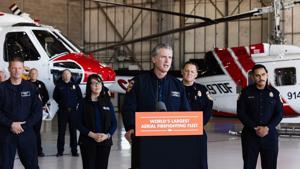
Investigation: California brush clearance stalling 9 months after January fires
California’s brush clearance efforts are stalling nine months after the devastating January fires that destroyed vast swathes of Los Angeles County, state data shows.
Only 0.2% of expedited acres of brush clearance reviewed by The Center Square are reported as complete, and overall brush clearance data for the most recent quarter shows a 22% year-over-year decline in completed projects.
Pacific Palisades resident Spencer Pratt, who lost his home in the Palisades Fire and has taken a leading role in policy discussions surrounding the community’s rebuilding, told The Center Square about his disappointment in the state’s brush clearance project.
“There has been an increasing trend of decreasing fuels mitigation in the state. The numbers are all fungible; they say ‘treated’ acres because they don’t want to admit how few [prescribed burn] acres they do,” Pratt said. “We just watched two cities burn down when ignitions hit the state responsibility area above Altadena, and in the state park surrounding the Palisades. The fire was then allowed to slam into our towns because they never got rid of any fuels … if they were really doing this work, and doing it in the areas with maximal impact, these cities would still be standing.”
In July, an investigation of state records by The Center Square found just one small brush clearance operation was conducted in the Pacific Palisades from 2023 through January 2025, leaving the community exposed to high risk of uncontrolled wildfire damage. The Palisades Fire, which burned 23,488 acres, destroyed 6,837 structures, and killed 12 people appears to have stopped along the border between coastal Pacific Palisades and slightly more inland Brentwood, where the pre-fire brush clearance operation was concentrated.
The Center Square reviewed 131 of the 140 expedited projects for which state data was available as of Oct. 9, totaling 30,159.5 acres of approved exemptions under a new regulatory exemption process created by Gov. Gavin Newsom’s March 1 executive order declaring a state emergency for wildfire risk. Under the proclamation, entities seeking to conduct fuels reductions projects can request exemptions from California Environmental Protection Agency and California Natural Resources Agency regulations, which can be approved at the discretion of the agencies’ secretaries. Data could not be found for the remaining nine.
Thirty-eight of those projects were in progress, totaling 14,786.24 acres, while seven projects, totaling 70.1 acres, were reported as complete. A separate state database showed 385 brush clearance projects were completed in the state across July, August and September 2025, compared to 494 completed projects in the same period the year prior.
CalFire, which hosts both databases, told The Center Square the first dataset was created by the California Natural Resources Agency and pulls together data from multiple sources, including CalFire, and only reflects data that has been sent in to the state.
“Fuel reduction projects undergo weeks or months of leg work before having an approved plan,” said CalFire spokesperson Ed Fletcher in a statement to The Center Square regarding project delays. Then the work can be delayed for an additional period waiting for a good weather window.
Of the 123 projects approved and past their proposed start date, only 36 projects were in progress.
When asked about the state’s brush clearance progress, Newsom’s office referred The Center Square’s inquiry to CNRA.
“California is working faster than ever to approve critical wildfire safety projects – streamlining projects across thousands of acres in communities particularly vulnerable to catastrophic wildfire,” CNRA spokesperson Daniel Villasenor told The Center Square. “Many projects are highly complex, involving state, local and federal partners, and require multiple stages to implement on the ground.”
Funding for fuel reduction from the state’s general fund has declined in recent years, falling to $210 million in the current 2025-2026 fiscal year budget from a peak of $988 million in fiscal year 2021-2022. However, additional funding through voter-approved Proposition 4 added an additional $1.5 billion in wildfire resilience funding, which CNRA says includes $596 million for the 2025-2026 fiscal year.
CalFire, the state agency responsible for protecting 31 million acres of land from wildfires, is also contracted by some counties to provide direct fire protection service. One such county is coastal San Luis Obispo, which had the highest concentration of approved brush clearance projects reviewed by The Center Square. The county has 4,234.63 acres of expedited projects of which 1,922.63 acres were in progress.
In an interview with The Center Square, CalFire forester for San Luis Obispo Dave Erickson said the new exemptions have allowed several brush clearance projects to move forward, and that fuels reduction projects have played a role in containing the region’s fires.
“San Luis Obispo had two of the largest fires this year in California, we had the Madre and Gifford Fire,” said Erickson. “One of our prescribed fire projects helped to stop a division of the Madre fire. We’re using that project as an example of how fuels reduction and forest health and ecological restoration projects can not only help suppress and slow the spread of wildfires, but also provide for restoration and ecological benefits.”
Erickson explained CalFire provides grants at the state level to nonprofits, cities, and other government agencies for wildfire prevention, planning, and forest health. Those are administered at the regional level by CalFire with grant recipients working independently of CalFire to complete their work.
In August 2020, Newsom’s office announced a new goal of reducing fire risk on 500,000 acres of non-federal land each year, which included a commitment from the federal government to treat an additional 500,000 acres per year on federal land in California.
CNRA data show that in calendar year 2023, the most recent year for which full data is available, more than one million acres of land was managed for wildfire risk, including over 415,000 acres of non-federal land. Of the 1.1 million acres in 2023, 234,729 acres of management were conducted by timber companies.
According to Ed Ring, California Policy Center Director of Energy and Water, the scale of the forest management backlog in California — which the state estimates is 15 million acres — means that state-funded efforts alone won’t be enough to reverse course.
“California’s total timber plus chaparral area is estimated at around 50 million acres. All of it has been subjected to aggressive fire suppression for several decades,” said Ring to The Center Square. “Consequently, all of it is overgrown and at risk of not the normal fires that used to occur routinely, but catastrophic fires that burn when areas that are overgrown because of fire suppression finally ignite.”
“From this perspective, even clearing 500,000 acres per year is futile. That would equate to 1 percent of all acreage per year, which is particularly insignificant in view of the fact that brush can regenerate in a few years,” said Ring. “In order to successfully manage wildfire risk in California’s overgrown forests and wildlands, you need a combination of logging, thinning, grazing and prescribed burns.
“Especially in the Santa Monica Mountains, you have to look back at history — there used to be herds of cattle and sheep and goats up there, and the grazing didn’t destroy the environment, but it thinned the foliage,” said Ring. “They also used to do controlled burns out there, and controlled burns don’t cost as much as mechanical thinning.”
Costly mechanical and hand fuels reduction represented the majority of CRNA’s 1.1 million treated acres in 2023, coming in at 565,100 acres, followed by 256,900 acres of prescribed burns, 109,500 acres of grazing, 79,700 acres of tree planting, and just 44,500 acres of timber harvest.
Researchers estimate approximately 1.8 million acres of California land burned every year before 1800. With the state 42.2 million hectares large, this means the entire state’s equivalent of land burned every 23 years. This suggests that forest management efforts in the state must expand significantly to keep up with the natural rate of change.




Isolated Rain Showers
Latest News Stories

Trump administration finds SNAP fraud

WATCH: Trump says tariffs may cost Americans ‘something’ but keep U.S. safe

Chicago mayor: IL legislature has ‘more work to do’ on tax increases
Chicago pension, debt services costs among highest in country
Casey City Council Takes Action on Blighted Properties, Rewards Redevelopment

WATCH: DCFS still looking for missing children numbers; Pritzker on elections results
Illinois quick hits: DHS ordered to address ICE facility conditions; Garcia explains retirement decision
Congressional Perks: Luxury cars and mileage result in big costs for taxpayers

Illinois quick hits: $20 million for Alton housing project; alleged migrant assaults reported
WATCH: Illinois DCFS can’t locate documents showing number of missing children

Warriors Advance to Sweet 16; Community Bonfire Planned for Friday

Casey-Westfield Cross Country Concludes Season at Mattoon Sectional