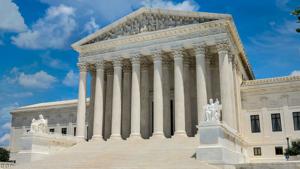
Supreme Court won’t let lawmaker intervene in tariff challenge
The U.S. Supreme Court denied a move from a Montana lawmaker seeking to intervene as the high court takes up a challenge to President Donald Trump’s tariff authority.
Montana state Sen. Susan Webber, rancher Jonathan St. Goddard, and Rhonda and David Mountain Chief asked the nation’s highest court to intervene in the case because Trump’s tariffs “directly burden cross-border commerce of these tribal plaintiffs, who operate small businesses and family ranches near the U.S.-Canada border.”
Trump’s team at the Justice Department said Webber shouldn’t be allowed to intervene at this point, suggesting that Webber file a friend-of-the-court brief in the case instead.
The Supreme Court did not explain its decision on the request to intervene: “The motion of Susan Webber, et al. for leave to intervene is denied.”
Webber’s attorney, Monica Tranel, had argued the group should be allowed to intervene in the case.
“This case presents unique and crucial issues that are distinct from those already before the court,” Tranel wrote in the motion. “These claims are not merely about the commercial legality of tariffs but are rooted in fundamental constitutional principles and a unique body of federal Indian law.”
Tranel and Webber didn’t immediately respond to questions from The Center Square about the Supreme Court’s decision on intervention.
Trump used a 1977 law that doesn’t mention tariffs to reorder global trade through tariffs to try to give U.S. businesses an advantage in the world market. Using tariffs under the International Emergency Economic Powers Act, Trump hit nearly every nation with import duties of at least 10%. Some countries face higher rates, up to 50%.
Two lower courts have already said the 1977 International Emergency Economic Powers Act doesn’t give the president unbounded tariff authority. In late August, the U.S. Court of Appeals for the Federal Circuit affirmed a previous lower court ruling, but said Trump’s tariffs could remain in place while the administration appeals to the U.S. Supreme Court. In the 7-4 decision, the majority said that tariff authority rests with Congress.
The Supreme Court set oral arguments for Nov. 5.
New tariffs raised $80.3 billion in revenue between January 2025 and July 2025 before accounting for income and payroll tax offsets, according to an analysis of federal data from the Penn Wharton Budget Model.
Trump has said he wants to use tariffs to restore manufacturing jobs lost to lower-wage countries in decades past, shift the tax burden away from U.S. families and pay down the national debt.
A tariff is a tax on imported goods paid by the person or company that imports the goods. The importer can absorb the cost of the tariffs or try to pass the cost on to consumers through higher prices.
Economists, businesses and some public companies have warned that tariffs could raise prices on a wide range of consumer products.




Sunny
Latest News Stories

Illinois pushes rate-hike protections forward despite consumer cost fears

Illinois bill aims to delay 2024 tax sales, protect homeowners’ equity

Illinois Quick Hits: Man on pretrial release charged with fireman’s murder

Casey-Westfield High School Students Secure Top Honors at Regional Academic Competitions

Comptroller, state lawmaker call for federal tax credit scholarships

Early Surge and Defensive Miscues Propel Casey-Westfield Past Centennial 11-1

Karras and Goble Lead the Way as Casey-Westfield Softball Downs Clifton Central 6-1
Power Surge and Goble’s Arm Lead Casey-Westfield Softball Past St. Anthony, 7-1

Marshall School Board Approves Adjusted 2025-26 Schedule, Sets 2026-27 Calendar
Gilbert’s Shutout and Seven-Run Fourth Inning Propel Casey-Westfield Past Centennial, 10-0

District to Purchase Discounted Floor Burnisher for Junior/Senior High School
Casey-Westfield Capitalizes on Oakwood Errors, Holds On for 6-3 Victory
Casey-Westfield Capitalizes on Free Bases in 14-1 Rout of ALAH

Board Grants Fire Department Building Access, Upholds Wednesday and Sunday Sports Restrictions