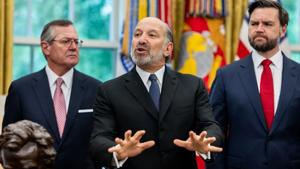
Electronics retailer asks Supreme Court to quell tariff chaos
A national electronics retailer asked the U.S. Supreme Court on Friday to quell the uncertainty around tariffs for businesses that must import products.
Crutchfield, a Virginia-based company, asked for relief in a candid plea to the nation’s highest court. The retailer, which started as a car stereo catalog in the 1970s, said it can’t plan ahead because it doesn’t know how much the products its sells will cost.
“If tariffs can be imposed, increased, decreased, suspended or altered, not through the deliberate legislative process in which both chambers of Congress must agree and the President must sign the legislation, but instead through the changing whim of a single person, then Crutchfield cannot plan for the short term, let alone the long run, because it cannot possibly predict what the household electronics it sells will cost,” attorney Peter Brann wrote in a friend-of-the-court brief on behalf of the company.
The company said it has no choice but to pay tariffs because finding a U.S. supplier isn’t an option. Crutchfield noted that some of the products it sells are only made in foreign countries, so it must import them for consumers it serves in America and Canada.
Crutchfield wrote the brief in support of the arguments of other groups that have filed a lawsuit challenging President Donald Trump’s tariff authority. A group of small businesses, some Democrat-led states, and two education firms have challenged the president’s tariff authority under the International Emergency Economic Powers Act of 1977.
Trump has used tariffs to reorder global trade to give U.S. businesses a home-field advantage. But his frequently changing tariffs have left businesses and consumers frustrated. Trump used the 1977 law – which doesn’t mention tariffs – to put import duties of at least 10% on every nation that does business with the U.S. Some nations, including many U.S. allies, face much higher tariff rates.
The tariff challenge is pending before the U.S. Supreme Court, which scheduled oral arguments for Nov. 5. Trump has said the case is so important that he may personally attend, a break from presidential precedent.
Crutchfield’s brief opened with a plain request on behalf of all retailers that must import products.
“First, before considering the merits, it is important to recognize that high and highly volatile tariffs, and not trade deficits, are the ‘unusual and extraordinary threat’ to American retailers that must import the products they sell,” Brann wrote. “Crutchfield wants to avoid the economic harm not only of the tariffs, but also of the chaos and uncertainty resulting from wild gyrations in the tariffs that make rational business planning impossible.”
Crutchfield imports about 60% of the products it sells.
“Before considering the legality of the recently imposed tariffs, it is important to recognize that both high tariffs and the frequent changes in the tariffs have real-world, devastating consequences on retailers like Crutchfield that have no alternative today to importing the electronics and other products they sell,” Brann wrote in a 25-page brief.
The company was also frustrated with how the tariffs have been implemented in the months since Trump’s “Liberation Day” on April 2, when he announced reciprocal tariffs on all U.S. trading partners.
“Pauses to announced tariffs of uncertain length and the threat of additional tariffs of unknown size likewise paralyzes Crutchfield’s ability to make intelligent business decisions. Although many of the highest announced tariffs are currently paused, they hang like the proverbial sword of Damocles over every retailer that imports any product, or component part, from anywhere in the world. Furthermore, Crutchfield cannot engage in sensible business planning if tariffs can be increased, decreased, suspended, or altered on a moment’s notice without any recourse (in the Government’s view) to challenge them,” Brann wrote.
The attorney further raised concerns about the holiday season before delving into the legal issues in the case. Customers and government regulators demand that the catalogs it sends out to consumers have accurate prices. But the problem isn’t just with the time it takes to print and send out catalogs.
“For its online products, Crutchfield must make go-no go business decisions long before it hopes to sell those products,” Brann wrote. “Due to the extensive lead time to source, manufacture, and ship products from overseas, decisions on how many products to order must be made months in advance. Conversely, faced with possible crippling tariffs, decisions to cancel or scale back purchase orders from overseas vendors for future orders must be made long before retailers know if their worst fears are realized. Stated differently, although the President claims authority to change tariffs instantaneously, retailers cannot react immediately, and that inability could be catastrophic for retailers like Crutchfield that have crossed the Rubicon on sourcing, ordering, and pricing.”
The Trump administration has argued the president has tariff authority under the International Emergency Economic Powers Act of 1977.
“IEEPA quite naturally addresses the most major of questions – the powers available to Presidents to address extraordinary national emergencies in the foreign-affairs context – by conferring major powers,” Solicitor General D. John Sauer wrote in a petition to the court.
Trump and his advisors have predicted dire consequences if the Supreme Court doesn’t cemment Trump’s tariff powers.
In August, Sauer and Assistant Attorney General Brett Shumate warned the U.S. Court of Appeals for the Federal Circuit that tariffs must stay in place to prevent a financial disaster.
“Suddenly revoking the President’s tariff authority under IEEPA would have catastrophic consequences for our national security, foreign policy, and economy,” they wrote in a letter. “The President believes that our country would not be able to pay back the trillions of dollars that other countries have already committed to pay, which could lead to financial ruin.”
In August, the U.S. Court of Appeals for the Federal Circuit affirmed a previous lower court ruling saying Trump did not have the authority. Still, it said Trump’s tariffs could remain in place while the administration appeals to the U.S. Supreme Court. In the 7-4 decision, the majority of the Federal Circuit said that tariff authority rests with Congress. It wrote: “We discern no clear congressional authorization by IEEPA for tariffs of the magnitude of the Reciprocal Tariffs and Trafficking Tariffs. Reading the phrase ‘regulate … importation’ to include imposing these tariffs is ‘a wafer-thin reed on which to rest such sweeping power.'”
A recent report from U.S. Customs and Border Protection shows the U.S. has collected nearly $90 billion in tariffs through September. Another recent report, from the Congressional Budget Office, estimated tariffs could bring in $4 trillion over the next decade. That CBO report came with caveats and noted that tariffs will raise consumer prices and reduce the purchasing power of U.S. families.
A tariff is a tax on imported goods paid by the person or company that imports the goods. The importer can absorb the cost of the tariffs or try to pass the cost on to consumers through higher prices.





Partly Sunny
Latest News Stories
‘Code and Country’ report urges stronger U.S. response to China’s AI ambitions

Meeting Summary and Briefs: Casey City Council for November 03, 2025
Light at the end of the government shutdown tunnel

Everyday Economics: Is AI to blame for the layoffs – or a late-cycle hangover?
Deal close in U.S. Senate to reopen government

DMV small businesses also bear brunt of Congress’ budget brawl

Legal experts split over state, federal immigration control

Thousands of flights delayed, cancelled as shutdown rocks airports
Trump: Americans to receive $2,000 each from tariff revenue

City Hall Remodel Plans Move Forward for Public Bidding
Taxpayer costs rise as U.S. mounts pressure campaign against Venezuela
Large naval presence in Caribbean ahead of Ford arrival