WATCH: Businesses argue Congress holds purse strings in tariff challenge
Lawyers challenging President Donald Trump’s tariff authority say the president is acting contrary to what the nation’s founders intended.
A group of small businesses argue that the president has no independent constitutional authority to impose tariffs. The group’s attorneys point to James Madison’s writings about “power over the purse” in the Federalist Papers.
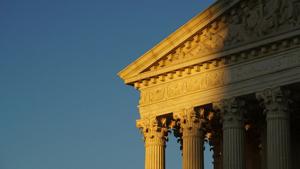
The arguments come as the Supreme Court prepares to decide what Trump has called “one of the most important cases in the history of our country.” The small businesses, represented by Texas-based nonprofit Liberty Justice Center, filed a brief in the case this week. Two other sets of respondents also filed briefs: A group of Democrat-led states and two Illinois-based toy makers. All three groups challenging the tariffs argued in briefs filed on an expedited review schedule.
The Supreme Court set oral arguments in the case for Nov. 5. The president said the case is so crucial to the nation’s future that he considered attending in person.
“Tariffs equal national security,” Trump said Tuesday in the Rose Garden, noting peace deals he has brokered using tariff authority and the prospect of trade deals. “We have a very, very big and important case coming up. We should win the case based on the legal merit. We should also win based on all the things I just said.”
Trump’s economic agenda is tied to his tariff authority. Trump has used tariffs to reorder global trade to give U.S. businesses a home-field advantage.
Economists, public companies and business groups have said the import duties will raise prices for U.S. businesses and consumers. Trump said the tariffs have also been a powerful diplomatic tool that has helped settle global conflicts.
Attorneys from Liberty Justice Center turned to American statesman and fourth president James Madison to make their point.
“The President has no independent constitutional authority to impose tariffs. Indeed, when the Framers enumerated Congress’s ‘legislative Powers,’ the first was the ‘Power To lay and collect Taxes’ and ‘Duties’ – tariffs,” attorneys for the group wrote. “No power was more fundamental. As James Madison wrote, the ‘power over the purse’ is ‘the most complete and effectual weapon with which any constitution can arm the immediate representatives of the people.'”
The group argued that the tariff authority Trump claims to have under the 1977 International Emergency Economic Powers Act is too broad for Congress to legally delegate.
“Here, the government contends that the President may impose tariffs on the American people whenever he wants, at any rate he wants, for any countries and products he wants, for as long as he wants – simply by declaring longstanding U.S. trade deficits a national ’emergency’ and an ‘unusual and extraordinary threat,” declarations the government tells us are unreviewable. The President can even change his mind tomorrow and back again the day after that,” the attorneys wrote. “That is a breathtaking assertion of power, and one would expect to see an unequivocal grant of authority from Congress to support it – if the Constitution permits it at all. Yet the statute the president invokes, the International Emergency Economic Powers Act, never mentions tariffs, and in 50 years no other President has used it for that purpose.”
The group also pointed to past presidential moves the nation’s highest court has recently shot down.
“In recent years, Presidents have resorted to increasingly extravagant interpretations of vague terms in old laws to justify everything from a $450 billion student loan forgiveness plan to a nationwide eviction moratorium, a sweeping vaccination mandate, and a brand-new carbon-emissions regime,” they wrote. “This Court invalidated each one, holding that unprecedented assertions of executive power having massive economic effects require especially clear statutory authority. This case is no different. IEEPA contains no clear grant of tariff powers, let alone the sweeping powers asserted here.”
The states, led by Oregon Solicitor General Benjamin Gutman, made a similar argument.
“Congress, not the President, decides whether and how much to tax Americans who import goods from abroad,” Gutman’s team of attorneys wrote. “This Court should reject the President’s bid to seize that power for himself.”
Gutman added: “Common sense weighs against discovering an extraordinary new power to remake the national economy in a longstanding statute.”
Trump has imposed tariffs of at least 10% on nearly every U.S. trading partner. Some nations face much higher rates. The U.S. president has used tariffs frequently, including threats of tariffs, in response to what he says are aggressive trade actions by other nations. He has also changed, delayed, and made exemptions for some of the tariffs he’s implemented using the International Emergency Economic Powers Act of 1977.
Learning Resources Inc. and hand2mind Inc., two toymakers based in Vernon Hills, Ill., said the 1977 law doesn’t grant the president any tax authority.
“Asserting authority under the International Emergency Economic Powers Act, the president with the stroke of a pen increased the nation’s effective tariff rate tenfold to the highest it has been since at least World War II. In the months since, he has raised and lowered, paused and resumed, and threatened and unthreatened tariffs at will, for a grab bag of reasons,” Attorney Pratik Shah wrote. “By the government’s own account, those actions amount to an over $3 trillion tax increase on Americans over the next decade. IEEPA does not give the president such vast unilateral power. Indeed, it does not give the president any taxing or tariffing power.”
The Trump administration has argued that the president has tariff authority under the International Emergency Economic Powers Act of 1977.
“IEEPA quite naturally addresses the most major of questions – the powers available to Presidents to address extraordinary national emergencies in the foreign-affairs context – by conferring major powers,” Solicitor General D. John Sauer wrote in a petition to the court.
Trump and his advisors have predicted dire consequences if the Supreme Court doesn’t cement Trump’s tariff powers.
In August, Sauer and Assistant Attorney General Brett Shumate warned the U.S. Court of Appeals for the Federal Circuit that tariffs must stay in place to prevent a financial disaster.
“Suddenly revoking the President’s tariff authority under IEEPA would have catastrophic consequences for our national security, foreign policy, and economy,” they wrote in a letter. “The President believes that our country would not be able to pay back the trillions of dollars that other countries have already committed to pay, which could lead to financial ruin.”
In August, the U.S. Court of Appeals for the Federal Circuit affirmed a previous lower court ruling saying Trump did not have the authority. Still, it said Trump’s tariffs could remain in place while the administration appeals to the U.S. Supreme Court. In the 7-4 decision, the majority of the Federal Circuit said that tariff authority rests with Congress. It wrote: “We discern no clear congressional authorization by IEEPA for tariffs of the magnitude of the Reciprocal Tariffs and Trafficking Tariffs. Reading the phrase ‘regulate … importation’ to include imposing these tariffs is ‘a wafer-thin reed on which to rest such sweeping power.'”
A recent U.S. Customs and Border Protection report shows the U.S. has collected nearly $90 billion in tariffs through September. Another recent report, from the Congressional Budget Office, estimated tariffs could bring in $4 trillion over the next decade. That CBO report came with caveats and noted that tariffs will raise consumer prices and reduce the purchasing power of U.S. families.
A tariff is a tax on imported goods paid by the person or company that imports the goods. The importer can absorb the cost of the tariffs or try to pass the cost on to consumers through higher prices.


Mostly Sunny
Latest News Stories

Massive Fourth Inning Powers Casey-Westfield Past North Central 13-4

Illinois proposal aims to improve detection of potentially staged deaths

Analysis: Homelessness predicted to rise despite policy efforts

Bachelor’s at Illinois community colleges may widen access, affordability

Iran reverses course, closes Strait of Hormuz

Los Angeles school district seeks state’s money for pay hikes
Congress kicks off government funding process for 2027
Seattle affordable housing goal elusive despite millionaire’s tax

Illinois Quick Hits: Teachers union says CPS to bus students to rally
Pritzker says of BUILD Plan for homes would not cost taxpayers

Hermann’s Two-Way Dominance Propels Robinson Past Casey-Westfield 3-1

Illinois GOP aims to keep power plants open, increase charge transparency