Supreme Court grants extra time for arguments in tariff case
The U.S. Supreme Court will grant some additional time for oral arguments in a case challenging President Donald Trump’s tariff authority, but won’t let tribal members participate.
Oral arguments usually last 60 minutes, with 30 minutes for each side. In the tariff case, the high court expanded that to 80 minutes for the hearing set for Nov. 5.
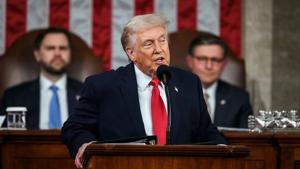
Trump said the case is so crucial that he might attend personally.
The groups challenging Trump’s tariff authority under a 1977 law that doesn’t mention tariffs asked the high court for 45 minutes to be divided among them. They didn’t get all of that time.
The high court granted one representative 20 minutes to speak on behalf of the two groups of private businesses that have challenged the tariffs. The Democrat-led states, headed by Oregon, will also get 20 minutes.
The government will get 40 minutes to make its case.
Blackfeet Nation members had also asked for 15 minutes for oral arguments. Last week, the high court denied the members’ request to intervene. On Thursday, the Supreme Court said the tribe wouldn’t get to address the court.
Montana state Sen. Susan Webber, rancher Jonathan St. Goddard, and Rhonda and David Mountain Chief previously asked the nation’s highest court to allow them to intervene in the case because Trump’s tariffs “directly burden cross-border commerce of these tribal plaintiffs, who operate small businesses and family ranches near the U.S.-Canada border.” The Supreme Court’s decision Thursday means they won’t get to participate at the high court, but the tribal case remains pending in another jurisdiction.
The case sets out to answer two questions. The first question asks if the International Emergency Economic Powers Act authorizes Trump’s tariffs. The second question asks whether, if IEEPA authorizes the tariffs, the statute unconstitutionally delegates legislative authority to the president.
Trump used the 1977 International Emergency Economic Powers Act to reorder global trade to try to give U.S. businesses an advantage in the world market. Under the International Emergency Economic Powers Act, Trump imposed import duties of at least 10% on every nation that does business with the U.S.
The challengers argue that Congress, not the president, retains the power to tax. Trump says he has the authority and that his deals worldwide benefit all Americans.
In August, the U.S. Court of Appeals for the Federal Circuit affirmed a previous lower court ruling, but said Trump’s tariffs could remain in place while the administration appeals to the U.S. Supreme Court.
In the 7-4 decision, the majority of the Federal Circuit said that tariff authority rests with Congress. It used that same language: “We discern no clear congressional authorization by IEEPA for tariffs of the magnitude of the Reciprocal Tariffs and Trafficking Tariffs. Reading the phrase ‘regulate … importation’ to include imposing these tariffs is ‘a wafer-thin reed on which to rest such sweeping power.'”
The Supreme Court agreed to consider the tariff challenge on an expedited schedule. A victory for Trump would cement the federal government’s newest revenue source – the highest import duties in nearly a century – in place, at least for now.
Trump has said a loss could be catastrophic for the U.S. economy.
Trump has made tariffs the centerpiece of his economic agenda during the first 10 months of his second term.
According to an analysis of federal data from the Penn Wharton Budget Model, the president’s new tariffs raised $80.3 billion in revenue between January 2025 and July 2025 before accounting for income and payroll tax offsets.
The Congressional Budget Office estimated that Trump’s tariffs could generate $4 trillion in revenue over the next decade, but they would raise consumer prices and reduce the purchasing power of U.S. families.
Trump has said he wants to use tariffs to restore manufacturing jobs lost to lower-wage countries in decades past, shift the tax burden away from U.S. families, and pay down the national debt.
A tariff is a tax on imported goods that the importer pays, not the producer. The importer pays the cost of the duties directly to U.S. Customs and Border Protection, a federal agency.




Mostly Cloudy then Chance Showers And Thunderstorms
Latest News Stories

Soaring costs and short supply shut millennials out of housing market
Vought testifies before lawmakers on Trump’s $2.1T budget request

SNAP eligibility changes spark debate on gap for impacted recipients

Trump puts spotlight on China, Iran’s top oil consumer
Lawmakers, auditors offer fraud prevention solutions

Illinois unions seek to kill Waymo-friendly bill in Springfield
Rich States Poor States: Tax policy largely determines states’ economic competitiveness

78 pro-life orgs ask DOJ to stop undermining state laws by favoring aborting drug industry

Illinois Quick Hits: Two of ComEd four released; new trial expected

Casey-Westfield Launches Seven Home Runs in 18-4 Rout of Tri-County

Meeting Summary and Briefs: Casey City Council for April 6, 2026

Chicago suit vs oil cos. may yet survive SCOTUS ruling, judge hints