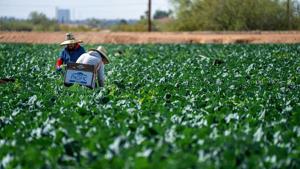
Texas lawmaker introduces agricultural visa reform
A Texas lawmaker introduced legislation to reform the H-2A visa program for agricultural workers.
U.S. Rep. Monica De La Cruz, R-Texas, introduced the Bracero Program 2.0 Act, a bill to make wage reforms and technical upgrades to the H-2a temporary agricultural visa program.
The H-2A visa program is a federally administered work visa system that allows agricultural employers to hire immigrant workers for temporary or seasonal jobs when there are not enough U.S. workers available.
According to data from the U.S. Department of Agriculture, 42% of farmworkers in the United States do not have U.S. work authorization. There is no limit to the number of workers who can be approved each year on the H-2A program.
The Bracero Program was initially implemented in 1942 as an agreement between Mexico and the United States to address farmworker shortages during World War II. The program brought in roughly four million temporary agricultural workers from Mexico before it ended in 1964.
De La Cruz’s legislation proposes centralizing the H-2A application process into a single electronic portal that will post advertisements for open positions and allow applicants to submit documents. The electronic portal would be administered by the Departments of Labor and Homeland Security. The bill also recommends extending H-2A worker contracts to 12 months from the previous less than 10 month period.
“For decades, the Bracero program created new opportunities for millions and provided critical support for Texas agriculture,” De La Cruz said. “I am leading efforts to revive the Bracero spirit by reforming H-2A visas.”
Florida, California, Georgia, Washington and North Carolina are among the top five states where employers recruit H-2A workers.
De La Cruz’s legislation also proposes requiring employers to pay H-2A workers two dollars more than the state’s hourly minimum wage.
The Trump administration recently proposed a rule that would change wage calculation for H-2A workers by requiring employers to pay based on state-level Bureau of Labor Statistics data.
The administration said this would stabilize the rate of pay for H-2A workers rather than having it fluctuate rapidly from year to year.
“This continuity is essential for minimizing the likelihood of shortages, price volatility, and disruptions throughout the supply chain, which can affect customers and businesses alike,” the administration wrote in its rule.
De La Cruz’s legislation also proposes expanding eligibility for H-2A work visas by allowing greenhouse and indoor farm workers to apply for the program. The program would also give greater flexibility to workers who change employers by allowing them to remain on a single visa.
Rosemary Jenks, policy director at the Immigration Accountability Project, said she is skeptical of expanding work visa programs in agricultural fields.
“We should as a country incentivize growers to invest in capital, to invest in the machines that can pick the crops rather than relying on an imported slave class to pick them,” Jenks said.
The future of De La Cruz’s legislation is uncertain as the Trump administration continues to make changes with various visa systems including the H-1B and H-2A programs.
“This will provide solutions desperately needed for hard-working immigrants,” De La Cruz said. “With workforce shortages challenging our communities, the Bracero Program 2.0 will bring stability and certainty for south Texas.”




Isolated Rain Showers
Latest News Stories
DOJ to release more than 3 million Epstein documents Friday

WATCH: Commission meets as Chicago mayor seeks to prosecute ICE; SNAP changes Sunday

Illinois Quick Hits: Unemployment up over last year
Trump taps Kevin Warsh as next Fed chair

National shutdown, strike planned for Friday, Jan. 30 in protest of ICE

Gori firm accused of fraud, racketeering, ‘bounties’ in asbestos litigation

WATCH: Democratic legislators introduce anti-ICE legislation

Illinois Quick Hits: Grayson gets 20 years for murder
Bill Cassidy, facing Trump-backed challenger, bets on ‘who delivers’
Trump Cabinet meeting: New Fed chair, coal saving lives, Russia and Ukraine

Paul introduces legislation to halt welfare funding for non-citizens
Food companies push back on Pennsylvania bills to ban certain food products