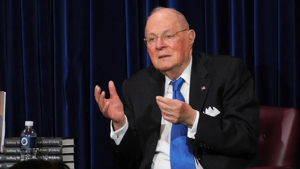
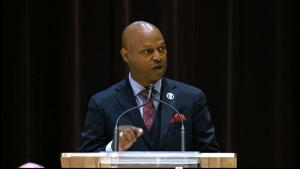
WATCH: Justice Kennedy talks about ‘Life, Law & Liberty’
It’s important to understand what the framers of the U.S. Constitution wrote and intended, but the U.S. Supreme Court’s work goes beyond that, according to a Reagan-appointed justice known for his tie-breaking votes.
“In my view, the framers were modest enough that they did not think they knew all the aspects of a just and decent society,” retired Justice Anthony Kennedy told an audience this week at the Ronald Reagan Presidential Library and Museum.
“They used words like ‘liberty’ because it has a spaciousness, and you learn more about what it means over time,” Kennedy said. He was answering questions on stage from David Trulio, president and CEO of the Ronald Reagan Presidential Foundation and Institute, in Simi Valley, just north of Los Angeles.
“Originalism is part of it,” Kennedy said Wednesday evening. He was referring to an examination of what the framers of the Constitution wanted. “And ultimately, what is moral, what is justice, what is right are of tremendous importance.”
In addition to discussing his new memoir “Life, Law & Liberty,” the 89-year-old Virginia resident posed for photos with a large number of fans.
The Sacramento native and Harvard Law School graduate was a lawyer who assisted Reagan when the latter was governor of California. Kennedy went on to serve as a judge on the U.S. Court of Appeals for the 9th Circuit from 1975 until he joined the U.S. Supreme Court in 1988 after the Senate’s 97-0 confirmation vote.
“Judge Kennedy believes, as I do, that the role of the judge in our democratic society is faithfully to interpret the law, not to make it; and that it is just as important to protect the victims of crime as it is to protect criminal offenders,” Reagan wrote in a statement at the time. It’s part of the Reagan Library’s archives.
Kennedy broke ties in key cases such as the 2000 presidential election (Bush v. Gore), gun ownership, abortion rights and same-sex marriage. He became known as the court’s swing vote.
It’s a term he said he dislikes. In “Life, Law & Liberty,” Kennedy wrote it was cases that swung, not him.
“The term ‘swing vote’ gives you an immediate picture of this judge going back and forth on a rope, left to right, left to right. That seemed to me to be quite wrong,” said Kennedy, who retired from the court in 2018. “My philosophy was quite consistent.”
Kennedy voted with a 5-4 majority in the controversial 1989 ruling that said burning the American flag as an expression of speech is protected by the First Amendment. The case was Texas v. Johnson.
“The hard fact is that sometimes we must make decisions we do not like,” Kennedy wrote in his concurring opinion at the time. “We make them because they are right, right in the sense that the law and the Constitution, as we see them, compel the result.”
At the Reagan Library, Kennedy discussed the ruling further.
“Once you start suppressing freedom of speech, freedom of thought, there’s no ending point,” he told Trulio and the audience. “Of course, there’s speech that’s unlawful: defamation and criminal conspiracy.”
But the U.S. can’t outlaw “the mere expression of views,” Kennedy said.
The retired justice also recalled an incident of patriotism that followed Texas v. Johnson.
“After we had the flag burning case, there were some protesters in front [of the Supreme Court] with signs, going up and down,” Kennedy said. “There was a group who came to see the court, probably eighth graders. They all stood together, and they saluted the American flag.
“The protesters looked at that, and they became more quiet,” Kennedy said.
Kennedy discussed a difficult issue for him: abortion. It surfaced in cases before Kennedy and his fellow justices.
Kennedy, a Catholic, said he almost stepped down from the court over it.
“I never heard the word ‘abortion’ until maybe I was in high school or college,” Kennedy said at the Reagan Library. But he added his parents – a father who practiced law and a mother who was instrumental at a facility housing unwed mothers – certainly were familiar with the issue.
“My parents were very much motivated by the Catholic faith as were my sister, my brother and myself. It seemed to be very, very wrong,” Kennedy said. “There is a voice crying out from the womb from the moment of conception: ‘Let me live. Let me live.’ And that’s a voice, it seemed to me, we had to hear.”
But instead of resigning from the court, Kennedy gave the issue more thought. He said he found a way to balance his faith with a woman’s right to choose.
“In my view, we should do everything we can to persuade the woman not to have the abortion, but she had the right to make that call,” Kennedy said.
He noted some women have what they believe are good reasons for having an abortion.
Kennedy also stressed the need to return to civil discourse after today’s era of bitter partisanship.
The retired justice said Reagan would disagree with people but also thank them for their views.
“Reagan was absolutely honest,” Kennedy said, then clarified he wasn’t only speaking about the president’s refusal to be corrupt. “He was honest in a second way. He was honest in the views he expressed.”




Partly Sunny
Latest News Stories

U.S. will continue blockade ‘as long as it takes,’ Hegseth says

Casey to Donate Surplus Tornado Siren to Village of Westfield

Gori seeks quick end to asbestos fraud, lawsuit ‘bounties’ case
Texas Ten Commandments law may reach Supreme Court

Feds reopen probe into LAUSD race-based program
Trump won’t be rushed on Iran as clock ticking for the regime

Multiple House Republicans defy proposed 3-year FISA Section 702 extension

Fetterman wants SNAP to cover hot rotisserie chicken

Advocates warn of looming debt crisis
Bears want more after Illinois House passes megaproject tax incentive bill

DHS wants millions more from taxpayers after federal SNAP changes
Illinois Millionaires Tax doesn’t get support