

Report: Barriers to social mobility largely manmade
Authors of a new report on social mobility across the 50 states said that barriers to social mobility are largely “man-made” and can be solved by policy reforms including changes to taxes, regulations, education and more.
President and CEO Gonzalo Schwarz of the nonpartisan independent public policy think tank Archbridge Institute as well as co-author of its newest report told The Center Square: “Most of the barriers [to social mobility] we’re identifying are connected to measurable policy reforms that states and policymakers can address.”
These reforms include “reducing occupational licensing, cutting local regulations, improving business taxation environments, increasing educational freedom, and other specific policies that have tangible implications,” Schwarz said.
“We should strive to remove as many barriers as possible so that people have more opportunities to flourish,” Schwarz said.
Likewise, another author of the report as well as chief economist at the Archbridge Institute Justin Callais told The Center Square that “barriers to mobility are large[ly] man-made, meaning they can be solved quite simply by removing them.”
“For example, housing regulations make the American Dream of owning a home more difficult today,” Callais said. “Taxes and regulations on businesses impact entrepreneurs, but also make employment opportunities more difficult, and create higher prices for goods and services for everyday consumers.”
“Restrictions on school choice lock children into schools in their district, which leads to a wide divergence in the quality of education being received,” Callais said.
The Archbridge Institute’s report categorizes barriers to social mobility by those that are externally imposed or “artificial” and those that are personal hindrances or “natural.”
Artificial barriers in childhood are listed as education quality, minimum wage, and marriage penalties hindering family formation while artificial barriers in adulthood include occupational licensing, regulation, taxes, rule of law, and lack of affordable housing.
Natural barriers in childhood include out of wedlock births, lack of parental engagement, lack of unsupervised play time, while artificial adulthood barriers include soft skills development, incarceration rates, addiction, and lack of strong community.
Schwarz told The Center Square that “there is a research blind spot as to what makes one place more economically mobile than another, and what are main barriers and leading indicators of mobility.”
Archbridge’s report “seeks to highlight the more positive-sum narrative of social mobility, as opposed to the more zero-sum narrative of inequality,” Schwarz said.
“The barriers we’re identifying and the conversation we want people to have is how we can remove more barriers for everyone to have more chances, which is a more hopeful narrative than one that seeks to frame the conversation as needing to bring someone down so that someone else can go up,” Schwarz said.
Schwarz said that the report additionally “seeks to highlight which state has the best environment for social mobility.”
According to the report, Utah ranks as the top state for social mobility with the greatest score of 6.44, while Louisiana ranks last as the state with the lowest social mobility at a score of 3.07.
Callais told The Center Square that “the report reveals that mobility is bipartisan.”
“Among the top 10 ranking states, there are predominantly red (Utah, Wyoming, Idaho) and blue (Vermont, Minnesota) states,” Callais said. “A similar trend exists for the bottom 10 (Republican states like Louisiana and Mississippi, Democratic states like New York and New Jersey).”
Interestingly, at number 36 and with a score of 4.36, Florida only ranks a little above California, which is in spot number 40 with a score of 4.16.
Callais told The Center Square that “the report reveals the holistic nature of mobility: Regulations, taxes, and entrepreneurship matter, but so does family engagement, judicial systems, charity, and education.”
“There is great work on measuring income mobility, but the obvious next step is figuring out why individuals and families can more easily achieve mobility in some states compared to others,” Callais said.
Removing barriers to social mobility “will make the American Dream more attainable for this generation and future ones,” Callais said.
According to the Archbridge Institute’s report, social mobility is “the opportunity to better oneself and those around them.” It can refer to “a person’s ability to climb the income ladder and outearn the previous generation,” and is also concerned with “achievement, aspirations, purpose, and skills development.”
Events

Latest News Stories

Illinois takes over health insurance marketplace in 2026 amid skepticism

WATCH: IL state reps challenge IEMA-OHS responses to local agencies

Meeting Summary and Briefs: Casey Township Library Board of Trustees for June 26, 2025
Judge expands restraining order against ‘Beto’ O’Rourke, adds ActBlue
Reversing Biden’s precedent, students complete FAFSA in minutes at beta-testing event

Trump, Zelenskyy to meet Monday in steps toward peace with Russia

Casey Library Reports High Turnout for Summer Reading and Imagination Library Programs

Possible ‘agreement’ reached in Trump-Putin meeting; more discussion likely

WATCH: Gun rights supporters celebrate 9th Circuit’s ruling against CA gun rationing law

Feds sue California over emission standards for trucks
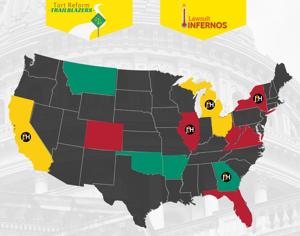
Illinois quick hits: ‘Lawsuit inferno’ bill takes effect after Pritzker signed 267 measures Friday

WATCH: UW-authored study on surgery times contradicts CMS basis for reimbursement cuts