Rubio explains reasoning behind Trump’s Venezuela strikes in Senate hearing
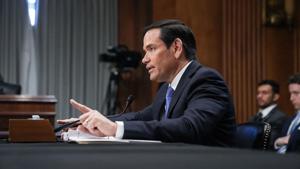
Amid congressional outcry over the Trump administration’s military actions in Venezuela, Secretary of State Marco Rubio defended the moves Wednesday and outlined future plans to U.S. lawmakers.
During a Senate Foreign Relations Committee hearing Wednesday, Rubio justified the large-scale strike against the Venezuelan government in early January.
The strike involved seizing two Venezuelan vessels and arresting Venezuelan President Nicolás Maduro and his wife on charges of running an international narco-terrorism operation.
“We had in our hemisphere a regime operated by an indicted narco-trafficker that became a base of operation for virtually every competitor, adversary, and enemy in the world,” Rubio said, pointing to Venezuela’s partnerships with Iran, Russia and China. “It was an enormous strategic risk for the United States…it was an untenable situation, and it had to be addressed, and it was addressed.”
With the Maduros absent, Venezuelan Vice President Delcy Rodríguez is temporarily heading the country and engaging in negotiations with President Donald Trump. Many lawmakers expressed concerns over the fact that Maduro’s regime is still in power.
They also asked Rubio why the U.S. has not called for democratic elections in Venezuela yet. Opposition leader María Corina Machado – who the U.S. and other countries recognized as the true winner of the country’s 2024 elections – would likely win.
Rubio said the Trump administration is trying to avoid triggering a civil war or refugee crisis in the country, which requires “direct, honest conversations” with the people currently in control of Venezuela’s government.
“What we’re trying to trigger here is a process of stabilization, recovery, and transition, so something that María Corina and others can be a part of,” Rubio told the committee.
“By no means is our policy to leave in place something permanent that’s as corrupt as you’ve described,” he added. “We are just acknowledging reality, and that is, you have to work with the people that are in charge of the elements of government.”
One of the strategic measures the administration is using to help achieve stability and recovery, Rubio said, is temporary oil sanctions.
The current arrangement allows the Venezuelan government to move oil to the market, but they must sell it at market prices, rather than giving large discounts to China. Additionally, the profits from oil sales must be spent for the benefit of the Venezuelan people, which the Trump administration will oversee.
Rubio assured lawmakers that the mechanism will not be permanent, with the end goal being a “friendly, stable, prosperous Venezuela” with a normal oil industry.
“We’re using that short-term mechanism both to stabilize the country, but also to make sure that the oil proceeds that are currently being generated – through the licenses we’ll now begin to issue on this sanctioned oil – go to the benefit of the Venezuelan people, not to fund the system that existed in the past,” he said.
“I am not here to claim to you this is going to be easy or simple,” Rubio added. “I am saying that in three and a half, almost four, weeks, we are much further along on this project than we thought we would be given the complexities of it going into it.”
Many lawmakers, however, remained annoyed at the administration’s lack of communication with Congress when undertaking the strikes.
The Senate had split 50-50 over a war powers resolution two weeks ago that would have curtailed further actions by the Trump administration in Venezuela.
U.S. Sen. Rand Paul, R-Ky., who had supported the resolution, argued that the military actions constituted an act of war, which only Congress can declare.
“If a foreign country bombed our air defense missiles, captured and removed our president, and blockaded our country, would that be considered an act of war?” Paul asked.
“We just don’t believe this operation comes anywhere close to the constitutional definition of a war,” Rubio replied, framing it instead as a law enforcement operation against an illegitimate political leader and criminal. “The U.S. always has the right to act in its national interests and protect itself.”
Other lawmakers, like U.S. Sen. Chris Coons, D-Del., ultimately concluded that the seizure of Maduro was constitutional, but still bristled at the lack of transparency.
“Nicolás Maduro was under indictment in the United States, and his rendition to the United States I think was legal,” Coons said after the hearing. “But the point I was making in my questioning of Secretary Rubio: the administration failed to be truthful and forthcoming with Congress in terms of briefing us, consulting with us, and seeking approval from us.”
U.S. Sen. Rick Scott, R-Fla., however, left the meeting feeling “optimistic,” saying he supported the Trump administration controlling oil flow as a pressure tactic.
“I think Secretary Rubio was being very honest. It’s a very fluid situation, but we’re way better off than we were four weeks ago,” Scott told reporters. “The expectation is that we continue to see political prisoners released, we see a reduction of oppression, and we see more political opponents being able to speak out there.”


Mostly Sunny
Latest News Stories

Canadians, Brits stress U.S., Texas are key to shipbuilding
Tariff litigation expands as federal court weighs next move
Democrats dissatisfied by DOJ’s pause on ‘anti-weaponization fund’
Hegseth calls allied defense ‘bad deal for taxpayers’ in budget push
Pritzker touts state spending to cover federal cuts in passed budget

I-95 quintuple fatal: Federal agency subpoenas state of New York
Illinois lawmakers give raises to diversity commissioners they criticized

Report: Credit card debt projected to decrease $61B
Taxpayer risk cited after Bears stadium bill stalls

Illinois Quick Hits: General Assembly approves CTE bill
Amended scooter, e-bike bill heads to governor
Property tax-free Bears deal fails to pass