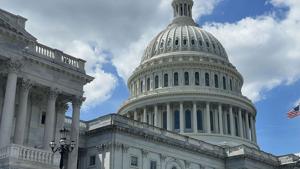
GOP lawmakers urge Thune to tweak filibuster rules to pass voter ID bill
Dozens of Republicans are demanding that the U.S. Senate take up House-passed legislation implementing election security reforms – and they’re willing to restructure filibuster rules to ensure it succeeds.
The SAVE Act passed the lower chamber with slim bipartisan support last April. The bill would require Americans to present proof of citizenship when registering to vote, necessitate in-person voter registration for federal elections, and require states to remove all noncitizens from their voter rolls.
Yet after 300 days, the Senate Rules Committee has still made no move to bring it to the floor. More than 30 House Republicans, led by Rep. Brandon Gill, R-Texas, sent a scathing letter to committee Chairman Mitch McConnell, R-Ky., demanding action.
Forty-eight Republican senators have cosponsored the legislation, and Rep. Chip Roy, R-Texas, says he received commitments from 50 senators to vote for it. But with Senate Democrats pronouncing the bill “dead on arrival” if it reaches the floor, GOP lawmakers are once again debating whether to change the Senate’s 60-vote threshold.
Sen. Mike Lee, R-Utah, has stated on social media that “the historical norm” required senators who wish to filibuster a bill to speak on the floor.
He condemned the current 60-vote threshold requirement, where senators use cloture as the only method of advancing most legislation.
“Cloture—which allows for a supermajority of senators to end the talking filibuster—first became available in 1917, but still wasn’t used routinely,” Lee argued. “The Zombie Filibuster—in which senators could have the benefit of ongoing debate without actually speaking—has now become the norm[.]”
Despite pressure from Lee and others, Senate Majority John Thune, R-S.D., has remained noncommittal on the issue. He told reporters Tuesday that leaders will “talk about that idea and determine how they want to proceed.”
“We will vote on the SAVE Act — but a talking filibuster has ramifications everybody needs to be aware of,” Thune added. “That would tie the floor up, with unlimited debate and amendments.”
If filibuster rules are not changed, the SAVE Act will almost certainly fail the Senate, where Republicans have up to 53 votes.
Democrats have called the legislation an act of voter suppression, saying that federal law already prohibits noncitizens from voting and the SAVE Act will simply make it harder for veterans, the disabled, minorities, and women who change their last names to register to vote.
Under the legislation, people would not be able to register to vote with only their drivers license, since noncitizens can obtain that. They must instead present documents proving U.S. citizenship, such as a birth certificate or U.S. passport.
Sen. Lindsey Graham, R-S.C., and other Republicans say the requirements are “eminently reasonable.”
“Common sense requirements to prove your eligibility to vote in federal elections are not ‘Jim Crow 2.0.,” Graham said on social media Wednesday. “Every time we try to bring rationality to the debate around illegal immigration, the Democrats let the radical, left-wing nut jobs take over for them – but they won’t for us.”




Chance Showers And Thunderstorms
Latest News Stories

WATCH: Businesses argue Congress holds purse strings in tariff challenge

Report: FEMA under Biden politically discriminated against Americans

Trump begins accepting $100k visa payments

Vance optimistic with Gaza peace plan; reiterates no U.S. troops to be on the ground

Poll: Majority of Americans do not support National Guard to deter crime
‘Legal minefield:’ Biometrics reforms needed to keep IL tech biz growing

Warriors Fall to Olney 28-27 in Heartbreaking Battle for Little Illini Title

As military branches celebrate 250 years, Democrats vote against paying them

Chicago transit violent crime at 7 year high, funding concerns persist

WATCH: National Guard case before SCOTUS; Trump insists China soybean deal coming

Illinois quick hits: Harvey furloughs some employees; lead poisoning prevention continues

Illinois quick hits: Filings made to SCOTUS in National Guard case; Chicago sued DHS