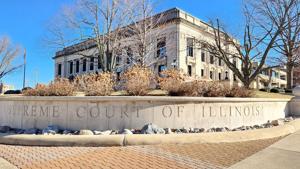
Ruling: Illinois Supreme Court likely overstepped in ousting of Cook County judge
A federal judge says he believes a Cook County judge has leveled serious accusations against the Illinois Supreme Court for trampling his constitutional rights by abruptly ousting him from a temporary, appointed judgeship, apparently in response to complaints from left-leaning attorneys’ groups over the Cook County judge’s public support for President Donald Trump.
But the judge said he still could not yet order the state high court to reinstate the Cook County judge, because, on one hand, it’s not clear if the Illinois Supreme Court exceeded its authority under the Illinois state constitution, and, on the other, the federal judge believes he is bound by prior higher court decisions appearing to require federal judges to avoid intervening in controversies over how state courts operate.
U.S. District Judge Edmond Chang filed the ruling on June 1, delivering a mixed bag of results for both sides in the case lodged against the Illinois State Supreme Court by former Cook County Judge James Brown.
And it appears to set up a likely appeal to the U.S. Seventh Circuit Court of Appeals, which is the only court Chang believes can give Brown’s legal claims a straight path forward, without otherwise forcing Judge Brown to sue the Illinois Supreme Court in a state court action that could inevitably give the Illinois Supreme Court the final word in the case.
In response to the ruling, Brown’s attorney, Brendan Philbin, from the constitutional legal advocacy group, the Liberty Justice Center, of Chicago, said the decision gives Brown “a clear path forward” in court.
“Judge Brown was appointed to a fixed-term judicial assignment. He began serving the public. Then he was removed by a one-sentence order after outside groups objected to political commentary he wrote as a private citizen before returning to the bench. He was given no notice and no hearing,” Philbin said.
“That should trouble every Illinoisan, regardless of politics.
“The Constitution does not allow government officials to punish people for disfavored speech, and it does not allow public officials to take away a position without basic due process. Judges do not lose their rights because bar associations dislike their views. And Illinoisans should not have to wonder whether political pressure campaigns can decide who is allowed to serve in public office,” Philbin said.
The case landed in Chicago federal court before Judge Chang in February when Brown sued the justices of the Illinois Supreme Court for ordering him removed from a temporary Cook County Circuit Court judicial assignment.
The lawsuit accuses the Democrat-dominated state high court of violating his official rights as a judge and his constitutional speech rights as a citizen, by weaponizing Illinois’ judicial conduct code against him to suppress his speech and punish him for supporting President Donald Trump.
Brown has asked the federal court to order the Illinois Supreme Court to reinstate him and potentially pay him damages for their alleged constitutional overreach.
Brown had retired from the Cook County Circuit Court in 2020, after 18 years on the bench.
However, the Illinois Supreme Court recalled Brown to active service five years later, appointing him to a temporary assignment on Cook County’s traffic courts in December 2025.
According to the Illinois Supreme Court at the time, Brown’s temporary appointment was needed to help Cook County’s overburdened courts deal with a shortage of judges amid a crush of backlogged cases.
However, in January 2026, the court suddenly decided to retract that assignment, amid a public pressure campaign mounted by Chicago Democrat lawyers.
At least two legal organizations, including the Cook County Bar Association, which represents the interests of black lawyers and judges in Chicago, and the Chicago Council of Lawyers issued statements and sent letters to the Illinois Supreme Court demanding the court rescind Brown’s appointment.
In those communications, the organizations claimed Brown had demonstrated himself to be unfit to hear cases in Cook County due to bias. As proof, they pointed to a column Brown published in an online publication operated by former Chicago Tribune columnist John Kass in September — four weeks before he applied for the judicial recall.
In that column, titled “His Judgment Cometh, and That Right Soon,” Brown assailed what he called “lawfare” waged by Democratic activists and politicians in Illinois and elsewhere in the U.S. against President Donald Trump and his supporters.
He further singled out for criticism the controversial criminal prosecutorial and policy decisions of former Cook County State’s Attorney Kim Foxx and other prosecutors, who Brown agreed had been propped up by billionaire left-wing activist George Soros and his political organizations to advance left-wing criminal justice reforms in Chicago and nationwide.
The complaining legal organizations asserted the column — which Brown authored and published when he was no longer a judge and before his recall — amounted to violations of the Illinois Code of Judicial Conduct, which require judges to “promote public confidence” in the courts.
The groups asserted the column was “wildly inappropriate for a member of the judiciary to be making” and showed Brown lacked “the temperament, judgment, independence, competence, impartiality and respect for the rule of law necessary for those who serve in the judiciary.”
After receiving the complaints from the lawyer associations, the Illinois Supreme Court then declared Brown’s appointment had been rescinded and he was removed from the bench.
Brown has argued the Illinois Supreme Court lacked the constitutional authority to remove him, because the Illinois state constitution gives only the Illinois Courts Commission the authority to remove judges related to ethical violations or other alleged misconduct, following a full investigation and hearings at which accused judges are allowed to defend themselves.
In this case, Brown said, he was provided none of those required opportunities.
In federal court, the Illinois Supreme Court argued it had the authority to remove Brown because the justices were acting within their discretion and merely “ended his recall assignment.” They argued they were thus protected from the lawsuit by so-called judicial immunity, which protects judges from being sued over their decisions as judges.
In their motion to dismiss, the Illinois Supreme Court justices asserted Brown’s ouster was justified because Brown’s pro-Trump column violated Illinois judicial conduct rules, even though he wasn’t a judge at the time he wrote it. They further argued Brown’s pro-Trump statements made him unfit to serve as a judge hearing cases in heavily Democratic Cook County, even in cases involving traffic tickets.
A path forward?
In his ruling, Chang said the state high court was wrong on the question of judicial immunity. Chang said it was clear the decision to appoint and remove Brown was an administrative act and not a “judicial” one, simply because the justices did it.
“… The decision to appoint a judge to the bench does not convert the employment-like nature of the decision to judicial in nature,” Chang wrote.
Further, Chang said he believed Brown had shown “a likelihood of success” on his claims that the Illinois Supreme Court violated his rights to due process under the state constitution.
Chang said he agreed the Illinois state constitution establishes the Illinois Courts Commission to be the only body constitutionally allowed to remove judges over allegations of misconduct.
“It would be one thing if the Illinois Constitution did not so specifically address removal of judges; if that were the case, then the Illinois Justices’ argument that the power of appointment implies the power of removal would have much greater force,” Chang wrote.
“But the state constitution’s extraordinarily detailed judicial-disciplinary process—from the creating of the charging Board, to the composition of the Courts Commission (complete with detailed recusal rules), to the requirement of notice and public hearing, to the categories of circumstances warranting removal, and so on, undermines the general notion that the power to appoint comes with it the power to remove.”
Chang put less stock in Brown’s claims regarding his private First Amendment rights.
He said Brown’s decision to publish the pro-Trump column while using the moniker “The Honorable Judge James R. Brown,” and referring to himself in the column as “This Honorable Court,” as judges do in judicial decisions, without also making clear he was retired at the time he published, shows that the Illinois Supreme Court may have been correct in determining he had acted unethically and had jeopardized his credibility as a judge.
But Chang also said it could yet be possible to determine that Brown was, as he claims, “speaking as a private citizen on matters of public concern,” when he published the column at the heart of the dispute.
The judge, however, refused to issue the injunction Brown sought. Chang said such an injunction would, perhaps ironically, serve to further restrict Brown’s free speech rights, as he would be subject to the speech restrictions normally imposed on judges.
And the judge said, on balance, reinstating Brown now would create only greater harm if it is later determined he should not have been.
Chang further ruled that he believed he may lack the authority to hear Brown’s case at all.
Chang noted that the Seventh Circuit court has previously ruled that federal district judges lack the authority to intervene in legal disputes over how state courts conduct their operations and must abstain in such cases.
Brown had argued that decision shouldn’t apply in Brown’s case, in part, because Brown lacked anywhere else to turn to sue the Illinois Supreme Court for violating his rights.
But Chang indicated only the Seventh Circuit could create a path forward for Brown in federal court.
Short of such a decision from the Seventh Circuit, Chang said Brown must, perhaps ironically, turn to the Illinois state courts to handle his claims.
While Chang agreed the Illinois Courts Commission alone may have the constitutional authority to remove Brown from the bench, the question of how to apply such provisions to judges on temporary assignments has never been addressed by the Illinois Supreme Court.
The state high court is generally considered to hold the final word on how to interpret state law and the state constitution.
In his decision, Chang noted any claim filed by Brown in state court against the Illinois Supreme Court would likely ultimately end up before the same justices that Brown is now suing for allegedly violating his rights.
And it could be left to the Illinois Supreme Court to determine if the Illinois Supreme Court overstepped its constitutional authority and violated Brown’s rights.
In comments to The Record, Brown’s attorney, Brendan Philbin, agreed such a proposition appears to be “farcical.”
Philbin told The Record that Brown is likely to appeal to the Seventh Circuit on the question of whether Chang is required to abstain in the dispute.


Partly Sunny
Latest News Stories

What’s Happening at the Library in August?

Casey Council Approves $33.27 Million Appropriation Plan for FY 2026

Cecile Stephens

Lake Land College Board Approves 3% Pay Raises, New Salary Structure for Staff

Lake Land College Backs 12-Year Extension for Mattoon’s Midtown TIF District

Lake Land College Celebrates Grand Opening of New Effingham Technology Center

EIU Leads OVC With 48 Academic Medal Of Honor Winners

Suncode Energy Pitches Six-Part Community Solar Project Near Martinsville
Meeting Briefs: Clark County Public Hearing for June 10, 2025
Clark County Residents Challenge Solar Developers on Farmland, Finances, and Future

Schelsky Wins 75th Casey Open in Playoff Thriller

Casey-Westfield Meeting Summary: Board Saves on Insurance, Approves Major Purchases