‘Half-baked’ Illinois social media tax poised to tee up court challenges
Illinois is poised to be headed back into court to defend another constitutionally questionable law, as tech companies and internet freedom advocates this time take aim at a new measure, jammed through with virtually no discussion by Democratic lawmakers, to impose steep “fees” on internet site operators that the the state deems “social media” to create a new revenue source to fuel the state’s ever growing budget.
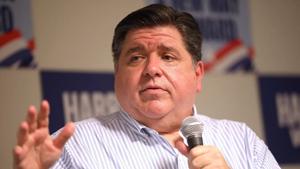
As part of Illinois’ new $55.9 billion state budget, Democratic lawmakers, with the support of Gov. JB Pritzker, slipped in a new measure that Pritzker and other supporters will force “social media” operators to pay the state to make up for the alleged societal damage they say is caused by their platforms.
Styled as a “fee,” the measure would impose what observers say is really a tax to extract potentially hundreds of millions of dollars, or more, every year from a host of companies engaged in the creation of platforms hosting interactive or user-generated content.
Specifically, the new “fees” will be charged against any online platform operator that the state believes has more than 100,000 users in Illinois. It would scale up progressively based on how many “Illinois users” a platform may have.
The fees would be charged at rates of:
100,000 to 499,999 users: 10 cents per user/month;
500,000 to 999,999 users: $40,000 base fee per month, plus 25 cents per user, per month, for each user over 500,000; and
Over 1 million users: $165,000 base fee per month, plus 50 cents per user, per month, for each user over 1 million.
The fee would be collected by the Illinois Secretary of State’s office, rather than the Illinois Department of Revenue.
The law specifically forbids companies hit by the fees from attempting to raise prices or implement charges to make “Illinois users” pay the new “fees.”
Supporters assert the measure will generate at least $200 million annually for the Illinois state government. Supporters, including Pritzker, assert the money will be used to fund programs to deal with mental health issues, allegedly exacerbated by social media, as well as to fund schools and other state budget priorities.
However, the measure faces a very uncertain future.
A variety of groups, including lobbyists and legal advocates for tech companies and internet freedom, as well free speech advocates, tax reform advocates, and others, have lined up to pillory what they call a deeply flawed and rushed measure that tramples not only principles of tax legislation, but constitutional protections.
Several groups, including NetChoice, a trade group representing social media companies and other big tech companies, have indicated they may quickly sue the state to challenge the measure.
NetChoice, for instance, is already in court against the city of Chicago over City Hall’s attempt to impose a similar “user fee” against social media platform operators. In that lawsuit, NetChoice has argued the city’s taxes are unconstitutional because they illegally “single out” social media platforms for “disfavored tax treatment.”
While those arguments would likely also be applied in challenges to the state’s new “social media” tax, critics of the state measure note the new law is also highly confusing, contradictory at some points, and lacks key details normally essential to effective and constitutional tax laws.
In a recent analysis of the law, Jared Walczak, a senior fellow at the tax policy and economic research organization, the Tax Foundation, noted the law falls far short of defining the terms it supposedly will use to determine how much the state will demand from online platform operators.
What’s an ‘Illinois user?’
To begin, he said, the law doesn’t actually define what a “user” is.
“This isn’t a philosophical question,” Walczak wrote. “It’s an eminently practical one.”
He noted many users may have multiple accounts on a platform for various reasons, and they may have accounts across multiple platforms operated by one company – for instance, one person may likely have accounts on Facebook, Messenger, Instagram and WhatsApp, all of which are operated by Meta.
“… Is each taxed separately, or is the person treated as a single user across multiple related services?” Walczak asked.
And, he noted, the law is further silent on whether the tax would be applied to only registered users, or if the state could somehow seek to tax the companies based on other determinations of what a “user” may be.
Further, the law doesn’t define what an “Illinois user” is. For instance, Walczak asked, must a person live in Illinois to be counted? Are they still an “Illinois user” if they engage with social media while outside Illinois?
“Would it cover a non-resident who accessed their social media accounts from Illinois at some point during the month, perhaps during a layover at O’Hare or while in Chicago for a convention?” Walczak asked.
Walczak and others have noted the law’s potentially sweeping effect, threatening to loop in companies most people may not associate as being subject to the tax. While supporters of such taxes have pointed to large social media companies, like Meta, Google and other operators of prominent social media sites, Walczak noted the measure could also impose a potentially crushing tax on lesser sites like AllTrails, a platform on which users can share route maps and other information about their favorite hiking trails.
“A social media platform is a website or internet medium that ‘permits a person to become a registered user, establish an account, or create a profile,’ permits sharing and viewing of user-generated content, and ‘primarily serves as a medium for users to interact with content generated by other users of the medium,'” Walczak wrote “This captures Facebook, X, LinkedIn, Instagram, YouTube, and Reddit, among others. But how about Yelp, Nextdoor, Substack, GitHub, WhatsApp, or Telegram? The language is unclear.”
But beyond the problems with legal definitions, Walczak and others have noted the potentially unconstitutional nature of the law’s proposed penalties.
The law would allow the state to impose penalties on companies that don’t pay up what the state believes they owe. The penalties would be “an amount equal to 100% of the unpaid fee and any penalties each month until the fee is paid.”
Walczak noted such compounding costs could be “astronomical” and subject to the determination of the Secretary of State’s office.
“Bear in mind that at some point, fines become unconstitutionally excessive,” Walczak wrote.
The return of the Stamp Act?
But the measure could legally fail at other key points, as well.
Free speech advocacy group, the Foundation for Individual Rights and Expression (FIRE), has said it believes the social media tax falls far short under the First Amendment.
“Pinpointing where exactly the problems that doom this proposal begin is a tall order,” FIRE wrote in an analysis following the measure’s passage.
FIRE asserted the measure amounts to an unconstitutional “regulation of speech.”
They and other observers have noted the measure’s constitutional infirmities date back to the very foundation of the American republic, as they equated such “social media taxes” to the British 1765 Stamp Act that helped to trigger the American Revolution in the first place.
The Stamp Act required publishers to pay a tax to obtain a stamp on all published works to show they had been approved by the government.
In the centuries since the Revolution and the establishment of the First Amendment, in large part in response to the excesses of the British Crown, courts in the U.S. have repeatedly struck down attempts by states and others to impose taxes aimed at publishers, FIRE noted.
FIRE predicted Illinois’ tax on “social media” is also “doomed.”
“We’re not surprised to see a proposal like this filled with ambiguities and holes. As states have attempted to turn around the losing streak social media regulation has faced in court, we’ve seen a number of half-baked schemes to find some kind of creative workaround,” FIRE wrote.
“States have tried to avoid scrutiny by casting their speech restriction as regulating ‘design choices,’ by targeting platforms through the app store, and by labeling their target ‘conduct’ rather than ‘speech.’
“Fortunately for free speech, the courts aren’t impressed. An attempt to punish speech is an attempt to punish speech, any way it’s structured,” FIRE wrote.
Critics have also pointed out what Walczak called the “laughably incomplete” nature of the legislation, passed hurriedly as part of the state budget at 4 a.m. on June 1, the final day of the spring legislative session in Springfield.
Despite state constitutional provisions supposedly requiring all legislation to be read in each chamber on three separate days, the measure was rushed through by Democratic leadership using legislative maneuvers blessed by the Illinois Supreme Court under a legal doctrine, by which the House Speaker and State Senate President can simply sign a document affirming all constitutional rules were followed in passing the legislation.
“The concept of a social media platform tax had been in the governor’s budget proposal for months, but language was only provided with the enactment of the budget early the morning of June 1st,” Walczak wrote. “Lawmakers and the public had no time to review the text before the vote.
“And while the governor’s team had months to work on the idea, they seem not to have made good use of their time, because the new tax is silent on crucial points and contains a litany of errors and inconsistencies across a few short pages of text. It would be hard to take the new tax seriously, except that it’s now Illinois law.”
For its part, NetChoice had attempted to warn Pritzker of the perceived legal and constitutional infirmities baked into the “social media tax” proposal.
The organization laid out its case in a letter sent to the governor and also posted publicly on its website, calling on Pritzker to veto the tax, as well as a separate tax the state has now imposed on digital ads.
They warned the governor the tax, even if it were upheld, would also result in higher subscription fees or charges, or in social media platform operators essentially blacking out Illinois users from their products and services.
“The social media tax’s flat per-user fee, disconnected from any platform’s actual revenue or profit in Illinois, will be passed directly to consumers through higher subscription fees or charges for services currently provided free,” NetChoice wrote. “Platforms unable to absorb the cost may exit the Illinois market entirely, cutting residents off from vital communities, educational resources and business services.
“Auto dealers, restaurants promoting daily specials, community organizations coordinating volunteers and Chicago artists reaching audiences would all face higher costs or reduced access.”
NetChoice added: “We understand the difficult fiscal environment Illinois faces and respect the legislature’s effort to address it. But these two provisions will not solve it. They will generate lawsuits, compliance costs, reduced services and reputational damage that far exceed any revenue gained.”
Pritzker signed the measure into law.





Chance Showers And Thunderstorms
Latest News Stories

CTA security enhancement plan follows federal push, complaints

Lawyers who specialize in suing Chicago cops seek special prosecutor to go after ICE
IL Labor Relations Board director: Rideshare unionization bill could double budget
Meeting Summary and Briefs: Casey City Council for March 2, 2026
Science Students Test Physics with Marble Runs and Paper Boats
Meeting Summary and Briefs: Clark County Board for Jan. 16, 2026
Fiber Internet Expansion Brings Construction Oversight Concerns

Students Excel in Academic Contests and “Soup-er Bowl” Drive
County Website Redesign and Highway Projects Discussed
Council Approves Renaming Street “Jim Bolin’s Way”
Monroe Elementary Launches Mentorship Program and Honors Late Teacher
Staffing Deficiencies Force Ambulance Service to Decline 115 Transfers
City Partners with School District for Resource Officer