U.S. launches retaliatory strikes against Iran
United States military strikes were launched in retaliation against Iran on Friday.
President Donald Trump said the Islamic Republic targeted a cargo ship with drones while transiting the Strait of Hormuz.
U.S. Central Command announced the strikes shortly after the president teased reporters that they would “find out” if the military would respond. Trump called the attack on a Singapore-flagged ship a violation of the ceasefire.
A CENTCOM statement Friday afternoon said, “U.S. aircraft struck Iranian missile and drone storage locations and coastal radar sites after Iran hit M/V Ever Lovely on June 25 with a one-way attack drone. The Singapore-flagged cargo ship was exiting the Strait of Hormuz along the Omani coast at the time of Iran’s attack.
“The unwarranted aggression against commercial shipping by Iranian forces clearly violated the ceasefire. Furthermore, Iran’s dangerous behavior undermined freedom of navigation as commerce increasingly flows through the vital international trade corridor.”
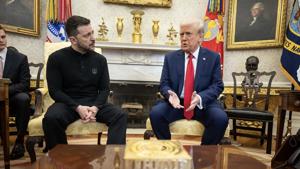
Shortly before the strike was announced, the president while in the Oval Office was asked if he “considered the ceasefire still in place?”
“I don’t like the fact that they took a shot yesterday,” he responded. “Actually, four, we knocked down three at a ship, not an allied ship, but a ship, a very expensive ship and it was fine, but it took a little beating. They shouldn’t be doing that. So, you’ll find out.”
Two weeks ago, the U.S. and Iran signed a memorandum of understanding to enter a 60-day ceasefire.
Earlier Friday, the president accused Iran of attacking a cargo ship with “at least four one-way attack drones as ships transversing the Strait of Hormuz.” Trump added that one of the drones successfully hit the upper deck of a large and “expensive” cargo ship.
“Damage was done, but the ship was able to proceed on its way,” Trump wrote on social media. “We knocked down three other drones. Obviously, this is a foolish violation of our ceasefire agreement.”
Shortly before the attack on the cargo ship, Iran’s Revolutionary Guard issued a warning to ships that they must transit through an Iranian-approved channel.
The International Maritime Organization, which had announced the evacuation of ships through the Strait of Hormuz, has since announced a pause on the operations.
The fifth article of the 14-point MOU stated that the “Islamic Republic of Iran will make arrangements using its best efforts for the safe passage of commercial vessels with no charge” through the Strait of Hormuz.
Earlier in the week, the president touted ships carrying a “record” number of barrels of oil through the Strait of Hormuz.
The strait has been a source of contention with Iran after it effectively closed the vital waterway following the coordinated strikes of America and Israel that began Feb. 28.
As part of the MOU, the U.S. agreed to lift its naval blockade on Iranian ports, which the Trump administration estimated was costing the Islamic Republic between $400 million and $500 million a day in economic losses.
The Trump administration has requested $87.6 billion from Congress to cover the costs of the conflict, including more than $70 billion for military expenses, according to a White House supplemental appropriations request.






Mostly Sunny
Latest News Stories

New agronomy farm opens as growers face challenging conditions

Illinois quick hits: O’Fallon man allegedly work with cartel; most dangerous for nursing home safety

Watchdog says Biden Education Department defied court order on Title IX enforcement

Illinois in Focus: Candidate urges civil debate around ICE; state spends 43% more; mandatory voting

Emergency HVAC Repair Approved for Lake Land’s New Effingham Technology Center

Ohio’s American-owned nuclear energy company plans expansion
Trump demands investigation into ‘sabotage’ during U.N. speech

WATCH: McMahon discusses education at Reagan Institute

Illegal border crossings near record low in August

Lower U.S. oil production projected in 2026

GOP leader disputes Newsom’s comments on Colbert’s show

‘Ivy League’ doesn’t mean excellent medical schools, according to new index