Republican revolt against Johnson halts business in U.S. House
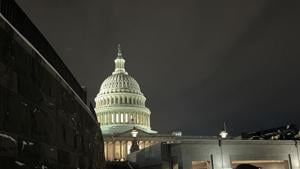
U.S. House lawmakers have left town early for the July 4th holiday after legislative business in the chamber ground to a halt, the second time in weeks that Republican House leaders lost control of the floor.
That leaves the chamber eight business days when it reconvenes on July 13 to tackle a slew of priorities before Congress takes off the entire month of August.
House Speaker Mike Johnson, R-La., had hoped to reauthorize FISA Section 702, a key government surveillance power, as well as advance must-pass annual Pentagon funding legislation before the chamber recessed for Independence Day.
But a small yet significant group of conservative House members, often backed by President Donald Trump, have blown up those objectives and backed up other legislative business in the process.
Because of 19 House Republican nay votes, a short-term reauthorization of FISA Section 702, which allows federal intelligence agencies to conduct warrantless electronic surveillance on foreign nationals of suspicion, failed in early June.
Those Republicans wanted the proposed extension to include more Fourth Amendment safeguards, given that federal agencies will also warrantlessly access Americans’ electronic data that gets swept up during FISA collection.
With no Republican compromise achieved and with Democrats opposing the extension for other reasons, the program’s status is currently in legal limbo with no track to congressional reauthorization in sight.
Johnson faced similar mutiny from his own party Tuesday, when the National Defense Authorization Act, which sets Pentagon funding levels for the upcoming fiscal year, failed to reach the chamber floor.
Over a dozen Republicans – seven of whom had also rebelled on the FISA extension – helped tank the rule vote that would have advanced the $1.14 trillion bill.
The group, led by Rep. Anna Paulina Luna, R-Fla., demanded that Johnson attach Republicans’ SAVE America Act to the bipartisan NDAA as an amendment.
Attempting to appease the band, who had threatened to shut down floor proceedings over the issue, Johnson modified the rule bringing the NDAA to the floor to authorize merging it with nearly identical voter ID legislation and sending both as one package to the Senate.
Luna and the others, however, called the maneuver “insufficient” and tanked the rule anyway. While Johnson had originally intended to spend Wednesday and Thursday trying to convince holdouts, he ultimately called an early recess after his efforts went nowhere.
“[W]hat they did was they impeded and stopped the progress of the week. It’s not helpful,” Johnson later told reporters. “We’re moving really important legislation for the people, and we don’t have time to waste because we’re coming up on an election and the end of Congress.”
Besides FISA Section 702 and the NDAA, the House still needs to pass a $580 billion federal highway bill and decide whether to grant the Trump administration’s nearly $88 billion funding supplemental to finance the U.S.-Iran conflict.
House lawmakers have also made minimal progress on the 12 annual appropriations bills to fund the federal government in fiscal year 2027, which begins Oct. 1.
Only two of those bills have passed the lower chamber and none have advanced in the Senate, making it highly likely that Congress will have to pass a Continuing Resolution temporarily freezing federal funding at current levels. Otherwise, they risk a government shutdown, which has already happened twice during the 119th Congress.
From Jan. 1 to July 1, the U.S. House has spent 91 days in session, while the Senate has spent 97 days in session, according to Congress.gov.


Mostly Clear
Latest News Stories
Republicans compete to face Neguse in congressional race

Vance says ‘progress’ made in talks with Iran

Report: Eight Michigan counties among most vulnerable to Social Security cuts

Los Angeles schools superintendent resigns after FBI probe

Illinois Quick Hits: Tornado kills 2 in Jefferson County
Although 95% lower than Biden era, illegal entries, apprehension up in May

‘Half-baked’ Illinois social media tax poised to tee up court challenges

DHS thwarts Iranian terrorist threats at the northern border, World Cup ties

Minnesota man ordered to pay $2.5M in fraud case, faces no criminal charges
Everyday Economics: A new chair, a shorter statement, a Fed that stopped talking cuts

Illinois congressmen worry as DHS Secretary seeks to ‘protect election integrity’

Poll: 70% of Americans ‘concerned’ AI will take jobs