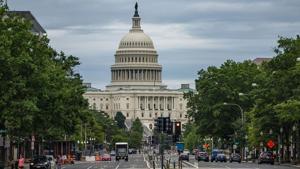
$95B price tag of Republican budget resolution questioned
U.S. House Republicans forged ahead Thursday with the blueprint for their third budget reconciliation bill, sending a $95 billion budget resolution to the floor for a vote.
The framework mostly functions as a war supplemental for the Iran conflict, authorizing $73 billion for the Pentagon to finance the costs of the ongoing military hostilities.
Though providing far less than President Donald Trump’s initial $350 billion war supplemental request, the plan includes no spending offsets, making it a hard pill to swallow for not only Republican critics of the Iran conflict but also deficit hawks.
“Our national debt is a runaway train,” U.S. Sen. Bill Cassidy, R-La., posted on social media following the framework’s release. “The next reconciliation bill should be fully paid for.”
To help sweeten the deal, drafters also tacked on $12 billion in farm aid and, notably, $10 billion to implement as much of Republicans’ SAVE America Act as is possible under reconciliation rules.
“Republicans are united and undeterred in our fight to restore America’s greatness. We don’t have a country if we can’t defend it, and we don’t have a democracy if people can’t trust the outcome of our elections,” House Budget Committee Chairman Jodey Arrington, R-Texas, said Thursday. “Passing Reconciliation 3.0 will support our troops, secure our elections, and SAVE America.”
Budget reconciliation bills can pass the Senate with a simple majority – a majority that Republicans currently hold – so long as the content is restricted to debt and deficit-related policies.
That means Republicans could not fully incorporate the SAVE America Act, which mandates that people present proof of citizenship when registering to vote in federal elections and states remove noncitizens from their voter rolls, even if the measure passes and is signed into law.
As House Speaker Mike Johnson, R-La., has floated, the $10 billion earmark will likely go toward creating a federal fund incentivizing states to enforce stricter election security measures themselves.
“We have a crisis in confidence in our elections. Say what you want about corruption and fraud, whether it is in pockets or pervasive, we have a public crisis in confidence,” Arrington told lawmakers during a committee markup of the budget resolution.
“So, yes, we are going to use reconciliation to make a run at doing what we think will save this country for our children’s future and for the remainder of this century. I can’t think of a more important thing to work on.”
Democrats condemned the budget resolution, arguing that lawmakers shouldn’t be funding an unauthorized conflict that Congress has already ordered the Trump administration to halt.
“Donald Trump and Republicans keep telling us America cannot afford to lower the cost of health care, food, housing, or energy for working families,” committee Ranking Member Brendan Boyle, D-Pa., stated after the budget resolution advanced. “Yet today, House Budget Republicans voted to add nearly $100 billion to the deficit, largely to bankroll the most unpopular war in American history.”
Nonpartisan budget watchdogs also raised alarms about the bill’s price tag, particularly given that Republicans’ previous two budget reconciliation bills will cumulatively add over $3.4 trillion to the national debt over the next decade.
“Reconciliation bills are supposed to reduce the deficit, not increase it,” Concord Action Executive Director Carolyn Bourdeaux stated.
“Reconciliation bills are also not supposed to substitute for a regular budget process where tradeoffs are debated and spending and revenues are reconciled…It’s time for Congress to get its act together: if it’s worth doing, it’s worth paying for.”





Chance Showers And Thunderstorms then Mostly Sunny
Latest News Stories

First day of World Cup games in Atlanta, first border crime arrest made

Newsom: Trump ordered investigation into him and his wife

Appeals court dumps $60M baby formula NEC verdict vs Mead Johnson

B-52 bomber crashes after takeoff from California base

Kiley maintains lead in California congressional race

Chicago council defers meter sale approval, criticizes Johnson over ‘lack of transparency’

Funding, tax questions loom over Obama Center opening
SECURE Data Act offers ‘clear, enforceable’ privacy rules, without the big money lawsuits

Illinois Quick Hits: State announces new Medicaid contracts

Record tornado numbers impact Illinois economy

Trump and Iran sign peace deal amid mixed responses from Congress
Trump throws another curveball at FISA Section 702 reauthorization

Supreme Court to hear jury limits, disability cases