Hegseth’s ‘High-T’ troop screening mandate comes without cost estimate
The Department of War is mandating annual testosterone screening for every active-duty and reserve service member age 30 and older, a mandate affecting about 2 million troops. The Ddepartment declined to say how much the program will cost taxpayers or how it will determine whether the screening improves military readiness.
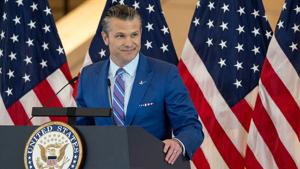
Secretary of War Pete Hegseth ordered the screening in a July 15 memo, citing research on “Operator Syndrome” among special operations forces as justification for expanding testosterone testing across the force. The Under Secretary of War for Personnel and Readiness has until Aug. 15 to update formal policy. Service members under 30 can request the screening voluntarily.
In a video message, Hegseth said the program is not “about artificial enhancement” and that any resulting treatment would be voluntary. The memo says the screening will let the department “establish a comprehensive baseline” and offer testosterone therapy to those diagnosed with testosterone deficiency.
Chief Pentagon Spokesman Sean Parnell said the effort will help the department “sustain a healthy, capable, and decisively dominant fighting force.”
Asked about cost and effectiveness metrics, a Department of War official said on background that the agency had “nothing additional to provide” beyond Hegseth’s video message and Parnell’s statement. The official also declined to say whether female service members would have access to hormone therapy if diagnosed with a deficiency.
Dr. Richard Auchus, an endocrinologist at the University of Michigan, said he saw no medical justification for the age-30 threshold.
“I can’t think of a medical one, so it must be a policy one,” he told The Center Square.
Pentagon data show roughly a third of active-duty personnel and about half of reservists are at least 31 years old, the closest age breakdown available in the department’s published demographics to the new mandate’s 30-and-older threshold.
Auchus said he was not aware of any research showing that testosterone therapy improves military readiness in men without a diagnosed medical condition.
“I fail to see how they’ll be a better fighting force,” he said.
The memo’s rationale draws on “Operator Syndrome,” a term coined in 2020 by psychologist Chris Frueh to describe a cluster of health problems in special operations forces, including brain injury, sleep disruption and hormonal dysfunction.
The concept was initially developed from informal consultations with more than 50 special operations personnel before later research sought to evaluate it further.
A follow-up study led by researchers at Stanford University and the VA Palo Alto Health Care System, published this year in The Lancet Regional Health, examined 222 special operations personnel with documented brain injuries, virtually all men. In that population, researchers found low testosterone in 27.9% of participants.
That study classified testosterone levels below 400 nanograms per deciliter as low, higher than the 250 to 270 ng/dL threshold commonly used to diagnose testosterone deficiency in clinical practice, Auchus said. Using a higher cutoff would classify more men as having low testosterone than standard testing.
Frueh said he could not answer questions about cost or effectiveness, deferring to endocrinologists.
He also cautioned against broadly prescribing testosterone.
“This shouldn’t be, and I don’t believe is, about just handing out testosterone like M&Ms to soldiers,” he told The Center Square.
Frueh said the policy could help service members and improve readiness, but only if paired with attention to sleep and pain management.
“I think if it’s done well, it absolutely could lead to an improvement,” he said.
The memo does not specify how positive screening results would be confirmed before treatment begins. In standard practice, Auchus said, an initial screening test is followed by confirmatory testing to rule out false positives before any diagnosis is made.
A 2022 study funded by the U.S. Army tested whether testosterone could offset performance losses during a simulated 20-day military operation. Soldiers who received a single testosterone dose preserved more muscle mass than those receiving placebo but showed no improvement in strength, power or aerobic capacity.
The Endocrine Society, a national group of physicians who specialize in hormone disorders, said in a statement there is “insufficient evidence to support a general recommendation to perform population-level screening for hypogonadism in asymptomatic men.”
Symptomatic testosterone deficiency affects an estimated 5.6% of men age 30 to 79 in the general population, according to a 2007 study published in the Journal of Clinical Endocrinology & Metabolism.
The Endocrine Society cited the TRAVERSE trials, involving more than 5,200 men, which found no increased heart attack or stroke risk from testosterone therapy, but showed about a 50% relative increase in pulmonary embolism and more bone fractures among men taking it.
The department has not identified outside experts advising the program, explained why it selected age 30 as the screening threshold, released a cost estimate or said how it will determine whether mandatory testing improves military readiness.



Partly Sunny
Latest News Stories
Lawmaker responds to IL’s push for adult COVID shots against CDC guidance
Immigration advocates sue Trump administration over ‘unlawful’ ICE arrests

18% of med schools receive F when judged by academic excellence, DEI rejection
Plastics industry one of ‘most powerful economic engines’ thanks to nation’s shale gas, ingenuity
Congressional candidate defends ‘dark humor’ video about Kirk assassination
Trump tells parents to get vaccines not available in U.S.

Grocery tax stalls in Chicago council, measure approved in Bloomington
GOP leader argues against Democrats’ descriptions of ICE
Illinois quick hits: Guatemalan national guilty of illegal presence; ‘peacekeeper’ arrested for battery

Lake Land College Formalizes Academic Restructuring with Faculty Association MOU
Trump tariffs drugs, furniture, heavy trucks to ‘protect’ U.S. markets

WATCH: Trump supports expanding Antifa terror designation internationally